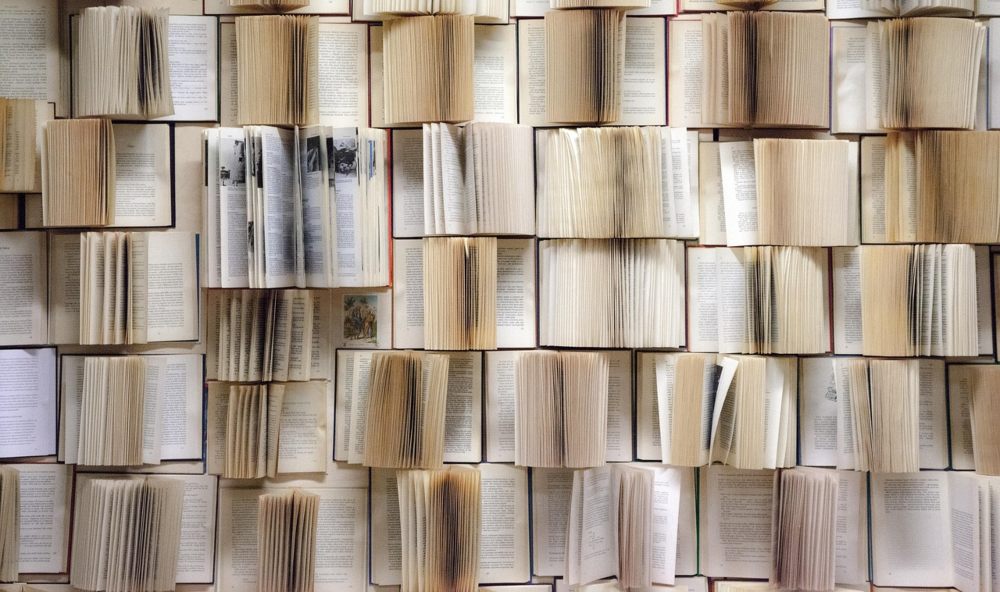

In a world plagued by too many guns and too many mind-altering pills, having too many books doesn’t seem a major problem. But apparently book proliferation is more troubling than we know.
Just last month, the New York Times reported on the plight of Mendel Uminer, a young Jewish scholar and translator, who faced a crisis when his landlord objected to a collection of 10,000 books that filled his 600-square foot studio apartment on the Upper East Side.
Uminer received a notice from building management with this charge: “You are maintaining the premises in a severely over-cluttered condition, creating a fire hazard by over accumulation of combustible books on premises.”
After he failed to heed the warning, eviction proceedings began. Uminer decided to fight eviction in court. He said, “I know my library seems excessive, but it is not as excessive as some might think. Every book I own, I need to keep on learning. That’s what I have to offer the world.”
Uminer’s battle struck a chord. New York Times letter writers identified with the 31-year-old scholar. One Maryland doctor wrote, “I, too, have bookshelves in every room (except my bathroom) and continually read and rearrange them to accommodate more. Books for many are heritage. I own books that my mother read to my brothers and me as children. When I enter someone’s home and see no books, my first thought is, ‘What’s wrong with this person?’”
Another writer acknowledged, “We, too, are proud bibliophiles; bibliophiles of centuries past are like Marcel Proust and Johann von Goethe.” Yet a third writer spoke of being afflicted, having “book despair – too many books, not enough space.”
I, too, admit to having collected an abundance of books, thousands are housed on bookshelves of which I have an ample supply. But sometimes I run out of shelf space leaving a few hundred volumes stacked in closets and along dresser tops. Should I part with some? In past years, I‘ve repeatedly tried to winnow, but seldom have I made much progress.
Friends tell me that, if I donate my books, database interests will acquire them, rip them apart and recycle into artificial intelligence. I’m not sure I understand how they accomplish this feat. But I’d rather not be complicit.
Nor am I ready to listen to Marie Kondo, author of “Tidying Up.” The neatness guru decreed that one should have no more than 30 books at a time. Another expert declared that the ideal size of one’s library involves splitting your age in half and adding 7.
While straightening my own shelves, I’ve kept worrying about poor Uminer’s situation. Did the young scholar finally get evicted? And where did his collection go? As it happens, I need not have been concerned. His friends rallied on Uminer’s behalf. One friend lamented over the court decision and said, “It’s a story about a city that no longer has room for quirky intellectuals.” They helped pack up Uminer’s vast collection and took many boxes of books to his family’s home in Crown Heights.
Book despair aside, there finally is a positive ending to the Uminer story. He lucked out and found a new, larger apartment in the area. The city — after all — has absorbed the young scholar and his collection. One friend, surveying the new apartment’s more ample space, joked: “room for more books.”a
Discover more from Post Alley
Subscribe to get the latest posts sent to your email.


It’s difficult to “de-accession” books.
The few bookstores which buy used books are VERY selective.
Even Seattle Friends of the Library is picky at receiving FREE books. (A friendly librarian pawed through a box of books and kept saying “…no …no …no …no …no”.
The “little libraries” are often already-filled and based on the few I have used don’t seem to have much turnover.
I even spent an hour at Green Lake trying to give away books but I probably didn’t have the right signage… People will probably thought I was trying to sell even though my sign said “FREE” and READ”.
I’ve given some thought to giving away books in “subject matter clumps” such as, based on my own little library, “boats” or” urban planning and architecture”. But the venues don’t appear many.
Oh well, there’s always Goodwill or Bella’s Voice.
An interesting story, given the importance of books to those of us who read incessantly. I did, however, give many of my scholarly books away, sold many on Amazon, sold a few to local booksellers, and kept a precious few that I could not part with. I did keep the titles, however, as data, in a file that I can always refer to when needed or desired. My hope, and my belief, is these books would find a new life with someone who would value them as much as I. I remember them fondly and treated them with respect, as they were all important to me. I still believe that finding new homes for them was my best option.
There are a few books that I keep close. For various reasons. But in my humble opinion books like to be read. They too need adventures so I send them back into the world. To friends, libraries etc. A books’ purpose is to be read.
Books and space. What a fraught subject.
As a former public library trustee, I know libraries send away totes full of books to be pulped and recycled every month. That may seem horrific, but it’s creative destruction; each unwanted and unread book pulped is space on the shelf for a new book that patrons want to read.
Our house has bookshelves in every room and not much space left for new paper books, but there’s always space for a gazillion new eBooks, which I read at night without turning on the light and keep my place without a bookmark or dog ear. For this, I’m glad to be living in the 21st century.
There is a non-profit organization called Books to Prisoners which operates here in Seattle as well as elsewhere. Volunteers gather donated books to stock the libraries of various correctional institutions. A worthy endeavor and a potential home for your “extra” books.
I’ve run out of shelf space in recent years and tried the ‘I haven’t worn this shirt in over 5 years’ strategy, narrowing down to the precious few. Still, some reference works will stay.
And some spines must remain in sight even if I’ll never open them again. From my upbringing I realized that full bookcases also have a kind of inspired wallpaper function – reminding me where I’ve been, what I’ve thought about, and who I am.
I’ve been enjoying winnowing down my books in little ways. Aside from maintaining two quite popular little free libraries in my neighborhood, I sell at various stores, gearing what I bring in to that store’s particular focus, which works quite well. At some stores I just take cash (Magus), at others (the wonderfully curated and often offbeat Arundel, for instance) store credit is my special treat, and at still others (the expansively popular Third Place) I convert that credit to gift cards, for my Holiday giving.
Of course I still have masses of books, but our interests and focus do change over time, and it can feel freeing to let go of some subjects or genres tied to past interests or identities I no longer feel strongly about. My collection grows less indiscriminate, and the process helps me be a bit more choosy about what I add to it, moving forward. Since I’m going to DIE, leaving all this as a burden to some relative and to be picked over by some dealer, or – worse – MOVE, creating a massive burden for myself, I find the artful bit by bit of deacessioning a fruitful and freeing process. Letting Go is liberating.
As a retired public library (and ongoing Little Free librarian), I’m pretty ruthless about getting rid of old or worn out books, and amused by the talismanic regard some folks have toward anything printed – witness old college textbooks and obsolescent manuals and guides that regularly pop up in my LFLs.
It’s sad that the Friends of the SPL—of which I’m a life member—lost the ability to find a venue for its twice-a-year ginormous book sales. Still, they’re my donation organization of choice with several outlets to re-sell the books, a program that gives them away to teachers and other organizations, and yes, they’ll sell to pulpers or wholesalers your ancient computer manual or dog-eared dictionary.
(Confession: Although I have two dictionaries on my book shelves, my go-to is either the SPL’s online access to the Oxford English Dictionary, or searching on the web for “define [word]”)