

Summer is the season when we seek out places of unique beauty and sensuous outdoor pleasures from beaches to barbecues. We nurture the body on vacation, whether splashing in surf or cycling through a bucolic countryside. We take in art through warm-weather music or theater festivals. We explore the stone-cobbled alleyways of a medieval French village or flock to a magnificent big city museum. We do not need scientific studies to tell us that these activities aid well being, though the research is ample.
Too quickly the the day-to-day erodes the refreshment of summer. In most of America, daily life conveys us from one parking lot to another along massive characterless arterials.
That’s why I was happy to get back to Bentonville, Arkansas, on assignment for Bloomberg CityLab. It is a small city that has been transformed, with a significant focus on well being. I had only been there once before, in 2011, when the Crystal Bridges Museum opened to house the billion-dollar collection assembled with whirlwind rapidity by Alice Walton, the daughter of Sam, who founded Walmart in Bentonville

I was impressed by the museum (and, on this visit, its recent expansion) wedged tightly by architect Moshe Safdie into a ravine with glass bridges spanning dammed ponds to make nature an ever-present backdrop to the art on view.
On my first visit, the museum’s sensitivity to place was in stark contrast to the fast-growing city that surrounded it. Bentonville formed the northern edge of a 30-mile undifferentiated sprawl of small towns and small cities shot through with strip malls. Churches, schools, and city halls were uniformly built like metal-sided warehouses.
“You find not just a lack of civic grace,” I wrote back then for Bloomberg News, “but what seems a mean-spirited aversion to it.” It was true to the soul killing speculation landscape that had spread across America, of which Walmart was both progenitor and product, with its big inexpressive boxes sucking the economic and social life out of walkable main streets. “A museum won’t change that,” I wrote. “Bentonville isn’t Bilbao. But maybe people who love the museum will.”
Urban revival via art, nature and fitness sports
Indeed, the museum’s success spurred an extraordinary transformation, much of it underwritten by Walton family members and other successful companies, with billions at their disposal. The common inspiration is Alice Walton’s determination to unite art and nature in the service of well-being.
Hers is an important insight. On a daily cultural, political or societal level most of us don’t live where we can immerse ourselves in art, nature, or well-designed places. Her passion is undergirded by her own journey through numerous surgeries and a long recovery after a car crash. Art saved her, she says.
On my recent visit to Bentonville, I walked from the spruced up town square through a woodland to the museum, past the Ozark Discovery Canopy—a children’s playspace that invites physical activity—and encountered a variety of artworks, most provocatively a monumental “Maman” spider sculpture by Louise Bourgeois. The forest also is entwined with unpaved paths for mountain biking enthusiasts, part of an extensive network that has made the area a mountain biking destination.

A beautifully paved trail for road bikes called the Razorback Greenway threads its way through towns and parks for 40 miles, connecting numerous specialty schools, new parks, museums, and other attractions that have sprouted across the metro.
Sensitively designed and adequately funded parks, libraries, and schools can all help maintain health in contrast to industrialized medicine that kicks in only when people sicken. Kids blossom when asphalt school yards host rain gardens where young people can learn about plants and amphibians. School greenhouses teach an appreciation of where food comes from and how to grow it. Libraries increasingly include lush reading gardens. Parks can serve all ages when they offer more than grass and a few basketball courts.

Too often, the nurturing potential of civic institutions defaults to imagination-free strip-mall style, just as Bentonville had done.
An immodest goal
Alice Walton has the immodest goal of improving America’s broken healthcare, founding two institutions that architecturally live and breathe the art, nature, and well-being connection. Walls of multi-colored stones in a local craft pattern called giraffe stone anchor a serpentine glass and metal structure that houses the Heartland Whole Health Institute. This intentionally striking contemporary building, designed by the award-winning local architects Marlon and Ati Blackwell, houses initiatives intended to bring the art-nature-health connection into daily life.

Inside, the building walks the aspirational talk. An appealingly undulating lobby ceiling of local pecan wood slats extends into a generous gallery displaying art from the museum’s collection. It’s all open to the public. With narrow floors on upper levels, everyone has access to daylight and woodland views.

The institute’s initiatives tend toward preventive care, improving overall health to reduce the need to treat epidemic-level maladies like obesity, diabetes, hypertension found in rural Arkansas and big cities alike. A no-brainer it would seem, but Walton has observed that this kind of care is not taught because doctors are not compensated for it.
Nature invades medical education
Can medical schools transform mechanistic medicine? The Alice L. Walton School of Medicine that opened in 2025 is the third leg in Walton’s campus devoted to the role of art and nature in healing.
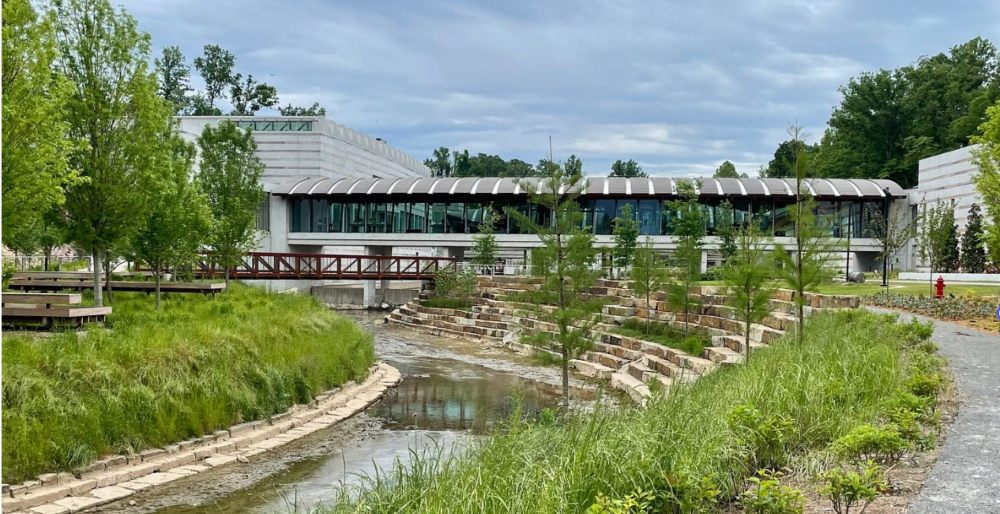
A portal cut out of the base of the school’s facade reveals a 215-foot-long cascade of water tumbling over slabs of local stone—a re-creation of local streams that seep from between the sedimentary strata. The water feature places the calming power of nature literally at the center of teaching, since it runs through a slice between the building’s two wings. It’s a far cry from medical residencies that take place in endless corridors of glaring strip lights and windowless, equipment-crammed treatment rooms set deep within massive hospital research complexes.

The architecture of the 154,000-square-foot building by the local firm of Polk Stanley Wilcox assures that most of the rooms look out to the extensively landscaped grounds. Shared spaces prominently display art. The landscape architect Simon David of the Brooklyn based landscape architecture firm OSD not only designed the water cascade, he turned the entire of rear of the four-story building into a terraced topography of stairs, paths, and small plazas made of rough-hewn sandstone slabs and planted with a variety of native species.
The building not only delivers the proven benefits of being immersed in nature, but “social spaces are ample and moving around the building provides alluring opportunities to be physically active,” David told me. It is architecture deployed in an integral way to advance health. Other medical schools are visiting to learn its lessons.
Clinics support prevention, cancer patients comfort each other
There are examples beyond rarified Bentonville that connect the built environment to healing art and natural environments.
Community health clinics are an underused means to deliver comprehensive preventive care. Consider the Family Health Center on Virginia, north of Dallas. Designed by the MASS Design Group, a non-profit architecture firm based in Boston, the clinic shows how affordable integrated medical, behavioral, and dental care can be delivered in a respectful setting, suffused with inviting daylight.
It includes dedicated OB-GYN services mated with maternity and pediatric care. The layout eases interaction among practitioners. On-site social services link patients to a broader support network, including weekly food distributions, clothing drives, healthy cooking classes, and access to educational and employment resources.
Such an approach sounds expensive, but emergency departments end up being used when people can’t afford healthcare and untreated maladies become life-threatening—a huge expense taxpayers bear that poorly serves patients. Offering one-stop care is far more effective than poorly coordinated agencies and nonprofits scattered willy nilly across neighborhoods, squandering the opportunity to address the whole patient. Mckinney can build a preventive health virtuous cycle for its patients through its team approach.
The late architecture critic Charles Jencks sponsored Maggies’ Centres (named after his wife) in the UK, a series of cancer recovery facilities designed by big-name architects such as Frank Gehry and Zaha Hadid. Built on hospital sites, they combine quotidian ingredients—gardens, ample natural light, and comfortable lounges—to inventively reduce anxiety during drawn-out treatments. Patients can share and learn from each other around a comfortable kitchen table.
The success of places like McKinney and US equivalents to Maggie’s is threatened by federal retrenchment in support for healthcare and nutrition in non-affluent communities. This will only lead to greater misery and cost burdens for everyone as affordable healthcare vanishes from places that deserve better.
Surviving trauma through art
Connections to art and art therapy are often treated as “nice to haves” or condescendingly deemed useless by people who have no idea how transformative art can be—especially for traumatized people.
Jesse Krimes determined to become an artist during a year of solitary confinement as he awaited trial on drug charges. While serving five years in federal prison he made works of art and sent them surreptitiously out of the institution. His work drew interest for its complicated search for beauty as it called attention to the injustices of the prison system. Now he is represented by prominent gallerist Jack Shainman and not long ago had a show at the Metropolitan Museum.
He started a fellowship to support current and formerly incarcerated aspiring artists and founded the Center for Art and Advocacy, a gallery in New York City that exhibits the work of those artists.
Krimes told me that people the Center advocates for find healing benefits from producing art but the programs and fellowships are mainly meant “to support prisoners as serious art practitioners.” The intensity of their incarceration experience (some spent decades inside) is reflected in the works overtly or symbolically, but the subject matter is wide ranging, such as reflecting on loss (particularly of family), unexpiated rage at the system’s gratuitous cruelty, and asserting humanity incarcerated life erases.
These extraordinary initiatives challenge the rest of us to embed summer rejuvenation—healing art and nurturing nature—more deeply into our everyday lives.
Discover more from Post Alley
Subscribe to get the latest posts sent to your email.


Frustrating and disappointing piece.
The first rule in journalism: Tell the readers where.
“Where” should be in no later than the third paragraph.
Where is Bentonville? South Dakota? New York? Washington State?
Location should be front and center.
If I am missing it, my apologies.
ditto. I do know where Bentonville is, but since this is a Seattle Newsletter wondered why it was in here.