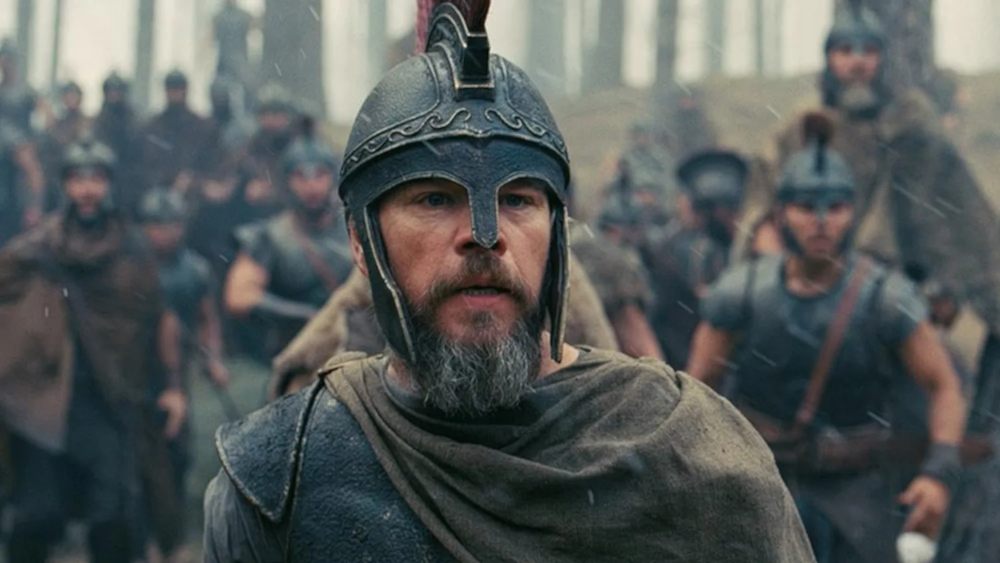

On opening weekend, “The Odyssey,” a three-hour movie based on a 3,000-year-old poem, earned box office receipts of more than $264.1 million. CinemaScore reported that viewers gave the movie an “A” grade. What was the appeal?
I bought a ticket hoping the movie would supplement my education. I attended Seventh-day Adventist schools with curricula grounded firmly in the Judeo-Christian tradition. While my neighbors who attended public school were reading about the Cyclops and the Sirens, I was immersed in the world of David and Goliath and Samson and Delilah. My faith community discouraged attending movies, so I also missed the “Wizard of Oz” and Mickey Mouse.
I’ve felt the gaps in my education at odd moments ever since — a reference I couldn’t quite place, an allusion I nodded along to without understanding. If someone talked about trumpeting down the walls of Jericho, a rich story filled my head. But for me, the mention of a Trojan horse or a yellow brick road was an allusion with no context.
The classics once formed a pillar of American education. Both my parents, who attended public schools in the first half of the 20th century, read mythology and studied Latin. By the time I came of age in the late 20th century, the classics had faded from the American canon. Children were more likely to know Hercules as a TV character on par with Superman rather than as a Roman name for the Greek god Heracles. Because I did not watch Saturday morning cartoons, I didn’t know any non-Biblical superheroes.
In the 21st century, classics are sometimes missing entirely from the public school curriculum. Enrollments have shifted from the humanities to business, science, and technology. Attention has drifted from long-form books and films to isolated quips and 10-second “reels” that are fed by individual algorithms, not shared experience. In this context, why would a major studio and A-list actors make a long movie about an old story?
Part of the answer is the movie’s director Christopher Nolan. His name sells tickets, at a time when Hollywood has spent two decades betting on franchises over filmmakers — superhero reboots, a two-part prequel to the “Wizard of Oz,” and an endless stream of “Toy Story” releases. Ticket buyers on opening weekend most often reported that Nolan, not the cast or the source material, was their primary reason for showing up. One director’s clout was enough to put Homer in front of millions of people for a weekend in a way no curriculum committee or classics department could have managed on its own.
But a blockbuster film is a single, brilliant flare — not a foundation. It can put Homer in front of an audience for three hours; it can’t teach anyone to read him, and it can’t guarantee anyone encounters him again. What does access to the classics look like for students in Seattle?
In Seattle Public Schools, Homer’s “The Odyssey” sits on the ninth-grade “core choice” reading list — one option among roughly two dozen texts that includes everything from “Romeo and Juliet” to “The Alchemist.” It’s available, but it isn’t required, which means whether Seattle teenagers ever meet Homer in a classroom depends largely on which teacher they draw that year.
At the University of Washington, the trends are somewhat hopeful. While classical studies degrees have fallen nationally by more than 40 percent over the past dozen years, UW’s Classics program reports that undergraduate enrollment in its courses has grown about 52 percent — although the total number of students in those classes is still less than 50. Some students in Seattle started turning to Odysseus before Christopher Nolan turned him into a modern-day superhero.
Even people who’ve never opened the poem carry pieces of it around. Washington Post columnist Monica Hesse admitted going into an early screening having never read Homer’s work or even modern-day adaptations of it — yet realized she’d used the word “Odyssean” correctly in conversation. That’s what a cultural touchstone becomes once it’s old enough: words like Jericho and Trojan horse are recognizable even to people who did not read the original stories.
Before anyone had seen a single frame of this summer’s blockbuster, the casting became its own small battle over who owns this story. Critics attacked Nolan for casting Lupita Nyong’o, a Black actress, as Helen of Troy, and Elliot Page, a transgender actor, as one of the Greek soldiers. Homer’s poem has been retold and reshuffled since it was first written down. The pre-release fight wasn’t really about fidelity to a 3,000-year-old text. It was about who gets to believe the classics belong to them.
The sharpest example of that question, though, isn’t about casting — it’s about translation. Hesse points to scholar Emily Wilson’s observation that older English translations of “The Odyssey” routinely called the female slaves who entertained villainous suitors “sluts” and “whores.” The original Greek carries no such judgment. For centuries, the translator’s word choice smuggled a moral verdict into the story.
This kind of gatekeeping goes past who gets a classroom seat or a movie ticket. A teacher choosing a reading list, a studio casting a role, a translator picking a word — each one is a small decision about which version of a shared story survives, and which quietly disappears.
The stories assigned to us, or kept from us, don’t just entertain us. They teach us what a hero looks like, how a marriage survives, what a homecoming costs. I spent my childhood learning those lessons from David and Goliath instead of Odysseus and the Cyclops. How the next generation learns those lessons may depend less on a single high-profile movie and more on who shares the stories and how those stories are shaped and sung.
Discover more from Post Alley
Subscribe to get the latest posts sent to your email.


McMillian skillfully tells of her own journey with Homer’s poem. But isn’t that the beauty of the Odyssey; inspiring us to tell of own journeys? Amazon now offers some two dozen versions of the Odyssey: among them a graphic novel, the best of Homer, a large print version, a delux edition, an illustrated book, as well as influencers accounts, such as a modern retelling, and decoded — step by step. So many choices to read Homer’s epic story.
Good article. Interesting.
Connie Niva
Sally does a wonderful job weaving together the treads that answer the question: who really gets to tell a story. Great article, worth sharing.
News of the film (and the squabbles about casting and heroes) prompted me to buy Emily Wilson’s translation. Time for a fresh look.
Thank you Sally. Reminds me to re read the poem and tell my story. Beautifully written.
Thought provoking, again! Sally McMillan writes with deep curiosity and wonder
“Ticket buyers on opening weekend most often reported that Nolan, not the cast or the source material, was their primary reason for showing up.“
Yes I read the link and I don’t believe it.
I’m reasonably well-informed and yes I watch “cinema” and even movies and I only knew of Nolan when somebody reminded me of Oppenheimer which I thought was a good movie (but way too loud) but hardly anything even close to Fargo or No Country….
Anyway, yeah, I know there was a “survey” but I’m skeptical.
Thank you, Sally. An elegant and personal reflection on “each small decision about which version of a shared story survives.” Now I’m eager to read Wilson’s translation, and here is AO Scott’s succinct comparison of several: https://www.youtube.com/shorts/d6fCUkaRmLI
What a great piece! McMillan elegantly weaves her personal journey with the Odyssey’s influence throughout millennia and generations of storytellers. Nolan’s film is the latest example of the story’s power to spark debate and reveal ourselves through our individual interpretations.
Another excellent article by McMillan. Would like to read more from her.
I learned so much from this beautifully written article and therefore decided to become a subscriber.
I’m not sure that Seattle Public Schools kids don’t know the story — my daughter was in a kid theater production at Seattle Public Theater a number of years ago, and it seemed that almost all the kids in the cast were familiar with the characters and the story before rehearsals began.