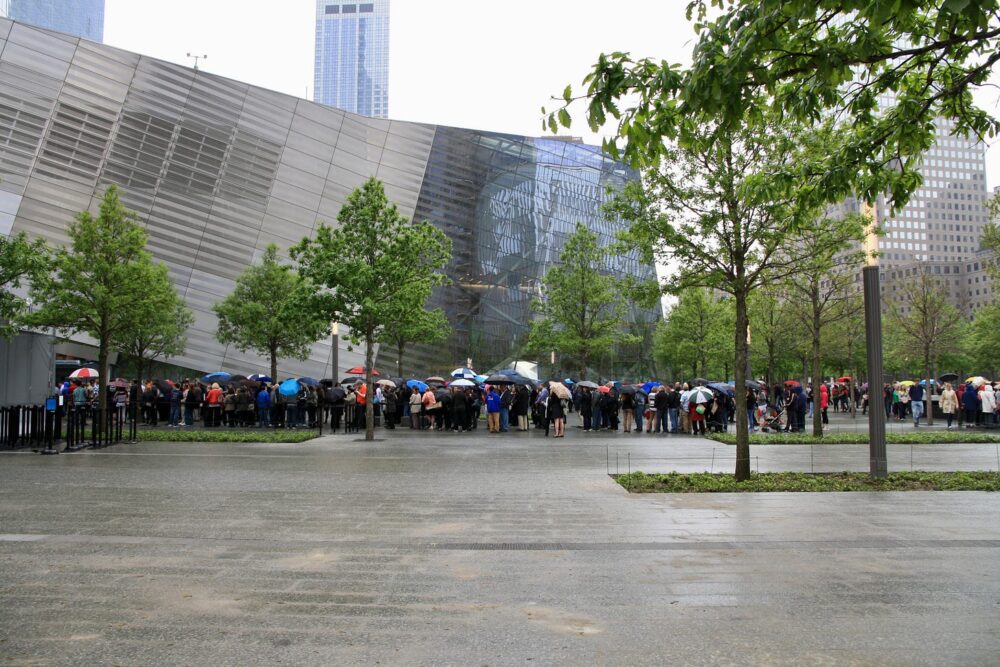

Must we still see bodies falling from the World Trade Center towers 25 years after the 9/11 terror attacks? This was among the questions that I hoped a visit to the 9/11 Memorial Museum last week would answer. It is the centerpiece of an eight-acre memorial landscape that took billions of dollars and years of consultation and design to realize. The full rebuilding of the 16-acre World Trade Center site is not complete.
With New York City a global media hub, the terror attacks of September 11, 2001 and its aftermath were arguably the most photographed, filmed, and written-about tragedy of modern times. Thus the museum is able to replay the day almost minute by minute.
It displays mangled fire trucks and police cars, videos from every angle of the explosive impact, and the billowing flames and smoke and the terrifying dust clouds that spread across Lower Manhattan. We are returned to the terrible day through news feeds, voice-mail recordings, peoples’ reactions in photos and interviews. Some of the horribles (including the falling people) are confined to alcoves accompanied by trigger warnings.

I know many New Yorkers who have never been to the museum because they did not want a return voyage to the trauma they had experienced.
I had not been back to the museum myself since it opened in 2014, when I wrote about it for the Wall Street Journal (paywall). On the day I returned most of the visitors I saw would have been children in 2001. Though the displays skirt the border of disaster porn, the shocked look on peoples’ faces said to me that the punch they pack is still emotional, not just titillating. The exhibition designers, (Thinc Design and Local Projects) adeptly shift the focus to the almost 3,000 people who lost their lives that day, including hundreds of first responders.
Little has changed in the museum over the years, although a new exhibit recognizes an increased death toll from recovery workers that were victims of deadly toxins on the site.

Huge pieces of twisted steel continue to be displayed as if they were elegant artworks, but the main focus of the museum and the surrounding memorial landscape is on those who died. I wrote many stories on the extensive debates and the tortured progress of rebuilding, but I have always wondered how future generations would regard the vast scale of the memorial and the billions expended in the rebuilding.
I walked the memorial site with its evocative 40,00-square-foot water-washed pits and its lush canopy of oak trees. A great deal of design intelligence brought this landscape to fruition. Architect Michael Arad took a year or more just to collaboratively figure out how to arrange the names of those who died. The extraordinary commitment by Arad and others paid off. The memorial continues to draw crowds (mostly from out of town I suspect) who amble respectfully.
Peter Walker’s grid of oak trees softened the searing austerity of Arad’s first design. Its sobriety isn’t too comforting, yet it signals that life goes on. The overall effect of the landscape is ambiguous, reflecting the tension between grief and hope.
Obsessively memorializing tragedy
I don’t want to minimize the extraordinary loss—and the evil intent with which so much sorrow was created—but the 9/11 Memorial is the apogee of Americans’ obsession over memorializing tragedy. Memorials have become a receptacle for our grief when American idealism might better be harnessed to reducing the political fuel that enabled a small population of Muslim religious fanatics to field 19 hijackers who thought killing thousands of innocents would somehow help their cause.
The attacks unleashed toxic political opportunism in America, with the entire Muslim world deemed to be collectively guilty of the hijackers’ crimes. As rebuilding plans advanced, a Muslim real-estate development team proposed a community center modeled on a Jewish version of a YMCA for a site north of Ground Zero. It was hoped to be a physical manifestation of Muslim and non-Muslim reconciliation. Though it had prominent supporters it was shouted down.

The terror attacks became a cause for bellicosity by the military hawks of the American right, and few moderates nor liberals stood up for any alternative to full-throated vengeance. The costs to America and the world of the military adventurism in the name of the 9/11 victims were high. Afghanistan was soon invaded by US forces, which then pivoted to Iraq on the faulty premise that its leader, Saddam Hussein, possessed weapons of mass destruction.
These military actions became “forever wars” as the goal to destroy Al Qaeda got stirred into America’s desire to protect oil and gas resources, aid Israel, and George W. Bush’s desire to finish the Iraq War that his father President George H.W. Bush had started with Operations Desert Storm and Desert Shield in 1990.
Historians and pundits have been engaging with the society-busting consequences—predictable and unpredictable—for America and much of the Middle East. New York Times Columnist David French wrote a thought-provoking defense of the Global War on Terror unleashed after 9/11. His may be a minority view. Security analyst and journalist Peter Bergen offers a book, All the Presidents’ Wars: Twenty Five years of America’s War on Terror. Military action in Iraq and Afghanistan alone cost a staggering $6 trillion and 7,000 American lives, he writes.
Al Queda lives, and peace remains elusive in the Middle East.
Military tributes multiply
We feel bad for veterans whose lives or life chances have been snuffed out by serial deployments, but our collective feelings have not coalesced into a serious debate about the ways these consequences could have been avoided and how we can do better.

Instead America’s commemoration obsession continues: I was surprised to find on my Washington bike ride in June, that a memorial to those who served in Desert Storm and Desert Shield was nearing completion not far from the Lincoln Memorial.The landscape architecture firmOlin and CSO Architects have created two interlocking crescents that tilt gently out of the surrounding lawn, with bas reliefs molded into the sand-colored granite interior and a central “shield” water feature.
It commemorates all who served in the seven-month conflict—that’s what we have come to expect— but it also “leaves visitors with an enduring memory of the historical significance and accomplishment of Desert Shield and Desert Storm,” according to the memorial’s website. No work of landscape design and sculpture, however sensitively devised, can capture that highly contested history. I suspect the design’s utter blandness will engage few who do not have a direct connection to the events. It’s inoffensiveness may have gotten it through the National Mall’s gamut of approvals. An October opening is planned.

I also learned from a press release in June that a design had been prepared by the respected Tokyo architect Kengo Kuma for The Global War on Terrorism Memorial (GWOTMF). Kuma has drawn up a “path of honor,” including “sacred” steel and stone elements recovered from the World Trade Center site. It wraps under a tilted archway of woven thin steel members with metal salvaged from combat operations. The archway would form an amphitheater gathering space called The Embrace. Intertwining vines will soften the steel. It awaits approval and has yet to raise necessary funds.
The GWOTM sensibly pays tribute to the “generations [my italics] of Americans who served, sacrificed, and supported loved ones through more than two decades of conflict.” Respect for such vast human sacrifice is certainly due but is it appropriate to physically commemorate this and Desert Storm/Shield on America’s most sacred ground when they cannot acknowledge—or even engage with—a gathering consensus that political hubris produced this colossal waste?
Learning nothing
The National Mall was never supposed to become a landscape of military tributes, but with these two monuments, just a stone’s throw from the Vietnam War Memorial, America is devoting its sacred ground to sacrifice the country is not coming to terms with.
We now have new cheerleaders for extravagant military force who have clearly learned nothing. President Trump and the MAGA opportunists still seek to brand all Muslims as terrorists, but don’t extend the favor to all Christians when fanatics similarly seek to kill and cause chaos.
President Trump has got us into a new quagmire in the Middle East with the acquiescence of Congress. He orders attacks on oceangoing boats, with the murder videos edited for TikTok titillation. America has kidnapped the hated dictator of Venezuela yet kept his corrupt government in place. The military enforces the starvation of Cuba.
The rest of us must reject this insanity and and strive to build a world that doesn’t nurture terrorists, where military intervention is the last recourse not the first—a world in which fewer memorial to the fallen need be built.
Discover more from Post Alley
Subscribe to get the latest posts sent to your email.