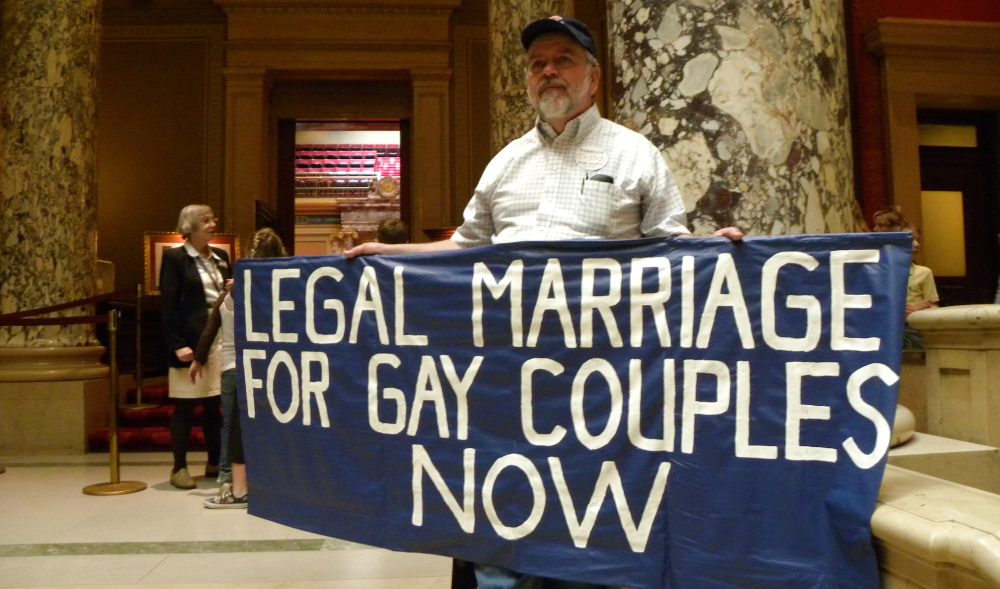

We had traveled back to Montana for my aunt’s funeral and made a stop in Bozeman where she and my parents graduated from college before WWII. We met my sister, also an MSU graduate, and her now wife at their RV campsite on a hillock near Bozeman. We broke out the Martini’s, basking in the Eastern Montana summer heat, when my cell phone rang.
It was Ed Murray, then chair of the House Transportation Committee and a legislative colleague. Ed told me he called to ask if I would sign on to an amicus brief opposing the constitutionality of the Defense of Marriage Act (DOMA). He said he’d been pressed against his better judgement to call, because they needed a Republican legislator on the sponsors’ list and several of his colleagues remembered I’d been a leader for domestic partnership benefits on the Metro Council in the 1980s. Ed knew the House Republican Caucus and told me I should say, “No.”
I said, “Yes.”

This story came back to me after I learned Bill Downing had written a chapter about the case in Challenging Cases, Judges Tell the Stories of High Profile and Other Tough Cases. Because Bill’s a friend, I rushed out to buy it from my local independent bookstore (I’d tried the King County Library, but they didn’t have it yet – I couldn’t wait!).
Bill was the trial judge in that case. He writes that the case called on him “to define – or perhaps redefine – the institution of marriage for the early twenty-first century” and he tells the story of how he approached, decided, and now reflects on the case.
It turns out it turned exclusively on the question of DOMA. There were no disputes regarding facts or matters for a jury to decide. Only a question of “Wedlock Deadlock.” After he, by “the luck of the draw,” had won “the gay marriage case,” he joked that maybe a one-decade continuance might be appropriate to create an opportunity for “a consensus to emerge.” Instead, he learned the case was on a fast track.
One decade later one can only admire his optimism a decade and a bit ago.
Bill took on the case and describes how he worked through the legal issues and chose to write an opinion in a form that was “less judicial” and “more like the ‘New Journalism’ of Joan Didion writing from within California’s counterculture or Norman Mailer on the streets at the 1968 political conventions.” He hoped the form would be more accessible and evidence his respect for all parties, that he had no personal agenda, and finally, that he could be transparent about how he worked through the issues.
When Bill closed the hearings in July of 2004, he promised he would write and release his opinion on the internet, and he requested readers read it in its entirety before reaching conclusions. Of course, it didn’t work that way.
The opinion, once posted, generated the court’s largest internet traffic spike. And, as one would expect today, the trolls got there first. One posted, “the stench from the bench” and suggested how and where Bill would spend eternity.
But it turned, and Bill’s tone and reasoning spoke to many, and evoked positive and emotional responses. One local paper described the ruling as “a down-to-earth ruling that gave a clear explanation of the legal issues without a jumble of convoluted lawyer-speak.”
So what did Bill decide? Kids matter. “I saw the relevant inquiry not as whether supporting heterosexual parents benefited children but whether prohibiting same-sex couples from marrying has the effect of helping children.”
Obviously.
We know now how the case turned out. The State Supreme Court in its wisdom decided 5-4 to defer to the legislature and overturned the ruling two years later.
In the end, maybe a good choice, as the legislature, finally accepting the deference, repealed DOMA and a subsequent referendum upheld the repeal. In December of 2012 at 12:01 AM, gay marriage became legal.
At the time I served as Deputy County Executive in King County. We opened our records section to begin issuing licenses at exactly 12:01 and had a steady flow of happy couples through the night. I had the pleasure of cooking and serving pancakes for our employees and the crowd as we celebrated a new era.
Obergefelll v. Hodges cemented that era as the US Supreme Court held marriage was a “fundamental right” DOMA unjustifiably violated.
The decade-long continuance Bill suggested, in part due to his opinion, ended up with a consensus, however fragile.
During that decade I left the Republican Party. Serving in state and local government as a Democrat, I can still look back at the roots of the Fourteenth Amendment in the Radical Republicans of the mid-19th Century and their quest to renew the ideals of the Declaration. Despite the revanchist court today, that amendment lights the way to understanding expanding rights.
Discover more from Post Alley
Subscribe to get the latest posts sent to your email.