
Winning back-to-back Super Bowls is hard enough — since the advent of true free agency in the NFL (1993), only the Cowboys, Broncos, Patriots and Chiefs have done it — but the Seahawks embark on that task Wednesday night against the New England Patriots, their victims in February, with a change at the franchise’s most important position: Owner.
Some fans may not see the owner’s position that way. But having lived through the tumult that dubious pro sports franchise ownerships can cause a town, I’m a little sensitive on that topic. Almost always, things start out swell, with flowery statements, grand visions and lots of tra-la and rose petals. Not long after, things often get weird.
In 1989, when Jeff Smulyan of Indianapolis bought the Seattle Mariners for $75 million, I had a chance to interview the new owner one-on-one.
“People have told me that (disparaged previous owner) George Arygros is the kind of negotiator who cuts your balls off and then buys you a beer,” I said. “True?”
“Well,” Smulyan said with a wan smile, “he owes me a beer.”
Ah, the good old days, when an owner was accessible and witty. Smulyan was easily the most engaging and likeable among the landed gentry in the more than half a century that Seattle has been a pro sports town. That is, until he and some of his fellow American League owners — believing Seattle to be a bad baseball town, as opposed to a town with bad baseball — plotted in 1991 to move the Mariners to a vacant dome in Tampa Bay.
Smulyan was abruptly demonized, and subsequently failed. Seattle foiled the scheme in 1992 and kept the Mariners. Hiroshi Yamauchi, a Japanese national who founded Nintendo of Japan and Nintendo of America, led a group of Seattle techies from Microsoft and McCaw Cellular, who cashed out the gregarious Smulyan for $100 million. That figure also established a $25 million valuation for Smulyan’s manhood. Minus the beer.
Something else was also lost: Contact with the cockpit. Not once did Yamauchi grant an interview to U.S. media on baseball. In fact, he never saw the Mariners play in person. He became an international man of mystery well before Austin Powers.
Regarding the public face of ownership, it’s hard to find a more disparate tandem than Smulyan and Yamauchi. Although they share a trait: Neither managed to bring a World Series to town.
Does it matter what a sports mogul says? Or doesn’t say?
Not at the beginning, which is where we are with Vinod Khosla.
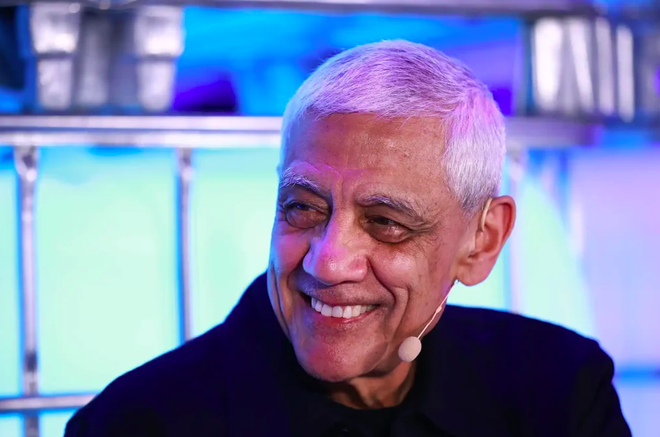
The venture capitalist led a group that paid Paul Allen’s estate $9.612 billion, an NFL record for now. A longtime Bay Area resident with a Master’s from Stanford, a 49ers season-ticket holder, a Pittsburgh Steelers fan, and a native of India, Khosla is eagerly responding to Seahawks fans via social media and saying all the right things into microphones and cameras.
The early accessibility sharply contrasts with Allen and his sister, Jody, who ran the franchise for a combined 29 years, each with a Super Bowl triumph. Paul almost never granted a Seahawks-related interview, and Jody did none. Their passion for public circumspection could be measured in megatons. They had a reason. At the time of his 1997 purchase of the club, Allen’s wealth was four times greater than the second greatest NFL owner’s fortune.
Per Teddy Roosevelt: Speak softly and carry a big stick.
Naturally, Khosla is making nice publicly. The deal closed too late in 2026 to do much for this season but shake hands with coaches and players and find the owner’s suite at Lumen Field. But when do fans start worrying?
I ask this not because I have any evidence of potential shenanigans. I ask because of current national events, and Seattle’s tumultuous history with the super wealthy.
Steve Ballmer, a Seattle guy who did well enough at a little computer shop in Redmond to buy the NBA’s Los Angeles Clippers in 2014 for $2 billion, was walloped last week by Commissioner Adam Silver with one of the most significant punishments in pro sports history. Ballmer was busted for cheating the salary-cap system.
To pay his star player, Kawhi Leonard, more than his contracted $28 million in annual salary, Ballmer was charged with conspiring with third parties to provide endorsement cash, for which Leonard did no work. Silver suspended Ballmer for one year — he’s not allowed in the Intuit Dome, the lavish arena he built on his own dime in Inglewood — fined him $30 million, and the Clippers had to surrender five future first-round draft choices. For more details here’s CNBC’s account.
Even though Seattle is no longer in the NBA, the topic is intriguing because Ballmer partnered in 2013 with Seattle native and fellow mogul Chris Hansen in an attempt to bring back the Sonics via a new arena in the stadium district. The plan required relocating the Kings franchise from Sacramento, as well as permission from a City Council reluctant to abandon Seattle Center’s KeyArena. The NBA and the politicians voted down the plan. Ballmer took his money to LA and bought out Donald Sterling, whom the NBA was thrilled to see depart.
Imagine if the Ballmer/Hansen plan had worked, and the pirated Kings had become the Sonics for the past 13 years. Ballmer is a ruthless competitor — ask anyone in Seattle who played against him in a pickup game — and seems destined to pursue any edge. Even though he claims innocence regarding the charges and vows to fight Silver in court, the NBA investigated for nearly a year and reportedly has evidence from Clippers insiders. It is hard to imagine the NBA punishing its richest owner, and recklessly inviting speculation about salary cap violations with other teams, with a slipshod investigation.
Obviously, the Ballmer scandal has nothing to do with the Seahawks’ sale. But the episode does evoke a shudder among long-timers regarding the local sports potentates’ penchant for saying one thing and doing another.
It goes back to 1970, when the owners of the expansion Pilots, under-financed and in an inadequate stadium, convinced Seattle it was ready for major league baseball, only to sell the team after one season to Milwaukee, where they became the Brewers. The Pilots’ one national contribution was to literature, where “Ball Four” by relief pitcher Jim Bouton, changed forever how fans viewed the follies and foibles of baseball.
Seattle successfully sued MLB in 1972 over the departure of the Pilots and was rewarded with another expansion team in 1977, the Mariners. Beset by another underfunded ownership, they became the slowest team to reach a winning season in American big-league sports history: 15 years. When they finally became good, the new, local owners controversially demanded, and received, a publicly-funded stadium with a retractable roof. The team has annually marked that achievement by avoiding the World Series for 50 years in a row, a feat unmatched in MLB.
The Sonics’ ordeal already has been mentioned, so in the interest of time, I will close the review with the remark Howard Schultz made in 2001 after he bought the Sonics and Storm from Barry Ackerley. He called it taking on “a stewardship of a civic trust.” It took him just five years to buckle under the pressure of the words “stewardship” and “trust.”
Paul Allen’s tenure strongly contrasted with these sagas. Not only did he buy out Ken Behring, the loathsome California real-estate developer whose 1988-1997 tenure was the oiliest in Seattle history, but he also agreed to fund a statewide election on whether the public was willing to provide $300 million of the $430 million cost for an open-air, two-sport stadium and exhibition center. The measure passed, 51 percent to 49. Unlike the Mariners’ threats to move, which seemed more like a hostage-taking, Allen created a partnership that thrives to this day, blossoming again this summer when “Seattle Stadium” joined the city’s new Waterfront Park to stage an internationally praised soccer showcase for the World Cup.
In addition, Allen created a franchise asset that was under-appreciated — at least until the HBO series “Hard Knocks” fell in love this summer with the Virginia Mason Athletic Center. Receiving a lot of airtime, the team headquarters and training camp sit on 19 acres of formerly industrial Lake Washington shoreline in Renton that Allen’s Vulcan Real Estate re-developed for about $60 million. Since its 2008 opening, the facility has been considered top-tier. Does it win football games? Dunno. But doing good things the right way has been a hallmark of the Allen tenure. The proof that it works is a pair of Lombardi Trophys.
In other words, the Khosla family has a tough act to follow, especially in a scarred-up sports town. But as was mentioned, we are at the beginning. I suspect the new owners will be welcomed with open arms.
But there’s nothing to be done about that permanently cocked eyebrow.
Discover more from Post Alley
Subscribe to get the latest posts sent to your email.


Thanks for an illuminating column, Art. It’s a concise history of Seattle sports ownership and a welcome complement to the win/loss and personality-driven coverage we get every day.
Somebody once told me, “There are no bad markets; there are just bad ownerships.” That gets more and more accurate every time teams move. The Baltimore Colts, the original Cleveland Browns, Montreal Expos, Minnesota North Stars, Atlanta Thrashers, Phoenix/Arizona Coyotes, Oakland Athletics, the Raiders, the Sonics; all had pretty good to incredible support, but fell to ownership greed, infighting, bad decision-making, or malfeasance. And I’m getting a sinking feeling about the Portland Trail Blazers.
The Steve Ballmer situation saddens me. He would’ve been a great, pugnacious face of the revived Sonics’ ownership, compared to our other teams’ more reserved stewards. I also enjoy his “USA Facts” YouTube channel, a data-driven look at our political and financial issues. However, a lot of people are relishing his downfall. They think he’s just a huckster who drove Microsoft down after Bill Gates left, dismissed the iPhone when it came out and couldn’t respond to its phenomenal success, and can’t wait for Pablo Torre to take down more billionaires like him.
I thought that the Pilots’ ownership were aiming for a 1970 or 1971 expansion year, but influential politicians in sister expansion team Kansas City pushed for 1969 as they wanted an immediate replacement for the recently departed Athletics, and Seattle got thrown into this 1969 deep end way before they were ready. Is that accurate?
Great essay Mr. Thiel! I always enjoy your way with words.
“The Pilots’ one national contribution was to literature, where “Ball Four” by relief pitcher Jim Bouton, changed forever how fans viewed the follies and foibles of baseball.”
Are we forgetting Bill (the Wreck) Veeck?