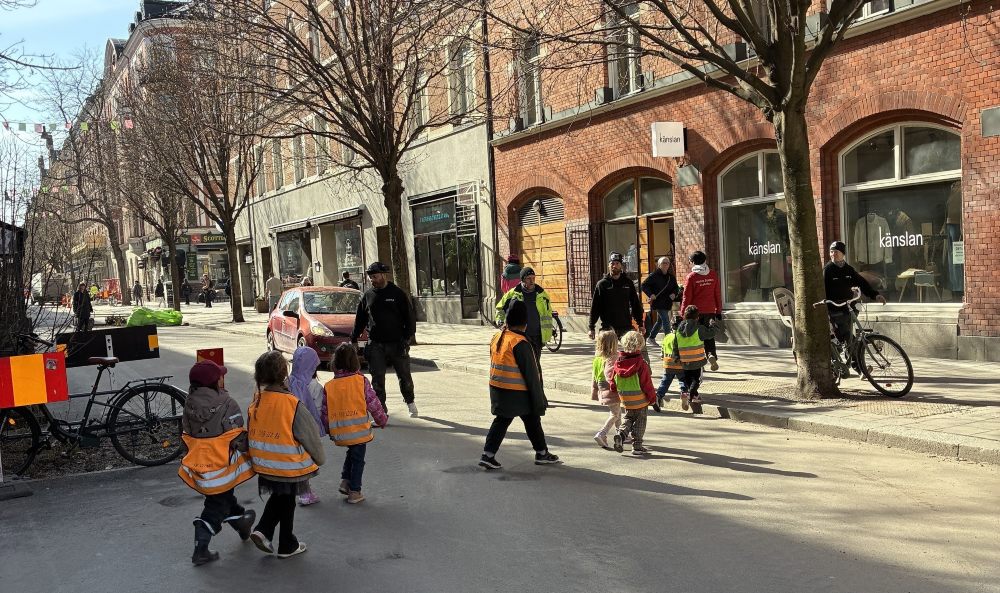

Typically, our stay in Stockholm is with my daughter and her family in the Södermalm district. The apartment buildings even have small bedroom suites on each floor for visitors that you can sign up for a week’s stay, next to your children. (They also have laundry rooms with industrial washers/dryers and a large wooden table in the center with overhead irons, for your larger smoothings.)
But often, we will stay at the nearby Hotel NoFo for the first few days to work off the jetlag and the time zone differences. And our grandchildren love the breakfast at the hotel. They walk us over to the hotel when we arrive in their assortment of strollers and bicycles.
The NoFo is in a converted monastery, four floors high with a lovely large courtyard. All the hallway windows look into the courtyard. Södermalm is nearest in Seattle to Pioneer Square, excluding the stadiums. Most distinctly, Södermalm is a residential district, on every block. And it has schools and children, though I must say the schools are so integrated into the building fabric that you never actually see them. The children you do see. Each morning and each afternoon there are lines of them, walking the narrow sidewalks, holding hands, going to school or going home. There are high schools and middle schools and pre schools. And playgrounds, with one soccer net and one basketball hoop and no room for more.
You will hear the children all the day. The high pitch of the youngest, jumping rope and chasing, the deeper sounds of sports and chatter, the gay sounds of just being outside, very hot or very cold, the choir practice, music studies, cheering. Children are a different pollination
You will not see the kids in the coffeeshops nor the shops, they are in school in their own world and it is a busy, bustling one. There is a distinct sense of getting some air, of having a break, a sense of the outside being a gift. You can hear it while they play.
The most unusual part of it all is that you hear children all over the city, the sound of children, young and older. The staff at NoFo are quite wonderful – when I was checking out, I mentioned they should quietly note in their description of the hotel that it has the sounds of children, much as you would note if it had the sounds of birds. I feared they would think I might be kidding but they understood exactly. It is the leaves and bustle of youth, to open the morning and to close the day.
It would be an interesting survey, measuring the sound of children in the cities. A scale, 1-10, of areas and space based on the sounds of a child. It may be quite a surprise. In Scandinavian cities, it may be that the sound of children is evident in 40-50% of the cityscape. Yet a simple walk in Pioneer Square was almost a hunt for child sound at all. Few families live there and there are simply no schools, until the International District.
By satellite, every urban center could be precisely measured for the sound of children. Every urban map and scale would measure, in color, the area and intensity of the particular sound as it ebbed and flowed the parameter. A kind of health and vegetation. Many cities are now actively concentrating on their population of trees, making great efforts to bring some measure of wood to their urban land. But children are a different pollination, a cross filter of pure youth. They are a particular herb to the task of a city.
In the fall, the downtown is filled with visiting children, brought to see the shop windows and lights. They tour, in packs, from one set of windows to the next set of shops, laughing and pointing. The shops know that they are a kind of street side theater and are very conscious to make a lovely, complicated tableau.
There are multiple studies of the wonderful effects of walking among trees, the community of many forces, or the humanity of having a pet, the very word, to pet. But I am not certain there is document to the effect of the sound of children, the silly, pitched sound of child play, the sound of youth. How it must surely effect optimism or prospect, or the very atmosphere of a street.
Seattle has a brilliant culture of flowers- from the early tulips and daffodils to the late handsome dahlias. Yet, unless you pass by the Pike Market, you might not see a flower, surely not a bouquet, on your day’s travel. We have but a scant tradition for bringing flowers home. I remember Peter Cipra, the late Czech restauranteur, would let not a week pass without carrying an armload of flowers.
Similarly, keep a sense to the sound of children – are they, like the robin and now crows, part of the musical composition of your day, your journey, to and fro.
Discover more from Post Alley
Subscribe to get the latest posts sent to your email.


An enlightened commentary on the sounds of children. A good read. I remember renting a house in Boseman with my wife for my sabbatical year at the university. Directly across the street, and through our bay windows, we could see and hear the children play prior to the beginning of. the school day, as well as during the recess and lunch breaks. We loved sitting adjacent that window, with a cup of coffee, watching and listening to these children. It was also our experience that we felt we got to know certain children just by our frequent viewings. A great sound, and one badly needed in our country right now.
Beautiful! I love this.
Yes – beautiful. thanks!
Indeed, “a particular herb to the task of a city,” right alongside trees.
A lovely and timely piece of prose ~
I recall living in a dorm right across from a school playground my sophomore or junior year in college. As I studied, I could hear the kids having fun. It uplifted me and made me jealous at the same time. Ultimately, it kept me grounded while I tried my best to handle the stress of college life. Thank you for prompting that recollection.