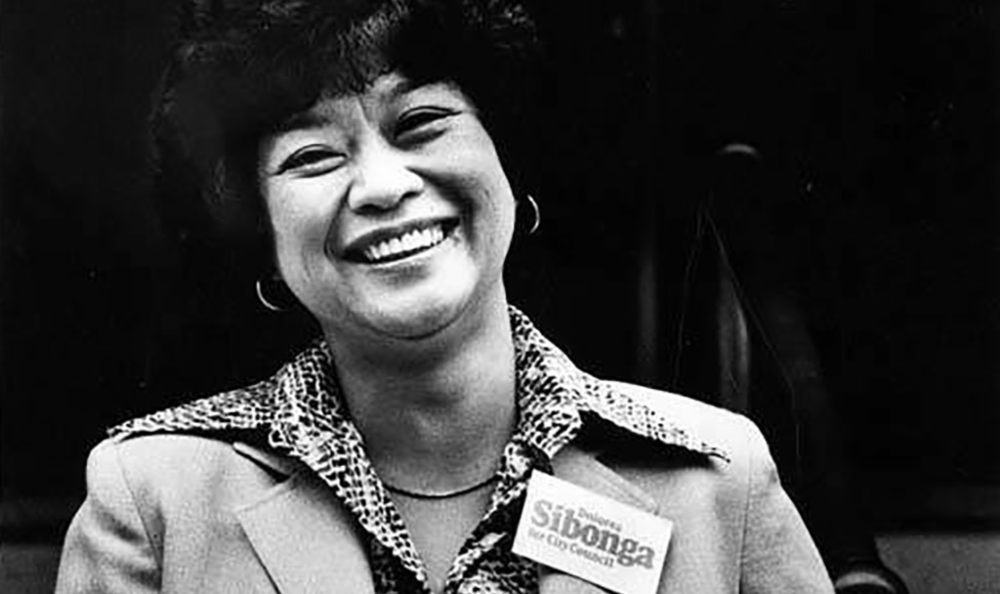

Dolores Sibonga calls herself “a child of Filipinotown,” part of Seattle’s Chinatown-International District where her parents owned a small restaurant. A Seattle trailblazer now in her 90s, Sibonga has written a captivating account of those times titled
The Best Adobo in Town: From Café to City Council.
In her memoir, Sibonga writes: “Filipinos had barbershops, social and fraternal organizations, newspapers, labor unions, business offices, photography studios, restaurants and a variety of stores. Filipinotown was alive.” Her parents, Mary and Victor Estigoy, who came from Luzon in the Philippines, ran the Estigoy Café where she worked, first bussing, then waiting on tables.
The family often shared meals with manongs, Filipino men who ate at the café after returning from Alaskan canneries; they were known as hard workers and sharp dressers. The café served a variety of other customers: officials from the Philippine Consulate, fight promoters, gamblers, prostitutes, gay men and some on the fringes of society.
Sibonga recalls, “My dad would fix rice with adobo juice for some of the old white men. He’d charge them a few cents or nothing at all. The manongs would settle up accounts when they had money after the season. At times we held mail for those without a permanent mailing address because they followed the harvest up and down the coast.”
Sibonga did well in school, skipping sixth grade. After Garfield High School, “said to be a mixing pot but defined by a hierarchy of kids who were white and the rest of us,” she entered the University of Washington and was accepted into the journalism school. As one of only three graduates of color, her professors worried they might have difficulty locating jobs.
But Dolores found work at KHQ in Spokane, followed by marriage to Martin Sibonga, a handsome combat veteran and former paratrooper. After Martin Junior (M.J.) was born, Dolores went back to work at local stations, moving into journalism jobs at KIRO-TV and KOMO-TV. During those years, the Sibonga family grew with the addition of sisters Teresa and Randi.
Martin persuaded her to complete a summer program for minorities, enabling her to enter the University of Washington’s Law School as part of the largest number of minorities to enter first year law. Grateful to her family for taking on added responsibilities, Sibonga thrived. She passed the state Bar Exam and joined the Public Defender Association working representing young people. She went to work for the (then) King County Council, learning about that body’s inner workings. It was a job that led to her becoming executive director in charge of operations for the Washington State Human Rights Commission.
In 1978, she got a call from Ruth Woo, the community’s legendary political guru. Woo convinced Sibonga to campaign for an interim appointment on the Seattle City Council. Dolores succeeded, becoming the first woman of color on the council. Later, she ran for a vacant seat and went on to serve 12 years as a councilmember. Her legislative aide Art Ceniza remembers that “she always asked the perfect question.”
During her council years Sibonga worked to open the door to opportunities for others. She used the tools she had and then worked to develop new ones. For example, as part of a committee that reviewed issuance of municipal bonds, she learned there were no women or minority lawyers or other financial experts who advised the city. Sibonga says, “I was told there were none qualified. But we found them and were able to make them part of the process.”
She repeatedly went to bat for others, managing to pass the first affirmative action plan that defined how the city would ensure applicants and employees were treated equally if they were a member of a protected class such as race, color, gender, age or disability. Throughout her career, she served as a mentor for minorities and women. In 1991 she ran for mayor, losing to her council colleague Norm Rice. But, as with many of her battles, she won the longer war inspiring workers “to take care of each other.”
It was community leader Ron Chew who finally encouraged Sibonga to write about her amazing journey. The 70-page memoir, rich with photos and revelations, was funded by her family and other community members and printed by the International Examiner. For information about obtaining a copy, contact iexaminer.org.
Chew authored a perceptive Forward for the book, noting that as the first woman of color on the city council “fighting for historic preservation, racial justice and gender equity,” Sibonga has had a lasting impact throughout the region. In her book, she tells about that history, once forgotten, but now no longer lost.
Discover more from Post Alley
Subscribe to get the latest posts sent to your email.

Just learned the Dolores just passed away. So glad that she was able to write a memoir in her final days. She gave so much to her city and to her community.How fortunate Seattle is to have had such a leader.