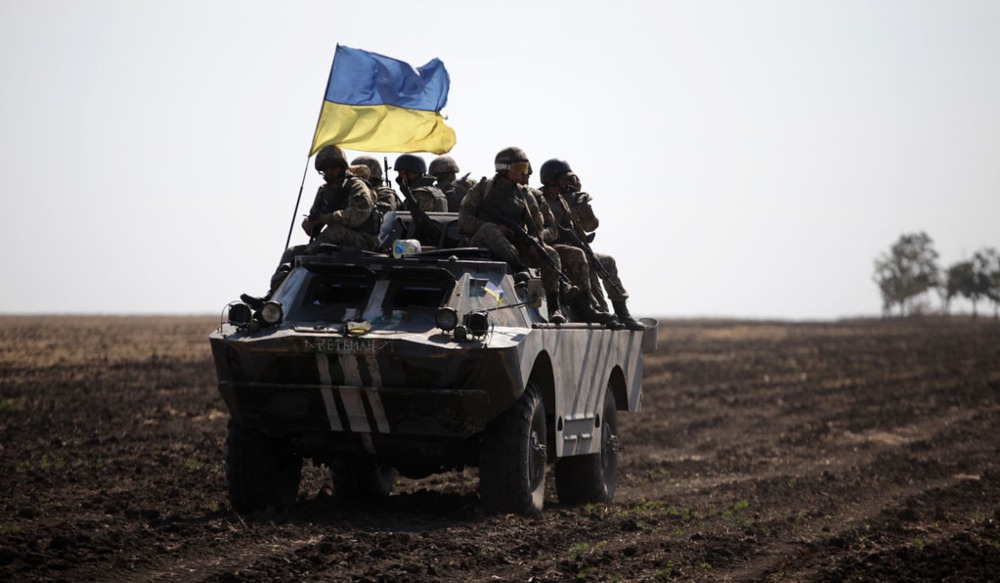

President Donald Trump has pivoted from shameless indulgence of Russian dictator Vladimir Putin’s ruinous war on Ukraine to praising the Kremlin leader’s unprovoked aggression against the neighboring democracy as “fine.”
Trump now says the quiet part out loud, that the devastating war Putin has been waging for nearly five years is not Russia’s fault. The war that has ravaged Ukraine—a former Soviet republic that has been an independent country for 35 years—is the fault of Ukrainian President Volodymyr Zelensky, whose ouster Trump demands as the way to end the deadliest fighting in Europe since 1945.
Zelensky reported over the past two weeks that the U.S. Starlink and StarShield systems that warn Kyiv of approaching missiles have been scaled down, preventing Ukrainians in the targeted civilian apartment blocks from evacuating to shelters in time to escape injury or death. Elon Musk, who created the early-warning technology, claims the order to withhold the intelligence came not from him but from “someone” in the White House.
“It is hard to think of a more effective way for the USA to help Russia both offensively and defensively in one move,” writes Phillips O’Brien, an American historian and professor of strategic studies at Scotland’s University of St. Andrews. “It is surgical and will lead to higher Ukrainian civilian and military deaths. Of course, that was the point.”
Only after word spread last week about the U.S. withholding effective warnings on incoming missiles and drones were normal conditions restored Tuesday, Zelensky said.
Zelensky said he had spoken with Secretary of State Marco Rubio on issues including ballistic missile interceptors, early warning of Russian missile attacks and “the situation with Starlink/StarShield, which needs to be restored,” referring to the Musk-owned SpaceX satellite system.
Rubio has been remote from the torrent of Trump’s pandering to Putin. He’s been on a tour of Central Asia meeting with political and business leaders of the “stans.” He denied to reporters following his far-flung travels that the White House ordered the Starlink interruption, initially speculating it was a software glitch.
What Trump clearly fails to understand is that all the pain and loss that Putin rains on Ukraine will not force the Ukrainian government or its battered population to surrender.
Ukrainians are fighting fiercely, and recovering territory of late, because they do not want to live under Putin’s brutal dictatorship. Their lives and freedom and hopes for joining the democratic alliances that constitute the European Union and NATO are Ukrainians’ North Star.
“This will be known as the week the USA pivoted from an informal ally of Russia, helping Putin kill Ukrainians and trying to bully Ukraine into handing over its territory and people to the Russian dictator, to a formal ally of Russia,” O’Brien wrote Monday.
Trump denied the Pentagon-financed intelligence had been suspended or that Russia had violated an “energy ceasefire” Trump himself announced last week to the surprise of Zelensky and the immediate violation by Putin. While the Starlink intel was disastrously slowed, Russian ballistic missiles and drones bombarded Ukraine’s major cities with unprecedented intensity.
The intensified Russian attacks across Ukraine in September “continued a pattern of civilian casualties in 2026 far exceeding levels verified in previous years, with devastating consequences for civilians, the U.N. Human Rights Monitoring Mission in Ukraine reported Friday. At least 328 civilians were killed and more than 2,100 injured in September, “with particularly high casualties in Kyiv city, Kherson, Kharkiv, Sumy and Zaporizhzhia.”
Confronted by White House reporters Monday and asked about his latest endorsement of Putin’s relentless assaults on Ukraine, Trump insisted that “Russia, frankly, has been fine on Ukraine.”
Trump contrasted Putin’s behavior with a claim that “Zelensky is not helping matters much,” that Kyiv needs to get rid of him and find “somebody else to negotiate.”
Trump’s shrugging off of Russia’s war has heightened fears among European allies that Putin may be encouraged to attack a NATO country to test whether the United States military would fulfill its treaty obligation to defend an attack on any of its 32 member states as fiercely as it would to protect its own security.
The White House announced last week that Trump has agreed to waive sanctions on Russian diesel imports, a violation of the restrictions enacted by Congress just last month. Trump has reacted to doom-filled polling projections that Republicans will lose control of at least the House of Representatives, if not the Senate as well, in midterm elections less than two weeks away. Trump defended his decision to buy sanctioned Russian fuel as necessary to bring down skyrocketing diesel prices pushing U.S. farmers into bankruptcy and consumers facing even higher prices for food once diesel-fueled trucks get the harvested produce to markets.
While Trump was defending his decision to buy Russian fuel, the senior U.S. military official in Europe was giving a reassuring speech to NATO allies that any provocation by an adversary would be decisively repelled.
“We will stop the attack and deny them the ability to achieve their objectives, whatever those might be. We will, in short, ensure any attack, against any ally, proves utterly futile,” warned U.S. General and Supreme Allied Commander Europe (SACEUR) Alexus Grynkewich at an alliance gathering in Warsaw. If the hostility persists, he insisted, “we will break the enemy’s forces and the operational warfighting system that is arrayed against us.”
The price Trump has offered to pay Moscow for the diesel hasn’t been disclosed, but the projected triple-digit millions or billions of dollars will replenish the Kremlin’s emptying coffers. Doubts persist whether Moscow can deliver on the announced deal. Ukrainian drone attacks on Russian refineries, oil depots and pipelines have inflicted heavy damage on the infrastructure of Russia’s export capacity. Coupled with European and other sanctions on energy imports from Russia, revenue has plummeted and inflicted shortages on the Russian domestic market that had experienced little hardship until this year from the war ravaging Ukraine.
Since Kyiv’s successful campaign targeting Russian oil export infrastructure began in mid-2025, 40% of the country’s refining and storage capacity has been destroyed, the Russian business journal RBC last reported a year ago. Long lines at gas stations and severe shortages in Crimea brought the war home to Russians occupying the illegally annexed Black Sea peninsula that depends on a single highway from southern Russia for its critical supplies.
At this time when Putin might be confronted by public discontent with the war finally having its impact on Russian social stability, Trump’s economic lifeline to the Kremlin promises to extend his ability to pummel Ukraine.
The Trump administration’s Russian diesel purchase “breaks its own laws as well as international sanctions agreements, and in effect places America on the Russian side of the war,” writes Timothy Snyder, another historian and scholar of Soviet and Eastern European history who is watching the political disintegration of his U.S. homeland from self-imposed exile at the University of Toronto.
Snyder makes a compelling case that Ukraine is fighting to defeat Russian aggression before Putin decides to attack another of the former Soviet-dominated countries now surrounding Russia. The small Baltic states of Latvia, Lithuania and Estonia have the most to fear should Trump refuse to uphold NATO’s Article 5 commitment to collective defense. Russia is also suspected of stealth “hybrid” attacks with munitions found in Germany, Poland, Romania and elsewhere.
“Putin’s idea that Ukraine is not a real country is the example of an oligarchical fantasy, the kind of centibillionaire nonsense that can take lives and destroy the planet. By resisting Russian aggression, Ukraine is showing that democracy can defend itself,” Snyder wrote in a recent Substack after his return from an extended stay in Ukraine’s embattled second city, Kharkiv.
“Proportional to population, [Ukrainians] have suffered losses on a scale Americans have never experienced, with the exception of the Civil War,” Snyder wrote in his latest Substack. “They live through the equivalent of a 9/11 in Russian terror attacks every few weeks.”
In Ukraine, the professor concluded, “even during conditions of war, civil society functions, and people speak their minds. Under Russian occupation, an entirely different mode of life prevails: women are raped; children are deported to Russia to be assimilated; local activists are murdered; young men are forced into the Russian army to die; total uniformity is imposed.”
Discover more from Post Alley
Subscribe to get the latest posts sent to your email.