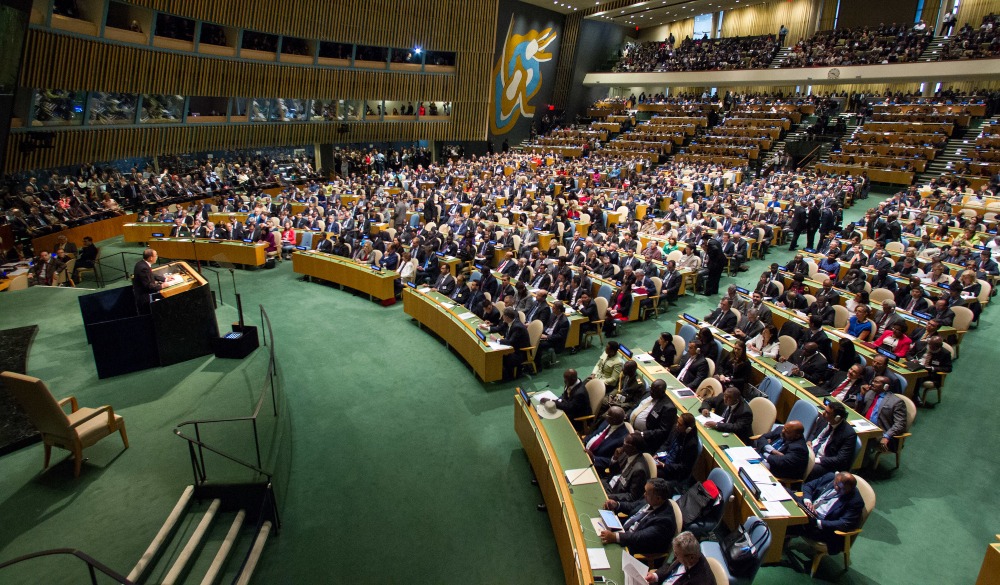

Despite the United Nations’ 1945 foundational objective of fostering global peace, its gatherings are seldom the forum where major world crises are resolved.
Last week’s General Assembly was historically notable for its failure to make progress toward resolving any of the world’s wars, trade disputes, climate protection retreats, threats of territorial seizures or deteriorating adherence to human rights or democracy.
The annual convocation of heads of state and foreign ministers of the world’s most powerful countries—and the middle and smaller powers bearing the brunt of the more influential leaders’ failures—spotlighted the bleak outlook for peace in Ukraine, Iran or Palestinian territories under Israeli siege.
Neither did the White House visit of Chinese President Xi Jinping resolve the security tensions or trade disputes between the world’s two most powerful countries. Trump treated Xi and his delegation to the predictable pomp and flattery he accords to authoritarian leaders but spent only 90 minutes in behind-the-scenes negotiations that yielded no change in their suspended tariff war or clarity on U.S. policy toward Taiwan.
Trump used his address to the annual assembly to vent aggression and grievance, threatening again to “annihilate” Iran, a country of 93 million, unless its leaders capitulate to his maximalist demands to reopen the Strait of Hormuz.
“Do I drive them into hell with no chance of survival and no hope of future greatness or generations?” He asked in his speech to a less-than-full house at UN headquarters on Tuesday, as if expecting audience applause for the idea.
Trump’s bombastic address was accompanied by a blitz of social media posts and impromptu comments to journalists echoing his usual claims that Iranian officials were “begging” to make a peace deal to end the war.
Iranian President Masoud Pezeshkian made those conditions clear in his U.N. speech. He vowed that Iran would never surrender to Trump’s terms and accused the United States and Israel of war crimes for deadly bombardment of civilian venues.
Behind the scenes, American and Iranian representatives held talks through mediators for the first time since the Memorandum of Understanding that halted most hostilities in June fell apart in July.
Iranian Foreign Minister Abbas Araghchi announced a proposed weeklong ceasefire to negotiate a more durable end to the war that would have included reopening the Strait of Hormuz. The proposal also envisioned new negotiations on limiting Tehran’s nuclear ambitions to civilian uses, like power generation and medical processing.
Iran’s proposed pause in the war spurred Trump to deploy his real-estate dealer negotiators Steve Witkoff and son-in-law Jared Kushner, whose intervention failed to elicit the total surrender Trump demanded. Little movement is now expected in the foreseeable future toward reopening the Strait to allow oil, fertilizer and other vital commodities to flow out freely.
As the General Assembly wrapped up its 2026 parade of irreconcilable differences, Trump rejected Iran’s offer of the seven-day pause, repeating his insistence that Iran first surrender and reopen the strait without conditions.
On Sunday, Araghchi warned the White House that only a diplomatic resolution will lead to reopening the vital oil transport corridor that previously delivered 20 percent of the world’s oil.
“Our conditions are clear, and any move toward reopening the Strait of Hormuz is contingent on these conditions being met,” Araghchi posted on social media. “Only a negotiated solution can get them [the U.S. and Israel] out of this deadlock.”
Iran’s throttling of the strait has drastically reduced energy traffic, sending costs soaring for gasoline and diesel fuel and the multitude of food and other commodities delivered to markets by diesel-fueled trucks. At least until the midterm U.S. congressional elections in five weeks, there appears to be no expectation of easing the global oil-shipment crises plunging major countries into economic tailspins.
Coinciding with the U.N. gathering, Trump hosted China’s president for a three-day extravaganza of military tributes, a lavish state dinner, tours of Trump’s garish self-aggrandizing projects in D.C. and an ironic visit to the National Archives where Trump showed Xi the Constitution’s original Bill of Rights. On display were the 10 original pillars of U.S. democracy—rights to free speech, due process, independent media and other freedoms to which neither of the world’s two most powerful leaders adheres.
Xi’s visit included only one 90-minute closed-door session with Trump. Reports to Chinese media by Xi’s entourage suggested nothing of importance was resolved. Both leaders agreed to extend their trade and tariff disputes they suspended during Trump’s visit to Beijing in May.
The only definitive “win” Trump got from his Chinese visitors appears to be a pledge to send two pandas to the Atlanta Zoo.
“Diplomacy or ‘diplotainment’?” The Guardian asked after the Xi visit it rated as “heavy on symbolism but no sign closed-door meeting yielded breakthroughs on thorny issues such as AI, trade, Taiwan and Iran.”
Little coverage of Xi’s visit emerged from prominent U.S. media as Trump was engaged in another attempt to bar journalists he brands as “the enemy of the people” from covering White House events.
A federal judge—a Trump appointee—ordered the White House to lift its ban on CNN, MSNow and Politico early Friday. The targeted journalists were eventually let in to cover what was left of Trump’s hosting of the Chinese leader though inconsistencies continued as Trump resumed excluding disfavored journalists from public events and air travel over the past weekend.
There was discussion between Xi and Trump on Taiwan, and according to the Chinese delegation’s readout to its traveling press, Xi pushed Trump to state that he is opposed to independence for the democratic island state that has been self-governing since the 1949 Communist takeover of the Chinese mainland.
Xi pushed Trump during their May meeting to halt a $14-billion arms sale to Taiwan, which was not mentioned in either side’s public comments on last week’s summit. That suggested the U.S. congressionally approved military aid remains on hold as Beijing intensifies aerial and naval maneuvers meant to intimidate Taipei leaders.
Russian President Vladimir Putin was absent from the global gathering as he is under threat of arrest on a war crimes indictment issued by the International Criminal Court in the Hague, Netherlands. Russian Foreign Minister Sergei Lavrov addressed the forum with a bellicose vow to press on with the campaign to seize the independent country of Ukraine, reiterating Putin’s twisted view that Ukraine must be conquered and annexed to prevent a pro-Western democracy on Russia’s border.
Lavrov blamed the United States and the European Union for driving a wedge between Russia and what Putin views as its vassal state. He condemned the aid and munitions being provided Ukraine to fend off Moscow’s attempts to destroy critical civilian energy infrastructure. Ukrainians face another winter of widespread power outages and freezing temperatures, indoors and out.
The veteran Russian diplomat also rejected calls from German officials to ease Moscow’s “dangerous path of escalation” of provocations against NATO and European Union neighbors. Lavrov brushed off the appeals for diplomacy and calm, portraying the modern German state as regressing to its World War II-era fascism.
“Does Berlin understand what this could lead to?” Lavrov asked during his speech to the general assembly early in the week. “Did they not learn the lessons of World War II?”
In his meeting with German Foreign Minister Johann Wadephul prior to his U.N. address, Lavrov dismissed his German counterpart’s appeal for an end to the Russian war on Ukraine as “simply reiterating his official public position condemning Russia.”
Ukrainian President Volodymyr Zelensky warned in his address to the General Assembly that Russia’s “ridiculous and never-ending war” on his country threatens to spread to neighboring states of the European Union.
Germany, Poland and the Baltic states have increasingly expressed fears that Putin is plotting to attack a NATO country to test whether Trump would come to the defense of longtime European allies or leave them to respond to Kremlin aggression on their own. Trump has attempted to force Ukraine to surrender territory to Russia as the price for ending the war fast approaching five years in duration.
Zelensky urged the U.N. to exert pressure on Moscow to end the war and reminded Ukraine’s allies of the worsening shortages of fuel worldwide and an impending disruption of grain delivery due to escalating attacks on Ukrainian shipments through the Black Sea.
On Thursday, protesters converged on the United Nations building and dozens of delegates inside walked out of the room as Israeli Prime Minister Benjamin Netanyahu addressed the gathering.
His combative speech lashed out at those accusing him of genocidal retaliation against Palestinians in the Gaza Strip after Hamas militants’ attacks on Oct. 7, 2023 killed at least 1,200 Israelis, the majority civilians. Israeli Defense Forces enduring attacks on Gaza killed a reported 70,000 Palestinians to date, also mostly civilians.
Netanyahu called allegations of Israeli genocide in Gaza “the biggest lie of the century” and defended Israel’s collusion with the United States in triggering another bloody war in the Middle East with their massive aerial war of Iran now entering its eighth month.
“If we hadn’t done it, we’d all be dead,” Netanyahu insisted.
The Israeli leader facing an uphill battle for re-election also slammed the U.N. host city’s mayor, Zohran Mamdani, who pushed U.S. federal authorities to act on the ICC arrest warrant for Netanyahu to face the court on war crimes charges.
“Mr. Mamdani, you tried to stop me from coming here. You tried to silence me. Well, you can’t silence me, and you can’t silence the truth,” Netanyahu warned the mayor he accuses of being antisemitic.
Kaja Kallas, the former Estonian prime minister now the EU’s top diplomat, announced at the forum that 51 countries have issued a joint statement condemning Russia for its war on Ukraine, including a Russian blockade of Ukraine’s Black Sea ports now threatening a worldwide grain shortage.
“We stand in solidarity with Ukraine as it continues to face Russia’s war of aggression,” Kallas said during an address on Wednesday. “We are deeply concerned by Russia’s escalation against civilians and civilian infrastructure across Ukraine, causing a record-high number of casualties in the last months, as recorded by the U.N.”
Most European nations, alongside Australia, Canada, Costa Rica, Honduras, Israel, Japan, New Zealand, Panama, and South Korea, are among those joining the declaration.
This year’s General Assembly also established that under Trump the United States is finally walking away from its failed attempts to exert its will on the Middle East, as claimed in this week’s cover story in The Economist.
“After three wars, countless covert operations and seemingly endless rounds of diplomacy, America’s attempts to impose its designs have run their course. Like Britain, France and Russia, America will still be involved. It will occasionally use military force to pursue its interests, including for counter-terrorism. But it will abandon its role as architect,” the editors concluded, citing significant signals of intended retreat.
“Earlier this month America declined to join its ally Saudi Arabia in striking the Houthis in Yemen, who are endangering shipping in the Red Sea. Instead it held talks behind the Saudis’ backs to spare American vessels from attack. That may seem like a detail, but when a superpower does deals with an insurgent militia, everyone understands it wants to cut its commitments.”
Discover more from Post Alley
Subscribe to get the latest posts sent to your email.