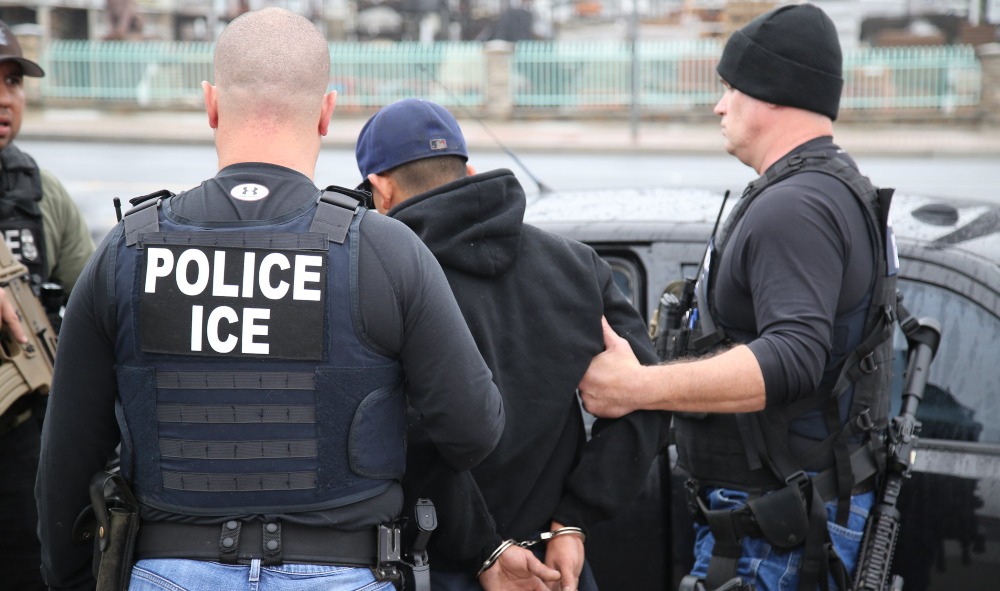

ICE arrests have been hitting hard to record levels.
Presumably, Congress’ June vote to give ICE and Customs and Border Patrol another $70 billion, enough to lavishly fund the agencies through the rest of Donald Trump’s presidency, didn’t hurt the arrest numbers. Presumably, neither did the Supreme Court’s temporary blessing of “Kavanaugh stops.”
Justice Brett Kavanaugh is no Ruth Bader Ginsberg or, if you prefer, Antonin Scalia, but those departed Justices don’t have their own eponymous law-enforcement stops. Kavanaugh does. Once famed largely for the allegation, during his Senate confirmation hearing, that as a drunken teenager he had committed sexual assaults, Kavanaugh has become linked (although reportedly, he’d rather not be) with the “Kavanaugh stop,” a form of what some people consider racial profiling, that the Supreme Court at least temporarily blessed last year.
The Court stayed a lower federal court’s temporary injunction – upheld by the 9th Circuit — against those stops in the Los Angeles area. Kavanaugh wrote a concurring opinion. The stay was –- of course –- was ordered through the Court’s “shadow docket.” Kavanaugh’s concurrence was all the explanation we got. Justice Sonia Sotomayor, joined by Justices Kagan and Jackson, wrote a dissent.
“The Supreme Court stayed an injunction issued against the federal government’s ‘Operation At Large,’” Duncan Hosie, who directs the Stanford Constitutional Law Center, has explained, “which deployed roving patrols of armed, masked officers to ramp up arrests of undocumented immigrants in Los Angeles.”
Kavanaugh thought it was OK for those roving patrols to round up Spanish-speaking people who hung out at Target parking lots and other places in which immigrants gather to get hired for day labor. Can federal officers detain and question people just because they are present at such places, speak Spanish and look like they’re foreigners? A federal district court judge and a 9th Circuit panel said no. Then, of course, a Supreme Court majority said yes.
In justifying that conclusion, Kavanaugh both maximized the scope of Southern California’s illegal immigration problem and minimized the hazards and horrors of being stopped. Using government figures, he said that “[a]bout 10 percent of the people in the Los Angeles region are illegally in the United States—meaning about 2 million illegal immigrants out of a total population of 20 million. Not surprisingly given those extraordinary numbers, U. S. immigration officers have prioritized immigration enforcement in the Los Angeles area.”
Sotomayor didn’t buy Kavanaugh’s numbers. “Without even a citation,” she argued, “the Government asserts that ‘10 percent of the population in the Central District’ is unlawfully present, so it is ‘inevitable and unremarkable’ that immigration officers would target any Latino person, or any person speaking accented English, or any person standing in a particular type of location, or any person working a low wage job in the greater Los Angeles area. Never mind that nearly 47 percent of the Central District’s population identifies as Hispanic or Latino. Never mind that over 37 percent of the population of Los Angeles County speaks Spanish at home, and over 55 percent speak a language other than English.”
How big a deal is all this? Kavanaugh suggested not very big. He evoked an idealized world in which neither ICE nor its targets are likely to live. The expression “parallel universe” comes to mind.
“The Government sometimes makes brief investigative stops,” he explained, “to check the immigration status of those who gather in locations where people are hired for day jobs; who work or appear to work in jobs such as construction, landscaping, agriculture, or car washes that often do not require paperwork and are therefore attractive to illegal immigrants; and who do not speak much if any English. If the officers learn that the individual they stopped is a U. S. citizen or otherwise lawfully in the United States, they promptly let the individual go.”
Everybody makes mistakes, but, “as for stops of those individuals who are legally in the country, the questioning in those circumstances is typically brief, and those individuals may promptly go free after making clear to the immigration officers that they are U. S. citizens or otherwise legally in the United States.”
Right. This doesn’t match the many public descriptions of how ICE detention actually works (or the impact that a brief stop can have.) But that’s the way it’s supposed to work, so why not assume it actually does?
Because we’ve all seen the videos. So, apparently, has Sotomayor. “Immigration agents are not conducting ‘brief stops for questioning,’ as [Kavanaugh’s] concurrence would like to believe,” she wrote. “They are seizing people using firearms, physical violence, and warehouse detentions. Nor are undocumented immigrants the only ones harmed by the Government’s conduct. United States citizens are also being seized, taken from their jobs, and prevented from working to support themselves and their families.”
(Kavanaugh maintains that the violence, which he opposes, is a separate issue that should be dealt with separately by the courts. True, the constitutionality of the stops is a question of why they’re made, while the violence is a question of how. But he has used his idealized vision of how in order to justify his defense of why. He can’t have it both ways.)
Which, Sotomayor argues, makes the government’s tactics a travesty of the Fourth Amendment’s prohibition of unreasonable search and seizure. “Of course, she writes, aggregate statistics . . . cannot substitute for the individualized suspicion that the Fourth Amendment requires.”
Sotomayor thought the lower courts that had temporarily blocked the ICE operation had gotten it right. “The Fourth Amendment . . . prohibits exactly what the Government is attempting to do here,” she wrote: “seize individuals based solely on a set of facts that ‘describe[s] a very large category of presumably innocent’ people.
“As the District Court correctly held, the four factors [used by federal agents} . . . are ‘no more indicative of illegal presence in the country than of legal presence.’ The factors in no way reflect the kind of individualized inquiry the Fourth Amendment demands.”
Trump’s immigration policy, however, demands something like the Kavanaugh stop – if not something even more focused on stereotypes. If you’re trying to carry out mass arrests and deportations, you can’t waste time on individualized inquiry. That’s simple logic. Or maybe just semantics. The current alternative certainly looks a lot like practices that less reactionary courts have rejected.
(Stanford’s Duncan Hosie has reported that it looks that way to legal scholars, too: After the Court ordered a stay, they “argued that the stay sanctioned racial profiling and punitive enforcement tactics, dispensed with standard decisional procedures . . . and reflected an institutional retreat from the Court’s responsibility to constrain presidential overreach.”)
Do we think that’s OK? So far, Kavanaugh and his allies evidently do.
Discover more from Post Alley
Subscribe to get the latest posts sent to your email.