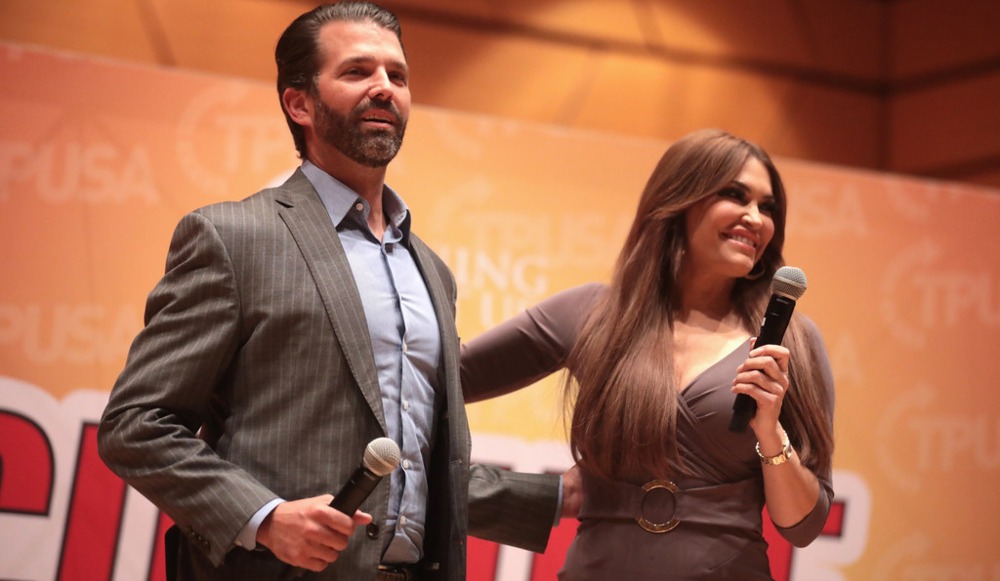

“I will not disappoint the United States of America. I shall not disappoint Greece,” beamed Kimberly Guilfoyle. Eleven months later, America’s ambassador to Greece left with her tail between her legs, caught in her own $100,000 shakedown. After Trump donor Eric Deters got sick of paying her big bucks for access and turned her don’t-leave-a-paper-trail texts over to The Wall Street Journal.
Who better to represent America than a tax-cheating, witness-tampering sex-tape schemer going from federal prison to ambassador to France? Ambassador Charles Kushner, Jared’s real estate tycoon dad, did not disappoint. In only seven months, he twice meddled in France’s internal affairs, twice rudely ignored a summons from the French government, and got himself barred from direct access to its ministers. The foreign minister said publicly that it would “naturally affect his ability to carry out his mission.” That’s diplomat-speak for “he’s useless to you now.”
Poland is “the best ally America could dream of,” declared talk show host Tom Rose at his Senate confirmation hearing. But it only took him three months as ambassador to start a public feud with that frontline NATO ally over the Norwegian Nobel Peace Prize, which neither country controls. While Rose pushed for Donald Trump, Włodzimierz Czarzasty, Poland’s second-highest official, disagreed on the grounds that Trump relies on force that breaks international law. Rose cut off all ties with him. Prime Minister Donald Tusk schooled Rose: allies should respect each other. It didn’t matter anyway. On October 9, the independent Norwegian Nobel Committee chose Navi Pillay.
“Fake news,” Pete Hoekstra told Dutch reporter Wouter Zwart, just after Trump named him ambassador to the Netherlands in Trump’s first term. He denied ever claiming the Netherlands had “no-go zones” where politicians were set on fire. Zwart played him the tape. His excuse: he “mixed up countries.” Really? With which one? None exist. Now he’s ambassador to Canada. He attacks Prime Minister Mark Carney’s campaign as anti-American while defending Trump’s anti-Canadian push to annex our northern neighbor. His expletive-laced tirade on David Paterson, Ontario’s trade representative, is legendary. He tells a Bellevue business audience Canada is “mean and nasty” because they answered tariffs with boycotts – boycotts that cost Americans about $3 billion and Washington about 1,300 jobs. Now more than 260,000 Canadians have petitioned to have him declared persona non grata.
What do these shenanigans cost?
France is our oldest ally, a nuclear power with a seat on the UN Security Council. Five days after Paris cut Kushner off, the United States went to war with Iran, and our ambassador couldn’t get in the room. Greece, America’s critical gateway for gas to Ukraine, is left hanging, with no American ambassador in Athens. Poland, bracing to be Russia’s next target, hosts some 10,000 American troops while our ambassador quibbles over a peace prize. And in Canada, our ambassador, sent to mend fences, keeps tearing them down. The relationship is irreparable, as Doug Ford, Ontario’s Premier said: “No matter what happens in the midterms. No matter who sits in the White House. We’re not going back to the way things were.”
Where do they get these people?
Ambassadors are appointed by the president and confirmed by the Senate. The Foreign Service Act of 1980 states that ambassadors “should normally” come from the career diplomatic corps, and that “contributions to political campaigns should not be a factor.” For half a century, most ambassadors were career diplomats, with only 32% political appointees. Under Trump II, 80% are political appointees; that’s 97 of 122 picks. Career diplomats spend decades mastering languages, protocol, history and precedent. Trump’s bring a checkbook or blind loyalty.
“This is a catastrophically low level and a complete change from any prior president over 60 years,” said Nicholas Burns, a career diplomat who served as ambassador to Greece and later to China. He was speaking of the dwindling ranks of career ambassadors.
As of October 20, 93 of America’s 196 ambassador posts sat empty. Nearly half. Last December, the administration had made it worse, recalling nearly 30 career diplomats from their posts.
Political appointees are not the problem in themselves. Our corner of the country has sent two of the best. Mike Mansfield, the Montana senator, went to Tokyo for Jimmy Carter and stayed on for Ronald Reagan. He served 11 years, the longest tenure of any U.S. ambassador anywhere, and liked to remind both countries that theirs was the most important bilateral relationship in the world, “bar none.” Gary Locke, our former governor, left for Beijing in 2011 carrying his own backpack. A Bellevue businessman snapped him buying his own coffee at the Sea-Tac Starbucks. The photo was reposted some 40,000 times in China, where even minor officials have someone to carry their bags.
That’s the standard, and it matters.
Consider the world we’re in. Russia’s invasion of Ukraine, year five. Russian drones shot down over Poland. The U.S. and Israel at war with Iran, the Strait of Hormuz shut for months, the world’s oil choked off, a war that could cost $1 trillion. Gaza, more than 73,000 dead, and an Israeli minister who wants the 2 million still alive shipped abroad. China building the power to seize Taiwan. Threats against Denmark, a NATO ally, over Greenland. Canada, our neighbor, told to become the 51st state. That one hits home. Washington is the nation’s most trade-reliant state. Our ports, farms and orchards live on trade with Canada, and Canadian trips south have dropped by half. This is when diplomacy matters most.
After two world wars, America led the world in building something new: the United Nations. Its Charter opens with “We the peoples,” an echo of our own Constitution. The rules were simple. Sovereign borders. Don’t invade them. Use words, not weapons. For 80 years, we worked to bury the Ugly American. The Marshall Plan rebuilt Europe, friend and former foe alike. The Berlin Airlift fed a blockaded city without firing a shot. In 1977, America became the first country to make it a crime for its companies to bribe foreign officials. Behind each were American diplomats. In a world that runs on bribes and threats, America stood for something else: good will, good faith, integrity, a word you could count on. (Well, except for helping topple governments in Iran and Guatemala, and backing the coup in Chile.)
It isn’t perfect. This September’s General Assembly was a big nothing burger, as Carol J. Williams wrote in these pages. But the week was one of the most powerful I have known. Not in the hall. In the meetings outside it. Just before Trump walked in to sign the Greenland agreement with the leaders of Denmark and Greenland, the sound system “accidentally” played “Send in the Clowns.” Away from the cameras, years of relationships, trust and connections came together, people incredulous at the state we are in. It was in the hugs, in the silent messages between old friends, in the late-night conversations. At 1:30 a.m. at the Millennium Hilton, One UN Plaza, squeezing every last minute out of the night, one weary-eyed ambassador confided, “I just want some peace — from the chaos, between our nations and in myself. Too much stress.” We searched our hearts, admitted our confusion and frustration, and realized: this is a moment when each of us must stand firm – in ourselves, in our friendships, in our values.
A former Fletcher School student at Tufts, now the leader of their own country, caught me on the street, pulled me into an embrace and whispered, “I never thought the American institutions were so fragile.” “They’re not,” I assured them, with a hesitation that was more hope than certainty.
Institutions stand only if we hold them up. That’s a message for each of us. Here are three concrete actions:
First, change one word in the Foreign Service Act: “should” to “shall.”
Second, pass the BEST Ambassadors Act. Two Michigan congressmen, Democrat Andy Levin and Republican Peter Meijer, proposed it in 2021. A president naming a non-career ambassador would have to explain why no career diplomat would do, and certify that campaign money played no part. It died in committee. Bring it back.
Third, train diplomats who know the job. Harvard’s Kennedy School has launched a program, led by Ambassador Nicholas Burns, to rebuild America’s diplomatic corps and train the next generation to serve.
Canada is demanding better. Greece deserves nothing less. So do France and Poland. So do we.
Discover more from Post Alley
Subscribe to get the latest posts sent to your email.

