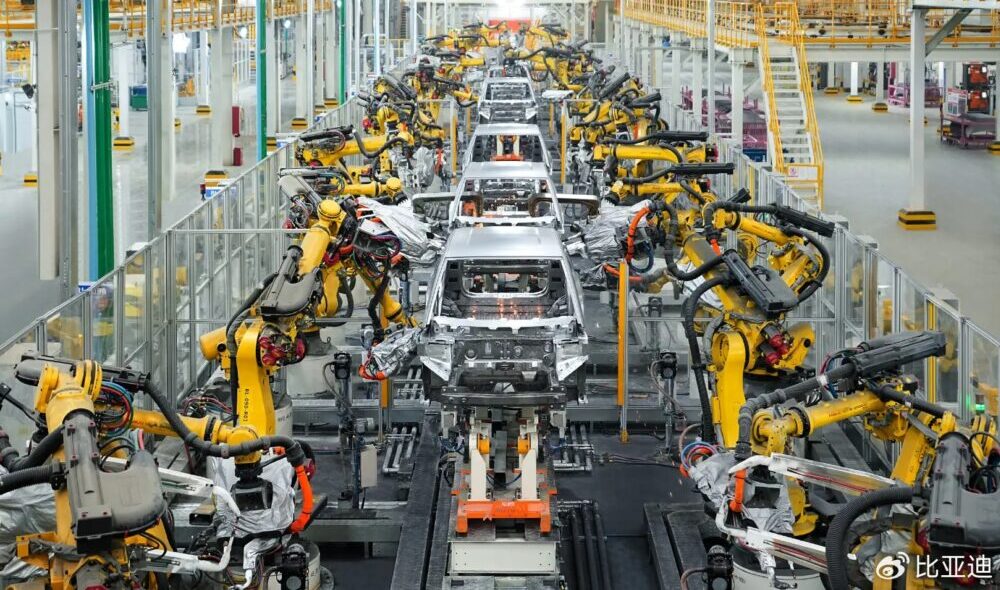

There has been a lot of talk and resentment about China’s overcapacity, or its “manufacturing and export juggernaut,” as the Wall Street Journal put it. The United States leads in the indignation and effort to turn the tide.
In March this year, the office of the U.S. Trade Representative launched investigations under the Trade Act of 1974 relating to structural excess capacity and production in manufacturing sectors. Even though 16 countries are being investigated, from the European Union to India, China is the No.1 target. U.S. Trade Representative Jamieson Greer called the investigations part of the Trump administration’s reindustrialization efforts and criticized those U.S. trading partners for producing more goods than they can consume domestically.
During the G20 finance ministers’ meeting in Asheville, N.C. in September, Treasury Secretary Scott Bessent encouraged his G20 counterparts to take a page from Trump’s tariff playbook to crack down on “cheap exports” that “caused global economic imbalances.” He was disappointed as China dissented. Again, at the G20 trade ministers meeting in Milwaukee in early October, U.S. Trade Representative Jamieson Greer said that nearly all countries agreed that the issue of excess capacity required action. And again, the meeting ended with an impasse because of China’s objection.
What does China have to say about its overcapacity or excess capacity?
Back in July, China’s Ministry of Commerce issued a paper titled “China’s Position on the So-called Excess Capacity Issue.” With that “so-called,” the Economist said, “China won’t apologize for overcapacity.”
Let’s see why.
In 1880, the Chinese paper pointed out, the UK’s share in global industrial output peaked at 22.9%. In 1953, the U.S. accounted for 44.7% of the global industrial output. (For reference, China’s share was at 27.4% in 2025.) Globalization, it said, shifted industrial landscape, from the U.S. to Europe, to Japan, to East Asia and China, now with movement to SE Asia.
Excess capacity, the paper said, is a dynamic phenomenon in the world economy of supply and demand. The growth of China’s exports to Europe, for instance, was contributed to by demand for photovoltaic devices, new energy vehicles, lithium-ion batteries, chemical products, etc.
Does China try to export its way out of a weak domestic economy? No, the paper said. In fact, from 2013 to 2024, China’s domestic demand contributed 93% of the country’s economic growth. Measured by the World Bank’s Purchasing Power Parity, China’s total retail sales of consumer goods in 2025 was 1.7 times that of the U.S.
What about China’s industrial subsidies? Well, the paper claimed, R&D subsidies for emerging industries and the agricultural sector are legitimate industrial and trade policy tools for WTO members. The past five years, it said, has seen a rapid increase in industrial policies worldwide.
Why does China have such large trade surpluses? Manufacturing powerhouses, the paper continued, like the UK, the U.S., Japan, and Germany all recorded trade surpluses for a long time. China now is the primary export destination for nearly 80 countries and offering zero-tariff treatment for all African countries. China is also the only country hosting an annual international import expo and “Export to China” events.
In conclusion, the Chinese Commerce Ministry said that China’s industrial modernization is a “China opportunity 2.0” for the world, not “China shock 2.0,” and that China is not only “the world’s workshop” but also “the world’s market.”
So, as the Economist said, China won’t apologize for its “so-called” overcapacity.
What exactly is the definition of overcapacity? It turns out that the World Trade Organization does not have an official definition or provisions of overcapacity. According to U.S.T.R., however, it is “producing more goods than the country can consume domestically.”
Glenn Diesen, a professor of international relations at the University of South-Eastern Norway, drew this parallel: “One can argue that the French have overcapacity in winemaking and the Italians have overcapacity in fashion (industry).”
Norway, Prof. Diesen’s own country, is the world’s largest producer and exporter of Atlantic salmon. Does Norway have a salmon overcapacity?
Same could be said of TSMC, Taiwan Semiconductor Manufacturing Company, the world’s largest chip manufacturer, which has a global market share of 72.5%. Or the Dutch company, ASML, Advanced Semiconductor Materials Lithography, the world’s only manufacturer of extreme ultraviolet (EUV) lithography machines. It controls 100% of the global market for EUV lithography systems.
The Chinese Commerce paper used a similar parallel with a manufacturing giant here in the Pacific Northwest, pointing out that “… about two-thirds of commercial planes delivered by Boeing were sold to clients beyond North America.” It is true. Boeing builds and sells planes all over the world and holds about 40% of the world’s commercial aircraft market share.
Other parallels could include America’s once-upon-a-time Big Three automakers, for instance. Together, General Motors, Ford, and Chrysler enjoyed 61% of global market share in 1965, and 70% in the 1950s. Or the U.S. pharmaceutical industry, America’s largest single export commodity today, accounting for close to 40 percent of total world production.
As for Trump’s complaints about China’s continuing trade surplus, ordinary Chinese have long had this refrain: We want to buy from America and there is a lot we want to buy. But the U.S. doesn’t want to sell to us, except soybeans.
Thomas Friedman of the New York Times, who just returned from another trip to China, after visiting Beijing and tech hubs Hangzhou, Ningbo, and Shenzhen, gave this advice to his fellow Americans:
“China is not going to slow down in manufacturing as a favor to anyone. If we want to influence China’s geopolitics and geoeconomics in the age of A.I., we have to create the economic competitiveness that would compel it to do so.”
Discover more from Post Alley
Subscribe to get the latest posts sent to your email.