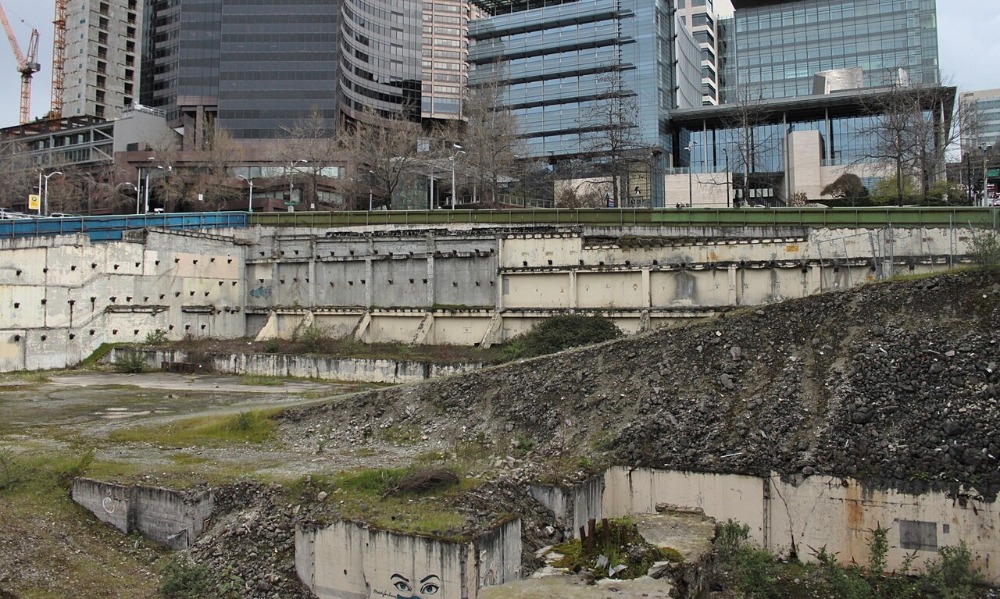

Visitors to Seattle have been asking questions. They inquire about the Museum of Pop Culture (MoPoP), the Frank-Gehry’s avant-garde building at the Seattle Center and wonder, “when are they going to finish it?” And then they look at the fenced-off, deserted block between Cherry and James, Third and Fourth, and puzzle over the yawning pit. They ask, “What in heck happened there?”
It’s a question even locals have asked. But, as long-time residents can recall, the unsightly yawning pit was once site of the 14-story Public Safety Building. Notorious for its people-trapping elevators and abandoned roof-top jail, the malfunctioning building was pulled down in 2005. By that time, it had been replaced by a new seven-story City Hall and the Seattle Justice Center directly to the East.
Incredibly, 21 years later, the fenced-off empty block remains an ugly scar at the center of the government compound. Surrounding are Seattle’s municipal buildings, the King County Courthouse and administration buildings, the Goat Hill garage and County Jail. The unsightly hole has blighted the area for decades while plans to activate it have flourished and then crashed.
During his first term in office, then Mayor Greg Nickels envisioned the location as a grand public-private development, a real civic square. He wanted the site to house a 43-story office/residential building, a jointly owned garage and a park rimmed with lively retail spaces, a worthy rival for San Francisco’s Union Square.
The project was negotiated with Triad, a well-known local development company. But soon after, in 2008, the Great Recession hit and the civic square plan was put on hold. Triad arranged for contract extensions but then came the 2015 election and, with it, a shady political deal.
Triad executive Brett Allen had a proposal for Jon Grant, a Seattle city council candidate. If Grant, the former Tenants Union president, would help settle the union’s lawsuit against Triad, a hefty sum opposing Grant’s election, would disappear. It was a blatant shakedown and not even much of a secret. Allen had also contacted former Mayor Mike McGinn, a Grant supporter, for help pressuring him.
The resulting scandal left then Mayor Ed Murray wanting to sever ties with Triad. The development’s contract with the city was due to expire at the end of the year and Murray had decided not to renew. Instead the city would find another developer capable of taking over the project.
The search failed – not once but twice – leaving the city trying to wiggle out of the Triad deal. Then along came Bosa, a British Columbia developer, with an alternative plan, one that differed from the original Triad blueprint. Bosa would acquire ownership of the entire block in exchange for $16 million in cash and $5.7 million expected in affordable housing fees. Bosa had plans to build a taller, skinnier residential tower and a 25,000-square foot plaza with street level retail space.
An easement would provide for public use of the planned plaza but leave the city free of the plaza’s operating and maintenance costs. The city would get exclusive plaza use up to 10 times a year. It seemed an appealing arrangement and the City Council approved implementing legislation with only Councilmember Kshama Sawant voting “no.” She branded it “a corporate takeover.”
Looking ahead, Fred Podesta, then the city’s director of Finance and Administrative Services (FAS), talked up the deal, saying that “when the Seahawks win the Superbowl, we’ll have a place to celebrate.”
Design changes meant that Bosa had to apply for a new master permit, meaning a couple of years delay and pushing back construction once again. Bosa’s plans were completed just as the pandemic arrived and snarled schedules. The site remained barren save for a bunch of scraggly sprigs and a single tree.
Finally in March 2022, there was big news: Bosa announced it would restart the project the following month. The city issued permits for shoring and excavation while Mayor Bruce Harrell cheered the news, noting “It’s an excellent step forward in efforts to revitalize downtown.”
But hopes raised were again dashed. In July 2022, Bosa put out a release saying the ill-starred project would be delayed. Word from the developer blamed “rising construction costs” and “uncertainty of the market” and spoke of “looking forward to the time when we can pursue this project again.”
The contract signed with the city had given Bosa four years to start on construction and six to finish the tower before incurring penalties from $500 to $5000 per day. Bosa’s pause could mean penalties for delay had been triggered. At the time, an FAS spokesman stated that “delay damages will be determined at a later date and assessed after April 2026 at the earliest.”
That brings us to the present: the April accounting arrived without any sign the derelict lot will become the long-envisioned public amenity. Calls to officials in Mayor Katie Wilson’s administration including Office of Finance’s Dwight Dively have gone unanswered. The silence is most unfortunate because it is well past time to take action. The block has been a blight under seven mayors, four potential developers and some two dozen councilmembers. Children born in the year of the Public Safety Building’s last gasp have been voting now for three years.
City leaders must again examine the situation: Was the original public-private deal destined to fail and, if so, how? Can the city somewhere find a developer interested in taking on the project? Or is Seattle forever stuck with the Pit from Hell?
Discover more from Post Alley
Subscribe to get the latest posts sent to your email.


Is it the same Jon Grant who is now working for the Mayor?
Yes.
Jean, great recap and a lesson in how little government officials understand about commercial real estate. The various deals were never structured properly to incentivize the developers to assume risk and move forward. That said, the site is extremely risky for market rate development surrounded by homeless projects and government buildings that do little to activate the neighborhood. Time to rethink the use IMO.
Well before this “pit”, I dealt with another one near PPM that was labeled “dangerous” because of its depth and interminability. On behalf of our clients, I had to fight in court to keep the “pit” open (and provide all sorts of assurances the site would eventually be developed…which it was).
I wonder if it isn’t time to consider filling this one in, making it a functional “open space”, and then waiting for the market to catch up?
That area is not as nice as when you worked at City Hall, Jean. That’s part of why it hasn’t been developed.
Maybe this post is part of the same story/tragedy explored in
“Democracy Dies in Ineffectiveness”
https://podcasts.apple.com/us/podcast/blue-city-blues/id1777289409
Seems to me it would be best for the city move all of city hall offices and courts to the numerous empty spaces in the core downtown area. Revitalize those areas and allow for some imagineering where the existing city hall is located. Move away from the blight. It’s not going to get better in the foreseeable future.
Perhaps we could simply let the lot be and watch how nature returns to fill the space. Several years ago, before Bosa came along and cleared out the space, it had already attracted a host of species, including several trees that had grown taller than 50 feet. I am guessing that birds and perhaps a mammal or two had found home in the space. Plants and animals are again returning, creating a little landscape of life in the concrete jungle.
Keep the block enclosed and think of the space as an experiment in entropy. If so many plants—in particular the native cottonwood—are thriving in just 15 years, imagine what we’ll be able to see if we continue to leave it alone.
I gather that the main difficulty in filling in the block has been the City Council’s insistence that any hotel on the site must be a union hotel. The real culprit all along has been the city council’s insistence on developers’ fulfilling various pet projects of the councilmembers. Where is the Municipal League to unearth the story of these endless delays?
Why had the Tenant’s Union filed a lawsuit against Triad? Because they were upset about John Goodman’s (Triad) plan to purchase the Theodora in Wedgwood, a money-losing apartment building run by the Volunteers of America for low-income renters. VOA put it on the market and spent months transitioning their tenants to other VOA or subsidized rental locations, but no matter – Jon Grant appeared to be using a technicality-based lawsuit as leverage to try to kill plans to convert the Theodora into market rate apartments (which it now has been for several years as MOD apartments). Equally questionable tactics as Mr. Allen’s supposed inverse “bribe.” Having worked with Brett Allen on the Civic Square project, I can tell you he is an upright guy of good character, who made a casual remark via text message that was then used against him and Triad with great amplification. The death of this project and the political machinations swirling around it is the greatest disappointment of my career as an architect.