

Just about everyone in Seattle knows why we have a homelessness crisis. Or they seem to. In fact, these confident observers don’t just have vague ideas; they have firm convictions informed by what they see on the streets, what they hear from housed neighbors, and what they gather from TV anchors and Talk Radio Jocks. We, however, think these armchair quarterbacks are wrong, and we write to offer an alternative explanation that Seattle homeowners won’t instinctively embrace.
But first, why do we reject the conventional wisdom?
First, very few of these local pundits seem to have read any of the academic literature on homelessness, and even fewer have ever bothered to talk with someone who is unhoused. In addition, and perhaps more telling, they have wildly different answers to the “why” question. It’s like watching a Jackson Pollack painting: What will stick to the canvass?
On social media, we hear that the primary cause of homelessness is:
- Substance abuse. Repeatedly we are told that rough sleepers in Seattle are drug addicts and alcoholics. The evidence is visible: “open air drug markets,” needles, bottles, tin foil left in camps, homeless people behaving erratically.
- Mental illness. Almost as often we are told that unhoused folks are crazy or unhinged and cognitively impaired. This, too, we see with our own eyes. They don’t behave normally.
- Parents. Some folks tell us that folks on the street have been abused or neglected by their parents. The unhoused didn’t get a proper upbringing.
- Poverty. The poor, we hear, are naturally going to end up on the street, regardless of underlying conditions. They are the have-nots, after all.
- Weather. Temperate climates on the West Coast, some argue, are amenable to campers, while harsher climates are not.
- Lavish services. We live in “Freeattle,” it is often said. The unhoused congregate here because progressive churches in Seattle (deemed enablers) provide a free breakfast of meat blanquette on mashed potatoes, even though it might be overcooked. And because left-wing politicians have brazenly agreed to finance some shelters and tiny homes.
There are other reasons offered, but these are the ones we hear most often. Why do we reject them?
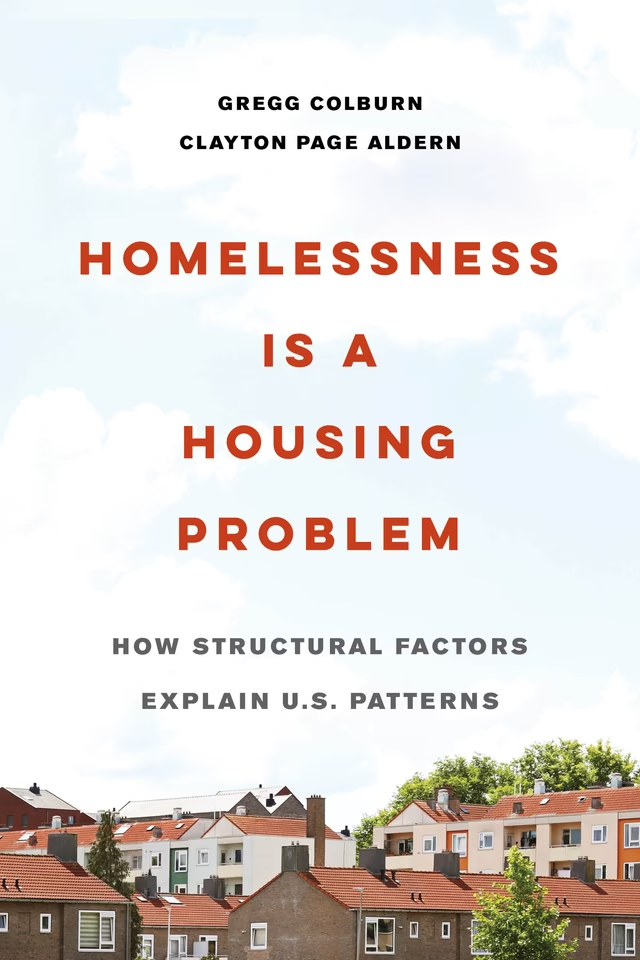
The primary cause of homelessness, according to almost all the experts who have studied this issue, is lack of housing. When a local jurisdiction fails to supply sufficient housing, someone is going to end up unhoused. And it should not be surprising that those who end up unhoused are those who are disabled or vulnerable, for whatever reason (substance abuse, mental illness, family trauma, poverty, racism, etc.).
UW professor Gregg Colburn and data scientist Clayton Aldern have written an empirically rich book, “Homelessness is a Housing Problem,” that tries to explain why cities like Seattle, LA, San Francisco, New York and Boston suffer from a high level of homelessness while cities like Milwaukee, Miami, Cleveland, Philadelphia, Detroit and Houston do not. Neither individual factors nor environmental and political factors explain the results. Their findings dovetail with the conclusions of other analysts:
- Substance abuse is a major problem in the unhoused community, perhaps as a cause of homelessness but also often as a result of homelessness. Either way, there is no evidence of greater drug and alcohol abuse in places with high rates of homelessness. In fact, some places with extraordinarily high levels of substance abuse (like West Virginia) have relatively low levels of homelessness.
- Mental illness also does not appear to be an underlying cause of homelessness. Cities and counties with disproportionately large numbers of unhoused people do not appear to also have unusually high numbers of mentally ill people. In fact, none of those cities and counties were listed in a 2017 study by the CDC of the 10 places with the highest prevalence of mental challenges.
- Bad parents are everywhere. (This variable is not analyzed in Colburn and Aldern’s study.)
- Poverty is not a major driver of homelessness. Cities with very high rates of poverty – like Detroit and Cleveland – have relatively low levels of homelessness. In fact, the most affluent cities tend to be the ones with higher levels of homelessness. Of course cities without adequate housing have more homelessness, and these people have become impoverished, and will remain so until housing is available.
- Cold weather does not deter homelessness. New York City and Boston have frigid winters, but very high levels of homelessness. What’s different from the West Coast is that almost all unhoused folks in those East Coast cities sleep in shelters.
- Progressive policies don’t explain regional variation in homelessness. Cities like Chicago and Philadelphia have been led by politicians that are just as “liberal” or “permissive” as their counterparts in Seattle and Boston, but they have had far lower rates of homelessness.
The only thing that explains the regional variation in levels of homelessness is the supply of housing, according to Colburn and Aldern.
This does not mean that individual factors are inconsequential. In our own work on the streets of Seattle, we have found a common denominator — trauma — among the unhoused. In his 2025 book, Paul Blankenship calls it “soul woundedness” — the tragic reality that most if not all folks without a home are hobbled by a deep, debilitating sense of despair, of hopelessness. This leads them to use drugs, to experience mental illness, or to give up on the world and themselves. But it doesn’t “cause” them to be homeless.
Colburn and Aldern use the metaphor of musical chairs: If there are not enough chairs, someone will always lose. The losers will almost inevitably be those who are slower, more distracted.
Likewise, in the game of “housing,” when there are not enough homes, someone will always lose. The losers will be those who are somehow disabled: addicted, mentally ill, or traumatized.
This means that, in a place like Seattle where there is not enough housing, the losers are those we see on the streets. But this doesn’t mean that individual “failures” explain why those folks on the street are homeless. It means that, given the constraints, they are the ones who will lose this awful game.
It’s a simple message (homelessness is a housing problem), but it’s also a deeply unwelcome one in our relatively affluent community. Colburn receives a high volume of vitriolic email. In a recent tweet, Andrea Suarez, the director of “We Heart Seattle,” a group that views homelessness as an individual failing by drug addicts, exhorted her 11,000 followers to torch the Colburn/Aldern book: “Post pictures of you burning it.”
Imagine loathing a scholarly book so much you want others to ritually destroy it.
Far more popular is the belief that flawed individuals, abetted by feckless politicians, are responsible for homelessness. One reason to embrace such a view is that it relieves us from any guilt for the problem. We aren’t to blame, one can easily conclude. It’s the fault of the drug addicts, the mentally ill, the politicians – everyone but you and me.
Except that we did cause the problem of homelessness. We caused it when we fought zoning changes that would have allowed more apartments or accessory units in our single family neighborhoods, or insisted on onerous permitting requirements and lengthy regulatory reviews that dramatically drove up the cost of new housing construction. We caused it when we rallied against shelters, tiny home villages, low-income housing. We caused it when we kept saying “Not in My Backyard.”
To be sure, King County needs better rehab programs and mental health services. And our courts probably should require more unhoused lawbreakers to undergo treatment to avoid long prison sentences.
But if we really want to eliminate homelessness in Seattle, we must embrace Mayor Wilson’s proposals to build more permanent and transitional housing throughout the city. Greater density and fewer zoning and permitting restrictions will help stabilize skyrocketing rents. Additional shelter and tiny home beds will pull folks from the streets. Better services for substance abusers and the mentally ill will move many of those folks out of shelter and into permanent, stable housing they can maintain over time.
We created this problem; we can fix it.
Discover more from Post Alley
Subscribe to get the latest posts sent to your email.


Putting the debates above aside, the way we currently manage existing housing resources may well be contributing to the decision by many to “remain outside”.
We tolerate drug use and dealing within facilities like Plymouth Housing. Residents remain unsupervised and prey upon each other. The overdose deaths in these facilities often exceed those for the streets. The frequency of police visits suggests a chaotic environment that is unattractive to all but the most desperate.
Yes, this is a different issue from causation. We agree that Seattle/King County’s current approach has failed badly, and we hope to show why in a future piece. Short version: Our approach in Seattle has been chaotic, with hundreds of non-profits operating independently — outside of any coherent strategy or plan. In short, we have lacked political leadership. Other local governments, like Milwaukee County and City of Houston, but very much unlike Seattle/King Co, have succeeded in reducing their homeless population by using a housing first (but not housing only) strategy that guides providers and caseworkers, holding them accountable. See “Beyond the Bridge” for more on this question of political will.
Also: Unhoused folks are diverse; they often have different if often overlapping needs. Some need drug treatment; some need mental health counseling and meds; some need workforce training; some just need a little time, a second chance. The city or county should identify providers who are best able to respond to different needs, and direct resources to the best qualified providers. And it must hold them accountable.
You are right that homeless folks sometimes remain outside because of conditions in particular shelters. They need choices, like we all do — sober folks, for example, shouldn’t be thrown into low barrier shelters. It shouldn’t surprise us that a low barrier shelter with a large number of addicts has higher overdoses than an encampment where many folks are not abusing drugs. But a low barrier facility should have well-trained caseworkers and well-tested treatment programs; and it must be willing to report predatory behavior, such as drug dealing.
The book “Homelessness is a Housing Problem” by Colburn and Aldern is a good polemic for publicly-funded housing, but it’s undermined by significant methodological shortcomings.
The authors’ central statistical analyses rely on repeated use of nearly identical data points across cities without proper clustering of standard errors, which inflates the apparent strength of correlations between housing prices and homelessness. (It takes 13 highly correlated variables for each city, and clusters them, overstating the correlation.)
Furthermore, these cross-sectional comparisons overlook causation, as they fail to account for omitted variables and do not align with temporal evidence: WITHIN-city homelessness rates over time frequently diverge from changes in housing costs.
Empirical data on individual characteristics further refutes their monocausal housing explanation. First — our own eyes verify that there’s a serious addiction problem on the streets. Are you seriously claiming that Andrea Suarez, founder of We Heart Seattle, who has been in contact with unhoused individuals (and whose organization has helped direct more than 200 people to housing) hasn’t met many homeless people?
Recent HUD figures indicate that approximately 22 percent of homeless adults suffer from serious mental illness; that’s more than 5x the rate of the general population. The sharp rise in fentanyl-related overdoses among the homeless population, such as the increase from 12.5 percent to 70.4 percent in Los Angeles between 2018 and 2023, underscores the role of behavioral health crises.
While housing affordability certainly contributes to overall vulnerability, it does not adequately explain national increases in homelessness or the persistence of chronic and unsheltered cases, which are driven predominantly by personal factors rather than inter-city housing market variations alone.
In 2015, Seattle declared a “Homelessness State of Emergency,” and has been focused pretty much exclusively on housing, while enabling addiction. It hasn’t worked. It is long-past time for a focus on treatment. Homelessness has many stakeholders, including but not limited to those who are addicted; simply providing public housing (which the book’s authors call for) is very unlikely to get an addict well.
What seems to work, in cities like Lisbon, Amsterdam and more — is to say “no, open air drug markets are not allowed”, to provide mandated safe shelter, have free or heavily subsidized addiction treatment, and then have EARNED housing that is predicated upon getting well.
Additional data:
Nearly half (47%) of homeless individuals in the 2024 King County “Point In Time” survey SELF-identified as having a substance use problem.
And 34% of homeless individuals self-reported a “mental, behavioral, or emotional disorders that severely interfere with an adult’s ability to function in daily life” (serious mental illness.)
Note that these are SELF-reported numbers, so the actual numbers are likely to be significantly higher than that. Indeed one academic study has estimated that self-report of substance use (which asked subjects to report, then actually blood-tested them) is roughly half of reality, which comports with our own common-sense ideas about denial.
Housing-First (which too often has become “barrier-free” or Housing Only) advocates also need to contend with the results of aggressive “just house the homeless!” initiatives, particularly those that were heavily resourced during COVID. For instance, Project Roomkey in California spent millions of dollars paying hotels to house the unhoused… with zero reductive effect on addiction.
Full King County report is here: https://kcrha.org/wp-content/uploads/2026/04/Revised-Point-in-Time-Count-2024-King-County-final.pdf
Last, we really do need to move from a place where we ONLY evaluate an approach from the standpoint of the unhoused. It may sound cruel at first, but what would you do for someone you loved? Would you let them poison themselves in a tent and hand them money every month without any requirement? Or would you get them into treatment? As every parent knows, lenience isn’t always the most “compassionate” approach.
There are many stakeholders who matter: the surrounding community, the children who attend schools and use parks and playgrounds, the taxpayer, and more. Let’s fund addiction treatment, disallow open-air drug use, keep dealers behind bars, and require that people to get well to get generous permanent housing benefits.
Problem is what to do when treatment isnt sought. Not everyone is excited about so-called “generous housing benefits,” they are choosing to poison themself in a tent. It’s extremely difficult to manage an outcome for a people with nothing left to lose.
A big reason we have laws and ordinances is to encode what is and is not acceptable. It’s reasonable to have well-known, permanent off-limit zones/areas for encampment. “No, you cannot do that here,” is one such limit that most functioning societies enforce. I’m in favor of generous publicly funded treatment, but not without limits.
OK but HOW do you enforce these anti-camping laws, and how do you motivate people under the grips of an illness to change?
We’re on our fourth Mayor since a homelessness emergency was declared and the response under each administration is very similar. You would think that if there was a better approach it would have been done by now. No city has a handle on this thing, just varied outcomes due to different general conditions (eg, NYC pays for overnight lodging, Houston has a more affordable housing stock available, etc).
I am REALLY glad you brought up the self-reported numbers on addiction and mental illness. I participated in the One Night Count for three years and got increasingly disgusted by the process. Because here’s another uncomfortable truth: we are asked where people are from/where they lived before they became homeless. Well over 75% were from outside King County, and yet we were supposed to then ask, “How long have you been here in (this location)?” If they had been here a month, they were counted as a resident. This is the Big Lie: policy makers and homeless advocates keep gaslighting the public that “these are our neighbors”. But most were not. Many that I interviewed came to our area for work that it turned out they couldn’t yet qualify for (few walk-on jobs at Boeing, for example, because most require at least some initial training or certification). Which raises the importance of job training/certification for many. But a shocking number DID come here because they heard they could get free housing/food. As long as we quit looking at these facts, we won’t get to the wonderland that the authors of this post want us to find.
Yes this exactly. So we’ll said. Thank you.
Hear hear!
It’s convenient (and amusing) that a public policy which is to the enormous advantage of capitalists — the construction complex of real estate owners, contractors, building material suppliers, brokers, developers, architects, engineers, bond and land use lawyers, title companies, so forth — is vigorously supported by self -proclaimed progressives who are almost universally against capitalism.
I wonder about the financial connections between the two elements.
Yes, this is amusing. We have received BILLIONS for the volunteer work we do with homeless folks, and for the unpaid labor to research and write this piece.
There’s a lot of good literature written by smart progressives and liberals (like Ezra Klein, Derek Thompson, Yoni Appelbaum, Marc Dunkelman — now called the “Abundance” School) explaining why blue cities like Seattle and San Francisco have done such a lousy job on housing and homelessness policy. Some of that lit is referenced in our piece’s hyperlinks.
“Abundance” thinkers argue that Democrats have ended up crippling government with all manner of regulations, rules, processes designed to give more voice to constituents (“power to the people”) — which sounds good but tends to produce perverse results. Nothing gets built; or it gets built at exorbitant cost. I think there is another factor that doesn’t get enough play in that lit: Democratic cities are dominated by relatively well-to-do homeowners, who — despite all the “Black Lives Matters” signs in their leafy yards — too often oppose density.
It’s great to finally have a renter as our mayor. She is a “socialist” — sure — but more of a pragmatic, “sewer socialist” who wants things to work. Mayor Katie Wilson understands that, to fix homelessness, we have to build more housing — both transitional housing (like the 4,000 units in her shelter expansion plan) and permanent housing (like the new MF units that will come through her proposal to relax some zoning and permitting requirements). Many lefty homeowners will oppose both proposals. Smart progressives like the mayor will have to persuade them to be more inclusive.
She is apparently a Marxist, by her own words.
Homelessness is the reason?
Not buying it….its a rationale to build housing, frequently as taxpayer expense.
“Low barrier housing” – the entry way for the homeless to housing…is a mess.
“Tenants” too often trash their “home,” even with on site staff.
No, Jim, homelessness is not a “reason;” it’s an outcome (of a severe housing supply shortfall).
We can help stabilize rents in Seattle by keeping up with the demand for housing. Relaxing some of our zoning and permitting restrictions would help — and neither of those policy moves would cost taxpayers a dime.
But you’re right that, now that we’ve created this homlessness crisis, we need to do more than just build housing to move folks off the street. What’s your solution?
And here’s my challenge to you: try to propose something that doesn’t demonize the homeless by suggesting where they live is not their “home.”
Well, it’s obviously a factor. Whether it’s the only factor, the principle factor, or just a major factor.
So? The last 15 years passed with no new housing built? Hardly! Record numbers, the average annual production was something like 13K. In the last 5 years, more affordable units than any other city (the Seattle metropolitan area, that is.)
Zoning didn’t prevent that, and big upzones last year don’t seem to have even kept the numbers up – I don’t recall seeing any hard numbers for 2025, but it appears to have been sagging. Thanks for the big upzones, but until costs and interest rates go down, we’ll just buy land and sit on it.
If Wilson thinks she can deregulate her way out of this problem, she’s a poster child for the socially conscious people who have unconsciously internalized the neoliberalism of the post Reagan era they were raised in.
I don’t have the answers, but one thing Seattle can do is learn from its mistakes. I’m guessing the current climate has stalled the UW’s plans to essentially create a second SLU in the University District, public/private medical research, with severe impacts acknowledged by SDOT on surface traffic, and of course considerable housing demand when thousands are drawn from other areas. It may be too late to do anything about it, but if that can be stopped or slowed down, it will help prevent a repeat of the demand surge in the preceding decade that led to the severe problems.
One wonders if you have read the book. It is a deeply researched empirical analysis, not at all a polemic (like your favored “San Fran-sicko”), and it doesn’t advocate only for “publicly funded housing.” One obvious implication of the Colburn/Aldern argument is that removing zoning and permitting restrictions would help reduce the housing supply shortfall in cites like Seattle, without costing taxpayers anything at all.
Methodology is always easy to question. But NUMEROUS other analysts have conducted solid studies that agree with C&A’s conclusion that housing under-supply is the primary cause of homelessness. Even critics of the book (including Furth and Sezgin) acknowledge that it makes a strong empirical case for systemic rather than individual or environmental factors.
Yes, if we follow the screamers on Nextdoor and just use “our own eyes,” the argument for blaming homelessness on the physical, mental, spiritual or other personal failings of the homeless seems compelling. We interact routinely with many mentally ill and/or substance abusing people on Seattle streets. But we also know many others who don’t fit into these categories. Bottom line: urban communities like ours didn’t end up with a homelessness crisis because they suddenly acquired more people in these reviled categories. The evidence points to housing, even if “treatment-first” advocates would prefer to burn that evidence.
We agree that explaining chronic homelessness is a different task. Getting rough sleepers into housing, and keeping them in housing, requires more than four walls. Indeed, the longer folks are left on the street the harder that challenge becomes. Addiction becomes more stubborn; so does mental illness and despair. We intend to address this issue in another piece.
You cite Lisbon and Amsterdam as examples of “treatment first” models. It is true,, as you and the Discovery Institute note, that Amsterdam had pursued a hybrid approach often including a “ladder” that rewards people with housing as they meet behavioral standards. But the Netherlands as a whole has, since 2023, moved to adopt the housing first model more completely. And Lisbon has reported success with its housing first model, which also comes with treatment and services for addicts and the mentally ill. The program has been around since 2009, and is called “Casas Primeiro” (Houses First).
Sorry, this was intended to be a reply to the first of Steve Murch’s four (thus far) responses.
Walter Hatch and Mark W. Garrett double down on the familiar claim: homelessness is solely a “housing problem,” per UW professor Gregg Colburn’s book. Gregg, who is a UW Professor for the school of Real Estate with a student body that work for the largest developers in our state. These developers and are often seen at the annual galas for Plymouth and LIHI. There is big money in Homeless, Inc. and profits are made while people die in these same shelters and Permanent Supportive Housing or what I refer to as Expensive Coffins.
They dismiss what Seattle residents see daily, rampant addiction, untreated mental illness, open drug use as mere “blame game” distractions pushed by uninformed armchair observers.
They’re wrong. And Caitlyn McKenney’s clear, evidence-based video response to King County Executive Dow Constantine (who made the exact same Colburn argument) dismantles this viewpoint.
https://x.com/caitlynmckenney/status/1905009581522366925?s=46
Colburn’s Own Book Doesn’t Say What They Claim:
McKenney highlights what Hatch/Garrett gloss over: Colburn explicitly states his regional comparisons (high-homelessness cities vs. low ones) do not mean mental illness or substance use are irrelevant at the individual level. He even acknowledges “ample evidence suggests that substance abuse is not only a cause of homelessness, but also a consequence.” Yet the article treats individual vulnerabilities as almost irrelevant, just the “slower players” who lose at musical chairs when housing is short. This ignores the deadly reality on Seattle streets.
The Data They Ignore:
A major nonpartisan study of street homelessness found half of unhoused people self-report that mental illness or substance use directly caused their homelessness. King County and Seattle have poured hundreds of millions into “Housing First” with minimal conditions for years. Result? Persistent increases in homelessness (including double-digit jumps in recent counts) and skyrocketing fentanyl deaths. If housing alone fixed it, we’d see declines, not the opposite.
Hatch and Garrett admit individual factors matter in Seattle but pivot back to zoning and supply as the only real fix. McKenney’s video nails the flaw: no-strings-attached subsidized housing helps those facing pure financial hardship. For someone in active fentanyl addiction, it can be a death sentence, a private place to use without accountability or treatment.
We Need Both
No one serious opposes building more housing to increase supply and lower costs. But pretending addiction and severe mental illness aren’t major drivers (or consequences that trap people) is gaslighting after a decade of failed policy.
Hatch and Garrett call for better rehab and mental health services, good. But they bury it after insisting housing is the structural silver bullet. McKenney is right: we need a thriving housing market and robust, immediate, accountable treatment. Both can (and must) be true.
Seattle residents aren’t “vitriolic” for pointing this out, we’re living with the results of one-sided ideology every day. Burning books isn’t the answer, but neither is ignoring Colburn’s own caveats or the human cost on our sidewalks.
We need more housing supply plus mandatory treatment options (Ricky’s Law) for those whose addiction and illness keep them unsheltered and dying. The data, including from Colburn himself, supports a balanced approach.
https://x.com/caitlynmckenney/status/1905009581522366925?s=46
There is no denying that drug addiction is an important consideration for recovery and stabilization of homeless people. But we see little evidence that drug addiction is the cause of people losing their housing. Only about 50% of homeless people have drug addiction problems, and we don’t know how many of those became addicted before or after becoming homeless. Our point, and Colburn’s conclusion is that the lack of affordable housing determines the number of people we have in the region, displaced into homelessness. But which particular people are displaced has a lot to do with disadvantages, such as trauma, relationships, mental health and yes, drug abuse. If we address all of these proximate problems with individuals, we will still not lower the number of homeless people until we increase the availability of low-rent, subsidized housing.
https://m.youtube.com/watch?v=rAXPZu2D-9k
Overview
This is a policy-focused interview with Eric Zimmerman, Mayor of Normandy Park (a small city in the Seattle area), who has conducted a detailed study on Washington’s homelessness crisis. Hosted by David Bose of the Washington Policy Center, it explains why Washington stands out nationally for high rates of homelessness, especially chronic/unsheltered cases, despite massive spending. Zimmerman draws on data comparisons across all 50 states and argues for shifting away from the current “Housing First” approach.
Key Points
• Washington as an Outlier
Washington ranks 3rd highest in the U.S. for point-in-time homelessness counts and has the highest ratio of chronic homelessness in the country. It has seen some of the largest per-capita increases over the last 10 years. The problem affects both urban (Seattle) and rural areas, with visible encampments, addiction, and related issues everywhere. [0]
• The Two Biggest Factors
1. High cost of living/housing: Expensive states generally have more homelessness.
2. Eroded barriers to drug proliferation: Decriminalization of drugs (possession, low-level sales), lenient policies that allow high-velocity drug markets (especially fentanyl).
States with both factors experience severe crises. Cost alone isn’t enough; drugs turn vulnerability into chronic street homelessness by severing family ties and enabling addiction cycles.
• Policy Failures Highlighted
• Minimum wage increases and other economic measures haven’t reduced homelessness.
• “Housing First”/low-barrier housing often enables ongoing drug use rather than recovery.
• Massive per-person spending (hundreds of thousands in some cases) yields poor results.
• Ninth Circuit court rulings (e.g., on camping) and cannabis legalization have contributed by normalizing open use and limiting enforcement.
• Resistance to change: Policymakers avoid addressing drug policy and accountability due to ideology.
• Other Insights
• Washington leads in fentanyl overdose indicators.
• Solutions discussed: More jail/system “friction” for interruption of addiction cycles, involuntary commitment where needed, family intervention, and balanced approaches combining housing supply with mandatory treatment/enforcement.
• Success stories from other cities/states that combine supply increases with stronger behavioral health interventions.
• Broader costs: Impacts on public safety, schools, parks, businesses, and taxpayers.
• Future risks: Potential AI-driven job losses could worsen things if drug policies aren’t fixed.
The Seattle Times reported “An explosion of vacancy” in affordable and subsidized housing. We did the build, build, build…and often with cheap loans from Amazon.
Here is the break down by Bruce Ramsey:
https://www.postalley.org/2025/09/09/not-there-why-affordable-housing-in-seattle-is-busting/
This thread is a perfect encapsulation of why Seattle and King County have made no progress on homelessness in the past ten years: the stakeholders are far more invested in being right than in actually solving the problem.
There are many causes of homelessness. Drugs and mental illness are two, though the studies show that they are not as prevalent as lack of affordable housing and general economic issues as causes for why someone becomes homeless.
Once people become homeless, however, things look very different. Living on the street is both physically dangerous and mentally traumatizing. Studies show that being homeless can initiate or exacerbate mental illness, especially for those who are homeless for a long period of time.
Many homeless people deal with the hopelessness and mental trauma by turning to drugs, in particular opiates such as fentanyl. In short order, it destroys their physical health, leaves them incapable of taking care of themselves or even doing basic daily activities, and (in the case of fentanyl) creates an addiction that is very difficult or even impossible to cure (many fentanyl addicts will spend the rest of their lives being treated for addiction because of the way the drug rewires their body). Also, many homeless people living on the street start taking meth or other addictive stimulants in order to stay awake, because they are most vulnerable to being robbed, attacked, and/or raped when they are asleep. There is no effective treatment program for meth addiction; it’s not even that we don’t have a program at scale; there isn’t a solution to be implemented and scaled up. Among the homeless drug users, the majority are addicted to both opiates and stimulants — and they probably will be for the rest of their lives. You don’t have to trust me on this; go read the literature, it’s well documented. There are some new experimental addiction treatments that may one day prove to be effective for curing long-term fentanyl and meth addiction, but none that are proven and widely available today.
There is no One Thing that will solve homelessness; we have to do several things at the same time. We need more affordable and accessible housing; that will both reduce the number of people who become homeless, and help some of those that are homeless to get housed again. We need “rapid rehousing” support programs so that someone who has just recently become homeless can get re-housed and back on their feet right away before being homeless starts to take a toll on them. We need more and better addiction and mental illness treatment programs. We need support programs for families and for people with special needs.
In the early days, we treated all homeless people as if they were identical, and created “peanut butter” solutions that we could try to spread across everyone; they worked for almost no one. The response was then to swing the pendulum to the opposite extreme: to try to craft personalized homeless response solutions for every individual with a custom selection of programs to fit their individual needs; logistically this has been a nightmare, very expensive, high-labor, and not something that could scale to the size of the problem it was trying to solve.
Where we have had successes — and we have had some! — it is where we found a middle ground: cohorts who are similar enough that we could devise solutions and community supports that would help them. Pioneering organizations like Mary’s Place have made huge strides in reducing the number of families with kids living on the streets. Veterans organizations have dramatically reduced the number of homeless vets (check the numbers for King County — it’s astounding). The Chief Seattle Club and tribal organizations are now making real progress with homeless indigenous people. And we know there are other cohorts: LGBTQ youth, for example. The most challenging cohort, and unfortunately the one that gets all the attention, is the “chronically homeless”: people who have lived on the street for a long time and have mental health and/or substance abuse issues. They are the ones who tend to create the most issues for the larger community, as they can be a danger to themselves and others (not to mention sometimes a loud, visible nuisance). Many of them will never be able to live independently again: to get them off the street, we need permanent supportive housing (PSH) for them — it’s expensive and labor-intensive, but it’s the only thing that may work for them. PSH is not something that every homeless person needs; and yet we know approximately how many chronically homeless people there are in King County (and thus how many PSH units we will need) and there is a huge gap with what is available. Reducing chronic homelessness means focusing on this population with money, labor, logistical support, housing construction, and a lot of patience — and keeping it up for decades.
The overwhelming majority of homeless people do not want to be living on the street; this is well-documented. The few that do — and it really is a tiny fraction of the homeless population — have lost all trust in a system that has failed them repeatedly. Made promises of housing only to have it fall through. Sent them to a clinic, only to return to their tent and find that either they have been robbed or the government has swept their camp and all their belongings away again, leaving them with nothing. Or offered them a spot in a shelter, but there is no place to securely store their belongings, and/or it’s single-sex so they can’t stay with their partner. They believe, based upon their past experiences, that trying to navigate the homeless response system is a waste of time and will ultimately rob them of what little dignity they have left. They may be right, they may be wrong, but this is what they believe and it’s important for us to understand why if we genuinely want to help them.
There will always be anecdotes about exceptions to the general trends among the homeless. We fail because we talk about the anecdotes as if they represent the majority. They do not.
Albert Einstein has been quoted (perhaps misquoted) saying, “Every complex problem has a solution that is simple, straightforward, and wrong.” Homelessness is not one problem; it’s many overlapping problems. Solving it will take everyone pitching in, but in different ways so that we can make progress with several cohorts at the same time, and also prevent people from entering homelessness. We have to stop fighting among ourselves and trying to make it about a single cause or a single solution that fits our preferred worldview. Have Seattle, King County, and the KCRHA all failed to make substantial progress on homelessness here? Yes, undoubtedly. Do their efforts need reform? Yes, absolutely. But yelling at each other about homelessness and trying to shoe-horn it into a comfortable narrative that aligns with our personal politics gets us no closer to solving homelessness.
So much I agree with there, Kevin: cohort-oriented approaches, intervention BEFORE people become unhoused (e.g., rent support) and evidence driven “what works?, let’s do that.”
Yes, for sure, some people who become unhoused THEN fall into addiction. But also, most on-the-ground caseworkers and volunteers know of an overwhelming number of stories of people who become addicted, and burn through their social support structure(s), and/or actively choose to go to places which best enable their addiction. Dealers go to places with the biggest, ready markets with the weakest enforcement or consequences. Seattle offers both, and the problem grows.
For the first ten years of the “Homelessness Emergency” declared in 2015, Progressives were lightning-quick to jump on anyone who merely pointed out “hey, I think there’s an addiction problem too.” For the first decade, it was solely about affordable housing. As another decade began, we now seem to be opening the Overton Window to the fact that yes, wow, there is a whole lot of addiction that needs to be addressed. That’s, um, progress, I guess… but glacial. And it didn’t have to be that way.
Policy “solutions” put forward confidently by Progressive King County and Seattle leaders never seem to include limits. Anyone remember the phrase “We know what works!”? It’s still “barrier free” — which means, drug use is fully permitted. That doesn’t work.
For normie taxpayers, it’s a one-sided deal: Pay for things, taxpayers, but don’t expect measurable improvement. We’ll share a heartwarming powerpoint story or two, but don’t expect us to track where all dollars go. Don’t expect enforcement. Don’t expect that your dollars will be spent well. And don’t expect, when there are clear signs of fraud and mismanagement, that anyone will be prosecuted.
Don’t expect limits. Don’t expect “No, you cannot do that here,” as any reasonable society would do.
Limits, by the way, are a key part of Houston’s and Lisbon’s and Amsterdam’s far more successful approaches. Are Progressives comfortable talking about the limits society can reasonably impose upon those receiving benefits in any way? Like entering a (publicly paid for) treatment program? Getting well? Entering training of some kind? Even helping to clean parks and trails?
Limits ARE part of any lasting solution, and enforced limits are part of EVERY successful rollout. Yet the authors of this piece don’t even mention a single limit they’d impose. It’s all in one direction. The taxpayer is forever the bad guy.
Regarding housing, I’m on the side of Austin TX and their aggressive upzoning/permitting adjustments which have helped drive DOWN rent successfully over the past 2 years. Bravo, Austin. I’m not opposed to more density. Regarding the “Abundance” agenda, I’d say union demands and regulations coming from the political left are far more of an impediment.
Ever-increasing benefits, and lenience, and “well, we sure hope those who are addicted voluntarily enter treatment” will not measurably move the needle. There need to be requirements, and limits tied to benefits, and also, “no you cannot do that here”, or we will not see lasting change. People do respond to enforced limits, and perhaps even more important, the taxpayers who fund the solutions need to see that there are limits, and that they are enforced, or the social contract breaks.
To that end, homelessness and associated addiction and mental illness are so often framed as having one stakeholder only (the individual who is addicted or unhoused), completely ignoring or downplaying the reasonable needs of the taxpaying, law-abiding community. Are some people cranky? Yes, absolutely. Years of failed financial controls, doling out large salaries to wholly unqualified people, and sometimes, overlooking outright fraud… gets tiring.
Yet we, the taxpayers, are always the villain. Compassion fatigue sets in.
“No, you cannot do that here” is necessary to have a higher trust society. The side advocating for generous investment needs to ALSO be the side clarifying the limits and the measurable controls, not postponing that important conversation for another article some day.
I have a bit of a different take based on growing up in Seattle. I believe Walt and Mark are correct in their understanding.
Forty to Fifty years ago we really didn’t have much of a housing issue for those with substance abuse issues (predominately alcohol) and the indigent. You wouldn’t find people sheltering on door stoops, parks, under bridging, etc. Those populations certainly existed, but Seattle had a somewhat plentiful supply of inexpensive housing located in what is now the Belltown neighborhood, the ID and Pioneer Square. In the last thirty-five to forty or so years the demand for properties in those neighborhoods increased and we never really replaced those cheap (and often pretty squalid ‘homes’) to house these populations. How do I know this? Purely much anecdotal. I worked part-time at a florist shop on 4th Ave, and fifty plus years ago, I made deliveries to these properties especially on Mother’s Day. Some of the Belltown tenements scared the crap out of me, and I still get the willies thinking about crawling up the unlit stairs in some of those buildings.
I could certainly go on about the associated issues of mental health, drug use availability, etc. I won’t at this point. I did want to point out that in Seattle’s rather recent history, we didn’t have an issue with inexpensive housing. It disappeared and was never replaced.
What might make an interesting historical analysis, is what happened during Seattle boom periods of yesteryear. May never have been anything exactly like the previous decade – young men loaded with money – but surely have been surges that outpaced the normal new housing unit production rate. The era you mention seems to be closer to the “last one out, please turn off the lights” part of the cycle.
Donn, thank for the reply. That period when I was delivering flowers was circa 1970 which would have been during the Boeing downturn. The loss of affordable housing in the neighborhoods I singled out was an ongoing process that probably began in the late 1970’s and continued to the late 1990’s to early 2000’s. The point I wanted to make is that we had inexpensive housing, and I would posit that it existed in many neighborhoods in the Seattle, but the redevelopment boom the city experienced pretty much wiped out those inexpensive properties, and they were simply never replaced. At the time, we just didn’t have the foresight that low income housing was going to be in demand. The irony is that in prior years, we did recognize the need. For example, Yesler Terrace was established and built sometime in the early 1940’s.
One under-discussed reason historically affordable housing isn’t available: Progressive policies. These policies have pushed out small landlords (and encouraged them to sell to luxury developers). They once supplied a key role in the housing inventory. Don’t take my word for it — when you have a moment, read through their commentary here:
https://www.seattlegrassrootslandlords.org/information
It’s a seven-page PDF featuring dozens of sample quotes from the Seattle Auditor’s 2023 survey of landlords who have removed rentals from the city’s rental inventory registry. “With alarming consistency, rental operators expressed a litany of unintended consequences caused by Seattle’s legislative actions and policy environment.”
Progressive policies are fundamentally inflationary. That is, they have decreased affordability. That’s why WA has moved from the 47th most affordable state to the 4th least affordable state. Good people can argue all the inflation is worth it, because the outcomes are much better, but please… let’s show our work.
Steve, I have been reading your comments on this page with much interest. I wonder, though, if you meant what you wrote here:
“That’s why WA has moved from the 47th most affordable state to the 4th least affordable state.”
The 47th most affordable state would be the 3rd least affordable; so to move from 47th most affordable (=3rd least affordable) to 4th least affordable is to advance one state in order of affordability.
“…in Seattle’s rather recent history, we didn’t have an issue with inexpensive housing. It disappeared and was never replaced.”
Thank you. Exactly,
Probably more complicated than that but you raise a good point. Back then we had SROs, single room whatever, and now we don’t. Maybe tiny houses will be the new SROs. Dunno.
Ozark Fire, 1970, SRO hotel that burned from an arson fire, 20 people dead. Followed by requirements for sprinklers, fire doors, etc. that wound up closing most of these SROs.
I like how the authors wish to “challenge the blame game” meanwhile everyone in the comments is like “let’s continue the blame game”.
Thanks, William. I’m grateful that SOMEONE noticed this. We (homeowners) played a major role in causing this problem. But instead of pushing for a solution, we prefer to blame everyone else — especially the victims of our own naysaying.
Homeowners haven’t victimized anyone, because our “naysaying” has been laughably ineffectual. Norm Rice left office in 1997, and he was the last mayor who responded at all to what Seattle residents actually thought about real estate development, though you could sort of give Schell a pass since it was Nickles who axed Jim Diers from the Department of Neighborhoods.
While I’m here, I should maybe correct an earlier claim of 13K units annual production, as per today’s Westneat column that may have been too high – maybe metro area. His words:
” Seattle put up 97,000 housing units between 2015 and 2025, when we were the crane capital of the world. That’s a historic level, twice the rate of the previous decade, and it boosted the city’s housing stock by 30%. ”
Because homeowners were strangling housing production. Ha ha, no. The industry will never deliver significantly better, because they compete for finite resources – capital, labor, equipment, materials. Today, despite vastly increased residential zoning, they’re producing less. Homeowners have been made scapegoats for the consequences of Seattle’s gold rush fever.
Until 2019, 75% of Seattle land was zoned for single family homes. This meant that 90% of Seattle land (including industrial areas, etc) was off-limits to multi-family housing. It was only until last year (2025) that Seattle fully dismantled SF zoning to allow “middle housing” (duplexes, ADUs) in those residential areas.
The housing boom you describe did help stabilize rents last year. But it was way too little and far too late. Seattle still faces a shortfall of 112,000 units by 2044.
As I wrote earlier, past generations realized the need for low income housing. I pointed out Yesler Terrace as an example, and it was funded and built 85 years ago. The need was realized back then, but we cannot recognize it now? You mean to tell me we can’t accomplish that sort of goal today that is commensurate with the needs of low income residents AND the greater city of Seattle? I don’t think being poor or disadvantaged makes one a bad person, and the apparent unwillingness to address a remedy is a remarkable statement about the community.
He’s with you all the way on the need for low income housing, but he’s a Son of Ronald Reagan when it comes to getting it done. If only we deregulate the industry enough, the free market will provide! Despite every indication it won’t.
Like Katie Wilson (a “socialist!”), I do believe in a wisely (but not overly) regulated housing market. We belatedly loosened some zoning regulations in recent years and managed to build more multi-family housing. The vacancy rate has finally increased into the normal range, and rents have stabilized (even fallen a bit). Problem is: Apartment construction has collapsed, and we are expected to face a dramatic shortfall in the future. I’m with “Post Sally Alley:” We did good planning and building in the past (but we had a lot of help from the federal government — not much anymore); we can do it again. Mayor Wilson is showing us how to move forward in a post-HUD world: density + shelter expansion.
Come on, quit the spin. We loosened zoning regulations in recent years, and it made no difference. The most recent, last year, was followed by a DROP in permitting. Production has been robust all along, until now, unhindered by zoning, because zoning is not the real problem.
It’s down now – since 2022 – because of real reasons like interest rates, like it was down right after 2008 because of economic conditions. If you want to really cause more building to happen, you need to interfere more radically with the market, than just the old neoliberal deregulatory thing. The public has to step in with something that really leads to housing creation, somehow without depressing the private market building any further. The demand side would be a lot easier to manage.
Wow – I’ve never seen so much commentary.
I’m going to add another factor. We have a high degree of homelessness in Seattle because so many of us moved west to leave our birth families behind.
You’re on it Sadie – what do you do with what is termed as the “treatment resistant” which include many that are so-called living in the rough and destroying parks and special areas such as the CD, where parents, families and individuals no longer feel safe entering? I was born in Seattle and left there after 60 some years in 2019 after beating my head here there sparring with this attitude that well you just need to have more compassion you can’t really speak the truth about what’s going on because…….. You need to make excuses for these people that are destroying your neighborhoods and your habitat that many have spent decades trying to restore. Insanity, but that’s where we’re at. We are not Portugal and it isn’t accurate to try to compare us to European nations but they do not as I understand it tolerate public drug use and I’m not sure about. living in the rough, but we can look that up. I could no longer afford to live in Seattle in order to desire to based on the attitudes of a loud vocal minority, some of which silenced public speakers at city council meetings when one dated to speak the truth about what was coming down in their neighborhoods. And I witnessed Mayor Durkan in La Te Da land, not comprehending the voiced concerns of Lake City and North Seattle residents regarding deterioration of our neighborhoods. Ditto representative Deborah Juarez in district 5 who couldn’t bother to return phone calls or emails. WTF? I would highly recommend checking out organizations like We Heart Seattle. If you want a perspective of someone that’s been through the hard core life, jailed, mandatory treatment, then earned a degree from the UW and worked in the current helping system, search for Ginny Burton.
I continue to wonder at —-why Seattle and similar cities are trying to house homeless in the most expensive and most densely populated real estate in Washington. Why downtown Seattle? Why not house homeless who are not drug addicted etc. in a suburban location with good transportation like buses or light rail? No one I know can afford a downtown condo. Why are we building this sort of thing for homeless people in some of the most expensive real estate in the country, and allowing them to just congregate downtown and mug people and do drugs?
What if we provide housing outside the densely populated inner city?
Mayor Wilson has proposed a 75-bed facility in Interbay — and nearby (well, Magnolia) homeowners are up in arms. She also has proposed a 90-bed tiny home village in South Park — and nearby homeowners are up in arms. And on and on it goes. People complain endlessly about the unsheltered homeless (“garbage! feces! needles!”); but then, when indoor facilities are proposed, they also complain about the sheltered homeless.
Because… there are no rules (for the tenants) and problems follow. I’m in Burien. I’ve seen it (DESC).
I think it was Andrea Suarez who called these low-barrier Housing First projects “vertical encampments.” Isn’t that exactly what they are? You can say there’s a social worker/manager on site. But it’s an apartment with addicts. And where there are addicts, there are drug dealers. Addicts need money for their dope, so there are thieves, prostitutes, and pimps. Who wants to live next to that? Honestly, a lot of this push for low-barrier shelters and tiny home villages seems to be based on Maslow’s hierarchy of needs, taught in freshman psych classes since Maslow developed the theory in the 1940s. Take care of peoples’ need for food, shelter, and security, and they will move up the scale of needs toward education, health, work, and self actualization. The problem is that this theory has very little application to addiction. The overwhelming need for an addict is drugs.
“We don’t have service-resistant clients; we have client-resistant services,” Ericka Frodsham, formerly unhoused person now providing outreach for CoLEAD.
If your solution to homelessness is to build more homes, all you will ever do is build more homes. The more and better services you provide, the more people will line up to take advantage of those services. The more money you spend acts like a magnet so you get more opportunity to spend more money.
Is “homelessness” getting better or worse after spending $billions on it?
We have indeed spent a lot of money failing to solve the problem – mostly because we have too many nonprofits running into each other. Successful jurisdictions like Milwaukee County and the City of Houston have exerted strong leadership, pursuing a Housing First strategy (part of which requires NO tax money at all – just looser restrictions on construction) and directing services to clients based on very different needs. They started with a coherent strategy, and insisted that contractors follow it. Unsurprisingly, it worked well for them. Seattle (or the KCRHA) never developed a clear plan, and never held contractors accountable.
One cannot help but have the impression that, too often, once money is handed to a non-profit, government has done its job. No accountability. No performance audits.Few if any solutions.
Yes, of course, services need to be better coordinated, and payment/renewal of contracts need to be tied to measurable outcome improvements. These are obvious areas of agreement, but it is insane that it has taken a full ten years to get there.
But here’s the thing. It’s not just about coordination of services and housing. Houston, Milwaukee and Seattle have very different ENFORCEMENT regimes, likelihood of prosecution, and enforcement scale.
When it comes to hard drug possession and public use, Texas has much stricter statewide felony/misdemeanor laws that are in enforced, particularly those relating to fentanyl and public order. Houston has strong civility ordinances on street encampment and 24/7 bans in key zones. They do routine clearances.
It is far more prohibitive on disorder than Seattle, and prosecution is much more likely, especially for repeat offenders.
Milwaukee is more permissive than Houston and less permissive than Seattle, but still has a much higher police-to-citizen ratio. Their police services do local outreach (and they have the scale to do so), they prohibit encampments near state highways and streets, and overall, Milwaukee certainly has less permissive weather.
Milwaukee has approximately twice as many police per citizen as Seattle.
I wish the SPD would copy the Milwaukee Police Dept’s approach on homelessness. Unlike here, where cops mostly stand around looking sullen and bored while sweeps happen (or, thanks to SPOG, where they contractually block important work by the city’s CARE team and where they aggressively badmouth city efforts to house the homeless), MPD has its own, well-trained outreach team that carefully follows the city and county’s overall Housing First plan. Milwaukee cops collaborate with caseworkers who refer people to needed housing and services. “As a result of these policing efforts and community partnerships a significant impact has been made on the homeless population resulting in declines in jail and emergency room usage.” This quote comes from an article in the international e-zine for police chiefs, about the MPD’s “Homeless Outreach Team:”
https://www.theiacp.org/news/blog-post/milwaukee-police-department-targets-homelessness
For more on the remarkable success of Milwaukee’s well-coordinated Housing First plan, please see:
https://www.governing.com/urban/year-after-year-milwaukee-manages-to-reduce-homelessness
It is a very difficult problem. I have known a few homeless people. One was a close friend who definitely had mental illness problems, he feared having a home because the “government” was after him. He died on the street. He was an outstanding programmer once.
I had a close friend whose teenage son became a drug addict. He could not get the kid to go to treatment and his son eventually ended up in jail. he did come out of jail clean and has been clean since.
lastly, I mentored a teen who’s mother and uncle spent significant time homeless and they OD’d in a tent outside of Eugene. Giving them housing would not have stopped their fentanyl use I would wager.
Jefferson County appears to be doing some good work housing the homeless. The Old Alcohol Plant and some of the social service agencies are actually successfuly housing a lot of folks.
All very difficult people to treat. And so it goes.