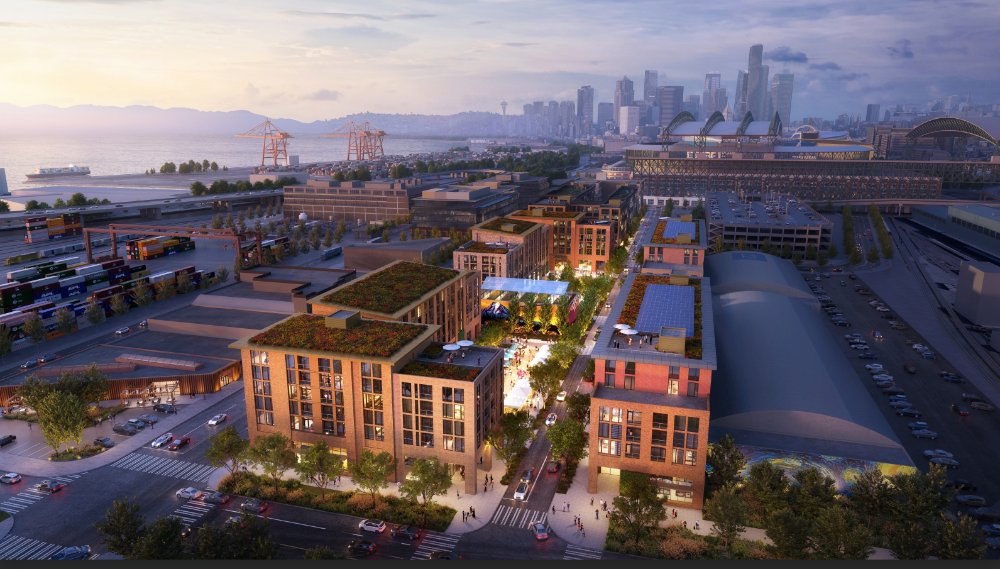

Last year’s bitter battle over former Council President Sara Nelson’s bill to open the area near Seattle’s sports stadiums to residential development ended quietly May 12. The City Council repealed Nelson’s signature initiative, which would have allowed several hundred residences and small business “maker’’ spaces south of T-Mobile Park.
The unanimous vote came after the state’s Growth Management Hearings Board, which enforces compliance with state land-use laws, faulted the ordinance last fall for comprehensive-plan violations and failure to timely submit the legislation for state review. The board ordered the city to revise the ordinance or face financial sanctions.
First-term Councilmember Eddie Lin, the repeal’s sponsor, said last week his measure “is not intended to review previous policy decisions,’’ but argued the city was compelled to act due to threat of state sanctions. He promised to work with supporters and opponents “to find a (land) use that everyone can live with.”
Despite Lin’s hopeful words, repealing the ordinance shows no signs of easing the decades-long conflicts over residential and commercial development near shipping terminals fiercely opposed by the Port of Seattle and longshore labor. Mayor Katie Wilson has already touched off controversy by siding with the Port on draft stadium-area zoning that would bar new housing altogether.
Last year, Nelson had rallied housing advocates and construction-trades interests behind her bill, arguing that residential and limited commercial development would help ease the city’s housing crunch, create jobs, and foster small business. The potential development sites are owned by Chris Hansen, backer of the ill-fated Seattle Sonics arena concept.
The Northwest Seaport Alliance, a joint venture of the Seattle and Tacoma ports, and their longshore allies contended housing would worsen traffic congestion and stall freight movement as they fight to reverse a long-term slide in cargo volume.
Nelson won passage of her measure on a 6-3 vote, but her victory was short-lived. She lost her council seat last November to Dionne Foster, a progressive challenger strongly backed by port interests.
The Stadium Transition Area Overlay District (STAOD), created in 2000, was intended to balance sports uses with adjacent SODO industrial activity. In recent years the stadium authorities that control the T-Mobile ballpark and Lumen Field pushed for changes in the special district to permit entertainment, hotels, and restaurant developments.
Various developers have advanced ideas of converting shipping terminals to convention centers and hotels. But they came up against the Port of Seattle, dockworkers and maritime companies that fear encroachment on scarce industrial lands would push out traditional waterfront businesses.
Adoption of Nelson’s ordinance was a rare defeat for the port interests, but they quickly appealed the action to the state agency and Superior Court. Those lawsuits continue despite the bill’s repeal.
Being out of office six months hasn’t tempered the fiery Nelson. She blames the City Council staff for the procedural missteps, along with the Law Department and her former council colleagues for “carrying the Port’s water” and ignoring her pleas to delay the repeal.
The city could have put a hold on any development plans pending resolution of the appeals, she said. “There was not a need for a repeal,” she said in a recent interview.
“Shame on (the council) for denying up to 1,000 homes, all those jobs and spaces for small businesses,” she said. “We have a housing affordability crisis going on. I just can’t understand.”
Lin, chair of the council’s Land Use Committee, offered to consider new ideas for development near the stadiums without offering any specifics. Council members Rob Saka, Joy Hollingsworth, and Maritza Rivera, who voted for Nelson’s bill last year, all voiced support for considering the issue again.
“I would love to see this proposal brought back,” Rivera said. “I think it’s important for all the partners to work together toward something that everyone can support.”
Saka said he stands by his vote to back Nelson, but he acknowledged the many unresolved conflicts. “There remain pending issues the city will need to confront,” he said.
The wait won’t be long for the next round in the fight.
In the city’s upcoming review of Comprehensive Plan policies this fall, Mayor Wilson’s proposed sub-area plan would ban housing in no uncertain terms.
Draft policies proposed by the city planning office for the Duwamish Manufacturing and Industrial Center, which includes the stadium district, would “encourage a broader mix of uses’’ including hotels in the area, “but do not allow any residential uses and do not amend codes to allow even limited residential uses” near the stadiums.
This position seemingly contradicts Wilson’s all-out push for new housing density everywhere, even in the face of neighborhood concerns about traffic congestion and loss of trees.
One factor may be the remarkably friendly relations between the Port and City Hall since the mayoral and City Council elections, which have been more often strained and contentious in the past. Port Commissioner Toshiko Hasegawa had a seat on Wilson’s transition team.
Since the November elections, “we have seen a truly collaborative spirit with the city,” said Port Commission President Ryan Calkins. “Not only do we want to make sure we address industrial affordability, we also want to make sure workers are able to live in the city where they work. Key staff from the city, the port and other agencies have been working together toward this shared vision.”
The Sound Industrial Alliance, representing the Port, maritime trade organizations and waterfront businesses, is backing the prohibition of residential uses near the stadiums.
“While we acknowledge the urgency of addressing housing affordability, locating housing in industrial areas where there are limited services and significant environmental, safety, and freight conflicts is neither an equitable nor effective approach,” the Alliance said in a letter to the city.
But housing backers – construction, laborers,’ and electricians’ unions, along with the Housing Consortium and the T-Mobile ballpark authority – are fighting to keep residential development options on the table. They cite a 2013 environmental review of development policies that concluded housing would not hamper Port operations, a conclusion the Port didn’t challenge. Then-Mayor Bruce Harrell, however, did not recommend allowing housing in the face of strong Port opposition.
In a recent letter to the city, housing backers insisted the latest draft policies should be revised to encourage retail and entertainment near the stadiums “including lodging and other complementary uses such as residential in targeted circumstances that are compatible with the vision for the stadium district” with measures to protect industrial activities elsewhere in the SODO area.
“We are still hopeful the City will find a pathway to leave the door open for this incredible opportunity that wouldn’t harm the region’s important industrial base,” said Monty Anderson, executive secretary of the Seattle Building and Construction Trades Council.
The coalition members are “still in the process of talking to folks, and seeing what could be salvaged,’’ said Johua Curtis, director of the T-Mobile ballpark district. “It’s not over.”
Discover more from Post Alley
Subscribe to get the latest posts sent to your email.


Nelson was a terrible policymaker. She failed to grasp that the nature of her power was in cultivating relationships and investing considerable time researching the topic at hand. Here, she either failed to understand the Port’s legal rights to land use, or she passed a weak ordinance for political points, knowing it wouldn’t stick.
I know you don’t like Mayor Wilson, but she has shown a willingness to change her mind when new information comes to light. Sure let’s engage with the Port to see what can be done, but the whole thing stinks of ‘how can we score points on the housing crisis without bringing new workforce residents into our existing neighborhoods.”
Two thoughts: (1) if housing is our priority, then the Port needs to back off (but ONLY if that housing is affordable, not market rate)(what are we doing here? we talk about how homelessness and housing are our most important issues but all we end up doing is paying lip service); (2) either state law (the middle housing mandate) means something or it doesn’t; municipalities can’t have it both ways depending on their preferences.
I realize that the Port’s activities are crucial to Seattle’s economy and image–the balancing act is real. However, the plan has ALWAYS been for housing near the stadia–I was chair of the Seattle Planning Commission in the 90s, and that was clearly articulated even before Seattle’s first comprehensive plan under the Growth Management Act. For the Port to complain about that is disingenuous and a straw-man argument: the Port has plenty of other property to deal with and defend–let the stadia property get developed like it is in so many other big cities, with mixed use residential and retail.
C’mon now.
Why must this housing be below market rate? Why put working class families in the middle of an undeveloped neighborhood with few amenities — schools, transportation, grocery stores? Why not go all-in and develop a real neighborhood, set people up for success like the rest of Seattle. I don’t get how or why people go through great lengths to segregate the poor from the affluent, even if dressed up as a noble cause—like letting poor people live in an industrial zone is some sort of gift.
Because market rate housing will simply lead to a version of “LA Live” (and if you’re not familiar with that, check it out). Also, I’m sure the Alliance for Pioneer Square (BIA) would have some things to say about your characterization of that neighborhood–a lot has changed since the 90s. Finally, there are lots of examples of how neighborhoods build with economic diversification, and there’s already high-end (and/or market rate) housing right there. It’s short-sighted to ignore this opportunity.
Nelson’s legislation made a technical change to the “Urban Industrial” land use zone. It removed the requirement that any housing in that zone be at least 200 feet from a designated “Major Truck” street–but only in the Stadium District. This left it vulnerable to being challenged as an illegal “spot” rezone, as it was clearly tied to one project.
A citywide amendment to remove the 200-foot requirement in Urban Industrial zones would have been more legally defensible. However, that would have allowed housing to be built across the street from Nelson’s brewery in Ballard/Fremont (to the north and south).
The UI zones in the 2023 industrial lands legislation (which was the product of YEARS of stakeholdering) were specifically designed FOR housing, 50% of which must be affordable. Harrell’s legislation added the 200 ft rule ONLY for the UI in the Stadium District. By eliminating that requirement and thus RETURNING housing to that UI zone, my 2025 legislation established precisely the zone uniformity you seem to be calling for now.