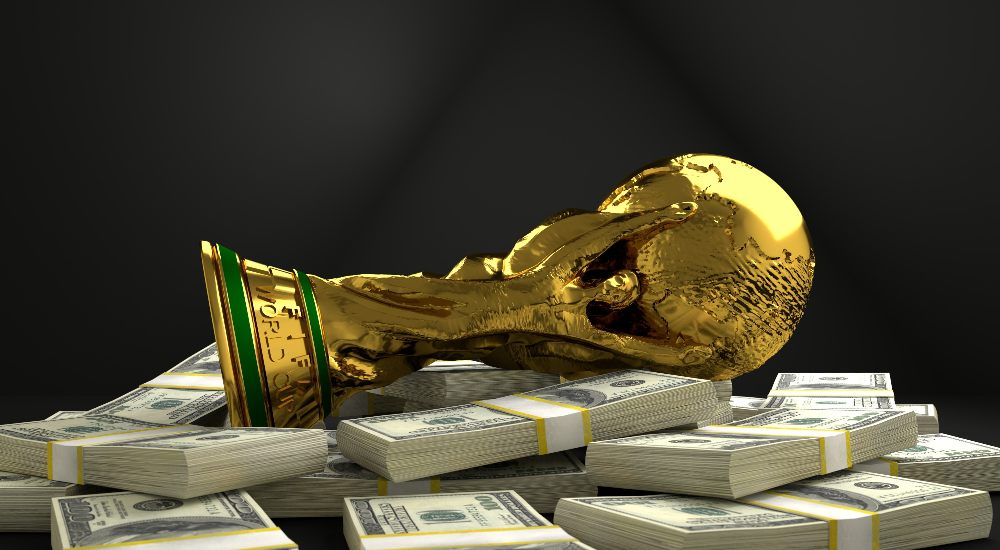

Donald Trump is far and away the most corrupt president in US history. Republican officials still can’t call him that, but polls show that a majority of Americans do. It’s about time, but it’s still only 54% margin according to a new YouGov poll. It ought to be about 80%: unanimous minus 20% for Trump’s mentally imprisoned MAGA followers, who still call him “honest.”
Democrats have been using the ‘c” word for most of Trump’s second term, occasionally (correctly) calling it “blatant.” But something important changed last week with Trump’s Justice Department’s creating an “anti-weaponization” fund designed to offer monetary relief (at taxpayers’ expense) to persons contending they’ve been victims of unfair investigation or prosecution by the Biden administration, including Jan. 6 Capitol riot perpetrators already pardoned by Trump and designated by him as “patriots” or “political prisoners.”
Trump defended the fund saying he “gave up a lot of money” to establish it (after first denying he had any involvement in it). He was referring to a $10 billion lawsuit against the IRS and Treasury Department over a government contractor’s unlawful release of his tax returns (which he promised to release but never has). He was, in effect, suing himself and the judge overseeing the case expressed doubt he could win it.
So he decided to set up the anti-weaponization fund as a “humanitarian” settlement of the case, with an added codicil that he and his sons would never undergo a government audit of their finances or be prosecuted over them. Payouts from the fund will be secret and Acting Attorney General stipulated that Jan. 6 defendants were eligible. Several of them have confirmed they will apply.
Senate Republican Leader John Thune (SD) said he was “not a big fan” of the fund and predicted it would get “a full-on vetting” from Senate appropriators. Former Majority Leader Mitch McConnell (Ky) called it “utterly stupid or morally wrong—you choose.” Sen. Bill Cassidy (R-La), just defeated for re-election when Trump endorsed his primary opponent, said “people are concerned about paying their mortgage or rent, affording groceries and paying for gas, not about putting together a $1.8 billion fund for the President and his allies to pay whomever they wish without precedent or accountability.” And others said that Congress ought to kill it.
The measure caused Senators to leave town without acting on a bill to add $70 billion to the budget to ICE and the Border Patrol, raising its total to $240 billion.
Cassidy raised a good point: what is Trump doing spending $29 billion on a stalemated war, “vanity projects” including a $400 million ballroom replacing the White House East Wing which Trump ordered demolished, plus $1 billion for security upgrades; erecting a 250-foot high T(ri)ump(hal) Arch costing at least $100 million and repainting of the DC Reflecting Pool at $13 million? Some of these projects are supposed to be funded by private donors, but some of the donors will be trying to buy influence with the Trump administration.
At the same time, Trump is proposing cutting the Department of Health and Human Services by $15.8 billion (12.5%), $5 billion from the National Institutes of Health, $985 million from the Centers for Disease Control, $30 billion from Obamacare, at least $20 billion from the SNAP (formerly Food Stamps) program, and Medicaid by $1 trillion over a decade.
Many of these cuts will hit poor Americans: the 43.7 million below the poverty line, and 15-20 million classified as “near poor,” meaning they are one job loss or medical condition away from poverty. According to Gallup, 35% of Americans are “actively worried” about being able to pay their housing costs and 48% say they are worried about paying health care costs. At the same time, families in the top 20% of annual income receive 70% of Trump’s tax cuts.
Forbes and Bloomberg estimated the Trump family’s net worth at $6.5 billion to $7.6 billion in 2024, before his second term. By 2026, it was $10 billion, with 40% of the increase coming from crypto transactions. Such transactions are secret, so they constitute a convenient channel for bribery. Trump forbade the Securities and Exchange Commission from policing the crypto industry.
Just before or after Trump’s inauguration, Tahnoun bin Zayed, a member of the United Arab Emirates ruling family and the UAE’s national security advisor, bought a 49% stake in World Liberty Financial, the Trump family’s crypto conglomerate, for $500 million. Shortly after the investment, the UAE was permitted to buy a large quantity of high-end computer chips from US companies.
The $500 million purchase has raised questions whether Trump violated the Constitution’s Emoluments Clause, which prohibits federal officers, including the President, from accepting anything of value from a foreign government unless Congress authorizes it. However, the clause has never led to charges being filed against anyone.
Trump also got into political trouble for his connections to Changpeng Zhou, the billionaire founder and CEO of Binance, the world’s largest crypto exchange. In November 2023, Zhou pleaded guilty to failing to maintain an effective anti-money laundering program at Binance. As part of a huge settlement, Zhou paid a personal fine of $50 million and stepped down as head of Binance, while that firm paid a staggering penalty of $4.3 billion. He was sentenced to four months in prison.
In October 2025, Trump granted Zhou a full and complete pardon, nullifying his conviction. Trump said he did not know Zhou personally, but that “some very good people” had told him Zhou was treated badly by Biden-era prosecutors.
In fact, World Liberty Finance had close connections to Binance, which donated software to help set up WLF, and a UAE government fund deposited $2 billion in Binance, specifically in WLF, which effectively provided a massive share of the Trump firm’s liquidity.
Although Zhou was not specifically charged with aiding terrorist groups, US officials established that Binance knowingly permitted 1.5 million currency transactions (worth nearly $900 million) that violated US sanctions. This failure allowed groups such as ISIS, Al Queda and Hamas to use Binance to launder millions of dollars for their operations.
Financial reports released by the Office of Government Ethics show that Trump executed 3,642 stock transactions in the first quarter of 2026 (up from 380 in 2025), leading to charges of insider trading and conflicts of interest. Many of the firms involved have business connections with the federal government, have been publicly praised by Trump (sometimes with recommendations to buy their stock) or whose CEOs have had personal contact with Trump. Trump is vulnerable to such suspicions because he has broken with the presidential tradition of putting their financial affairs in a blind trust.
The disclosures show a high volume of trades with companies whose CEOs accompanied Trump to China, including Nvidia’s Jensen Huang. Trump bought $500,000 in shares Jan. 6, a week before the federal government approved sale of the firm’s H200 chips to China. Similarly with Apple’s Tim Cook and Tesla’s Elon Musk: both their companies experienced high volumes of Trump purchases in Q1.
Trump also made trades shortly before or after making site visits to companies’ headquarters. With Thermo Fisher Scientific, Micron Technologies and Dell Technologies, Trump lavishly praised the companies and touted them as “hot companies” or recommended buying their products shortly before or after buying as much as $1 million to $5 million of their stock. Trump similarly lauded Palantir Technologies a month after praising its battlefield effectiveness and even repeated its ticker symbol in his remarks.
Trump also purchased Boeing stock worth $1 million and $5 million around the time China agreed to buy 200 jets from the company. Other major trades involved companies with close ties to the government, either large contractors or subject to federal regulation like Microsoft, Amazon and Meta. Trump spokespersons including his son, Eric, and Vice President Vance, deny that Trump personally picks stocks to buy or sell, leaving that to independent brokers.
And critics like the Campaign Legal Center and the Cato Institute accuse Trump of “selling” pardons for campaign cash or political favors. In early 2025, Trump fired the head of the Justice Department’s Pardon Office, Liz Oyer, replacing her with a Trump loyalist, Ed Martin. Oyer said afterward that the Trump administration was mired in “ongoing corruption.” His pardons often were promoted by highly paid lobbyists and accompanied by recipients’ being freed from paying restitution to their victims.
One recipient was Trevor Martin, convicted of securities fraud, sentenced to four years in prison and ordered to pay restitution of $660 million to defrauded victims. Before receiving a full presidential pardon that also freed him from paying restitution, Martin contributed $1.8 million to Trump’s campaign war chest.
Another was nursing home operator Joseph Schwartz, convicted of a $38 million payroll tax scheme. He served just four months in prison before receiving a pardon. The case developed a darker side when Schwartz’s lobbyist, Josh Nass, was indicted for extortion. He allegedly hired a convicted racketeer to kidnap or assault Schwartz’s son over an unpaid $500,000 “success fee” for obtaining Schwartz’s pardon. The case is still pending.
Trump’s approval ratings have descended to the lowest levels of his second term—34% to 38% in three major polls, with disapproval at 58% to 64%, the gap as wide as Joe Biden’s worst and close to any president’s at this stage of his presidency since 1977. The generic Congressional poll favors Democrats by six or seven points, historically presaging a “wave” election.
Trump is trying any number of strategies to steal the midterms—taking authority for running elections away from the states and giving it to the federal government, then establishing rules making it harder for minorities and the aged to register and vote and possibly enlisting pardoned and paid Jan. 6 defendants and/or ICE to attack or intimidate voters.
He knows that if Democrats take the House, he’ll certainly be impeached a third time. The articles of impeachment ought to begin with “rampant corruption.”
Discover more from Post Alley
Subscribe to get the latest posts sent to your email.


I get why you call it “monetary relief.” But “relief” from what? The J-6ers are not victims; that is Trump’s framing. They are perpetrators, just like he is. Better to call these “payoffs,” even “bribes,” maybe “down payments for future services rendered.” Still, great column. Thanks.