
On June 26, the Presidential Religious Liberty Commission released its draft report, a 224-page document timed to coincide with the nation’s 250th anniversary of independence. The commission, established by executive order on May 1, 2025, was charged with examining the foundations of religious liberty in America and recommending policies to protect it.
Commission chairman Dan Patrick, the Texas lieutenant governor, told the commission’s final hearing in April that the language of the First Amendment which requires that “Congress shall make no law respecting an establishment of religion, or prohibiting the free exercise thereof” does not mandate the separation of church and state. A single paragraph near the conclusion of the report offers the most revealing insight into the commission’s focus.
“The concept of a ‘wall of separation between church and state’ can wrongly imply that church and state are opposed to one another and must remain completely separate. In reality, however, church and state strengthen and support one another. Perhaps a better analogy is that religious liberty acts as a bridge between church and state.”
Read that again slowly. A commission called the Religious Liberty Commission has just redefined religious liberty to mean the opposite of what the term has meant for more than a century. The wall comes down. The bridge goes up. And the change is presented not as a radical departure but as a friendly clarification.
The Trump administration has found yet another rhetorical device for advancing an agenda that aligns with Christian Nationalism: not abandoning the language of American civic values, but quietly emptying it and refilling it with different contents.
To understand what has been lost, it helps to know the history of the term.
The modern American religious liberty movement was not built by the powerful seeking more room to operate. It was built by the vulnerable seeking protection from government-imposed religion. And its primary architects, largely forgotten in mainstream histories, were Seventh-day Adventists.
In the 1880s, Sabbath-keeping Adventists were being jailed under state Sunday closing laws — laws that mandated rest on the day most Christians worship and effectively penalized anyone whose faith required a different day. The church’s response was to build an advocacy infrastructure specifically designed to keep government out of religious practice entirely. In 1889, Adventist minister Alonzo Jones testified before the Senate against the Blair Sunday Rest Bill, which would have imposed a federally sanctioned day of rest. Jones’s argument was precise: it didn’t matter that the bill would benefit most Americans. Government endorsement of any religious observance, however popular, was a threat to everyone’s conscience.
That testimony helped defeat the bill. The advocacy organization the church founded around that fight eventually became the International Religious Liberty Association, now an independent, non-sectarian organization that works globally for freedom of religion for all people, regardless of faith. The church’s magazine on the subject, launched in 1906 and still published today, is called simply Liberty: A Magazine of Religious Freedom.
I was raised in the Seventh-day Adventist tradition, though I am no longer active. That background is why the commission’s report landed on me with particular force.
Ben Carson, former Secretary of Housing and Urban Development and a self-declared Seventh-day Adventist, served as vice chair of the commission. His presence gave the body a veneer of minority-faith inclusion. The commission itself was dominated by right-wing evangelicals and conservative Catholics, with a single Jewish member — a composition so skewed that a coalition of multifaith organizations sued the Trump administration in February 2026, arguing the commission violated federal advisory committee law by failing to represent the diversity of American religious life. Muslims, Hindus, Sikhs, Buddhists, and other faith communities were entirely absent.
Carson has publicly stated that “separation of church and state means that the church does not dominate the state and it means that the state does not dominate the church.” While that language could suggest a wall between the two, he went on to say that the church and state can “work together to promote godly principles” — a relationship that sounds more like a bridge.
The North American Division of Seventh-day Adventists, the church’s administrative body for the United States and Canada, sees it differently. In January 2026, the NAD’s Public Affairs and Religious Liberty department issued a formal statement opposing a Heritage Foundation proposal for a national Sunday rest law, calling it “a dangerous desire to use state power to advance religious objectives” and warning that it showed “a disturbing disregard for the religious freedom of all Americans.” The church has opposed any government endorsement of religious observance for more than 160 years, and its reasons have not changed: when the government picks a winner among religious practices, minority faiths lose.
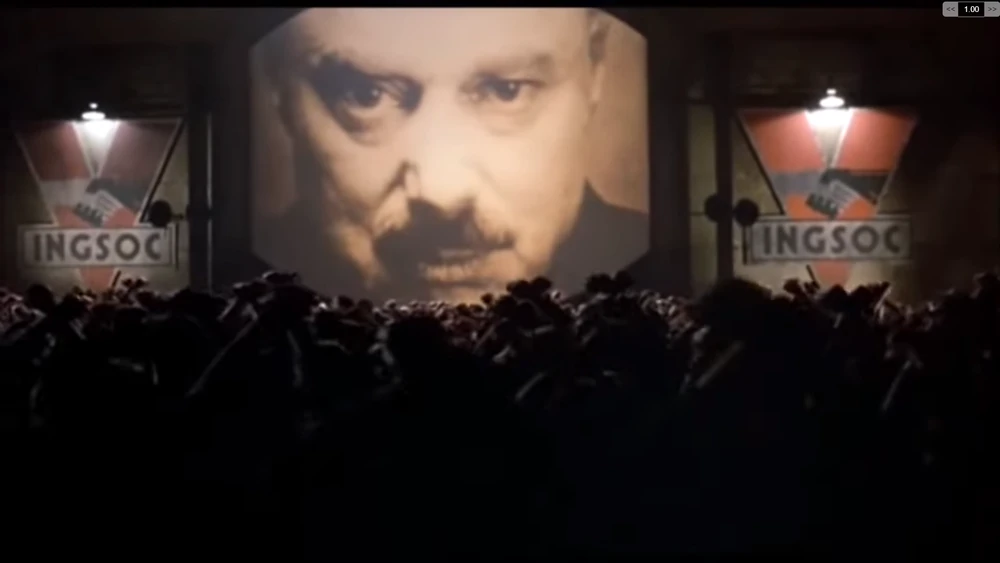
The commission has adopted a technique George Orwell identified in his 1946 essay “Politics and the English Language” — using reassuring words to make policies that might otherwise face resistance seem natural, inevitable, even benevolent. The wall of separation becomes adversarial, divisive, hostile to cooperation. The bridge becomes open, connecting, positive.
The practical stakes are concrete. If the commission’s framework is adopted — if religious liberty comes to mean government support for religion rather than government neutrality toward it — the legal protections that minority faiths have relied upon for generations may disappear.
The constitutional prohibition against “establishment of religion” is not being challenged directly. What’s new is that the government is now using its institutional weight to change long-established norms of what that language means.
When a term built to protect the minority is successfully redefined to serve the majority, the question worth asking is simple: what word is left for the original idea?
Discover more from Post Alley
Subscribe to get the latest posts sent to your email.


I so enjoyed this article. The kidnapping of our religious freedom by what seems like a conspiracy of Christian Evangelicals is scary indeed. And I loved the author’s reference to one of my favorite all time essays, by George Orwell.
Excellent article. Should be read in schools
Wow! Very insightful, albeit alarming. Thank you for writing this Sally!
A well reasoned article about the slippery power of words. Destruction can sometimes take place without a sword.
Thank you Sally, for pointing out the inconsistency and trickery of the language in the recommendations of the so called “Religious Liberty” Commission and its leadership. The church has never needed the support of the state in its work of encouraging the faithful, except for state provisions of justice and protection of liberty of conscience for everyone. And the state is best served by independent and moral thinkers. The wall should be strengthened, not bridged.
The idea of separation of Church and State has an older history. Roger Williams, founder of Rhode Island, first used the metaphor of a “wall of separation” in his 1644 book, ‘The Bloudy Tenent of Persecution for Cause of Conscience’. His opinion was that an authentic Christian church would be possible only if there was “a wall or hedge of separation” between the “wilderness of the world” and “the garden of the church.” Williams believed that any government involvement in the church would corrupt the church.
The most famous use of the metaphor was by Thomas Jefferson in his 1802 letter to the Danbury Baptist Association. In it, Jefferson declared that when the American people adopted the establishment clause they built a “wall of separation between the church and state.”
Religious liberty is like the tap root of our nation. From Thomas Kidd’s article on the 18th C Great Awakening: “The drive for religious liberty against a tyrannical religious authority fed into the movement for civil liberty against the unjust political authority of the British in the 1770s. Likewise, the evangelical teaching that each individual believer was equal before God made it easier for people to accept the radical implications of democracy and to question authority. “