
I was at this local wine-tasting thing in my small community of the Key Peninsula the other day when the subject of politics came up. Seems to happen whenever enough wine has been tasted anywhere these days.
After some verbal shoving matches, someone declared they would not vote in the mid-term elections. “A pox on both your parties,” or some such.
One among us said she’d recently completed a solo motorcycle trip from Maine to Texas and commented on how odd it was to visit 13 states with cities called Fayetteville or Lafayette. The country might not be united, she said, but all those cities and towns with the same name — that meant something, didn’t it?
I knew the answer from my seventh-grade history class.
In August 1775, a teenage Marquis de Lafayette attended a dinner party in Paris with the Duke of Gloucester, younger brother of King George III. The duke disagreed with his government’s policies in the colonies and praised the Americans’ display of courage at Lexington and Concord the previous April. The 17-year-old Lafayette was astonished by these words from the royal family of his country’s traditional enemy.
“From that hour,” he wrote, “I could think of nothing but this enterprise, and I resolved to go.”
Marie-Joseph-Paul-Yves-Roch-Gilbert du Motier, Marquis de Lafayette, was born in 1757 to a martial family whose antecedents had fought in the Crusades and alongside Joan of Arc. He wrote in his autobiography, “I was baptized like a Spaniard, with the name of every conceivable saint who might offer me protection in battle.”
The young marquis defied the orders of King Louis XVI and sailed to America in 1777. He was a musketeer and an officer, but also an aristocratic teenager who spoke little English and had never been in battle. Nevertheless, Congress gave him a commission as a major general in the Continental Army on July 31 because it was thought he would serve as a valuable figurehead — and because he offered to serve without pay.
Lafayette was shot through the calf in his first engagement at the Battle of Brandywine Creek Sept. 11, the largest and longest single-day fight of the war. But he held his position and kept his head, preventing a rout as the army retreated to Philadelphia. As a reward, General George Washington gave the 19-year-old his own command. They remained friends for life.
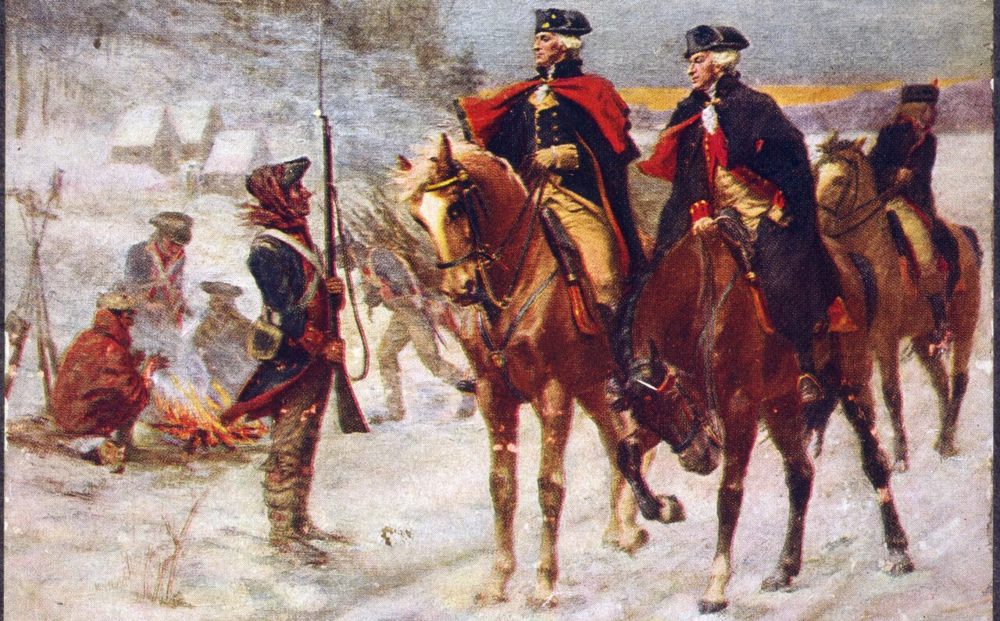
Lafayette fought in some of the most historic battles in American history and survived the long winter in Valley Forge. He returned to France in 1779 to lobby the king for more French support for the American cause and was immediately arrested. He was also hailed as a hero and released just eight days later. Working with his friend, the de facto ambassador Benjamin Franklin, Lafayette secured the promise of 6,000 more soldiers to be sent to America, and he returned to the fight himself in 1780 at the nadir of the war. He was 23 years old.
On Oct. 14, 1781, Lafayette led 400 men with Alexander Hamilton’s forces in an attack on two strategic outposts in hand-to-hand combat at Yorktown, successfully breaking the British defense line. General Cornwallis surrendered Oct. 19, ending the war.
Lafayette returned to France and joined a national assembly created to respond to rising social tensions. He argued that the group was not truly representative and, on July 1, 1789, presented a draft of the Declaration of the Rights of Man and of the Citizen, written with the help of the U.S. Minister to France, Thomas Jefferson. Lafayette’s work was later enshrined in the French Constitution. But the royalists blocked his efforts and those of his fellow reformers. Riots broke out, and the Bastille was stormed on July 14.
Lafayette remained a moderate throughout the French Revolution but was swept up in the new government’s Reign of Terror that followed and spent five years in prison. Though released by Napoleon Bonaparte in 1797, Lafayette refused to swear his allegiance to a dictator. Napoleon responded by confiscating Lafayette’s remaining properties, leaving him destitute. Napoleon abdicated as emperor in 1814, and Lafayette became a member of the Chamber of Deputies, a position he held for the rest of his life.
In 1824, to celebrate the approaching 50th anniversary of the Declaration of Independence, President James Monroe invited Lafayette to the United States as the nation’s guest. When he landed in New York City, 50,000 people — one-third of the city’s population — were waiting for him. The celebration lasted four days. He visited all 24 states; his route was lined with people who wanted to meet the last living Revolutionary War general. Wherever he went, the map changed in his wake. Towns changed their name in his honor; parents named their children after him. He returned to Massachusetts in June 1825 to lay the cornerstone of the Bunker Hill Monument and filled a barrel with earth from the battlefield to take home to France.
When Lafayette died in 1834 at the age of 74, his eldest son, Georges Washington de Lafayette, emptied the barrel from Bunker Hill over his father’s coffin, fulfilling his wish to be buried in American soil. The American flag still flies over his tomb in Paris. It even remained there during the Nazi Occupation in World War II. The flag is ceremoniously replaced once a year, on July 4.
In 2002, Lafayette became the sixth of just eight foreign nationals in our history to be made an honorary U.S. citizen by Congress. Living honorary citizens do not have the right to vote, but were he alive today, I believe Lafayette would insist on it.
First published in the Key Peninsula News.
Discover more from Post Alley
Subscribe to get the latest posts sent to your email.


Nice piece.
What a lovely retelling!
Wonderful article. I don’t believe this was taught in my seventh grade history class (or perhaps I just wasn’t paying attention). Thank you.
Well written.
Merci bien pour votre article. Lafayette was the scion of France’s ancien regime. His contributions to our infant nation at that moment of revolution in the 18th Century remain of extraordinary note. He later narrowly escaped execution in the anti-monarchical revolution in his own land. And returned in old age to visit the U.S., feted in all directions.
The 1776 aristocratic Britain (and its Germanic monarch) he confronted was struggling with its own effort to find a better way to govern – not rule. Vive Lafayette et son cadeau – notre victoire.
Was exchanging texts with a friend in France, commenting on a statue of Lafayette and Washington in Paris’s 16th arrondissement; he promised we’d go see it someday…and then reminded me that that Statue of Liberty was a gift from France. Vive La France! Long live the United States!