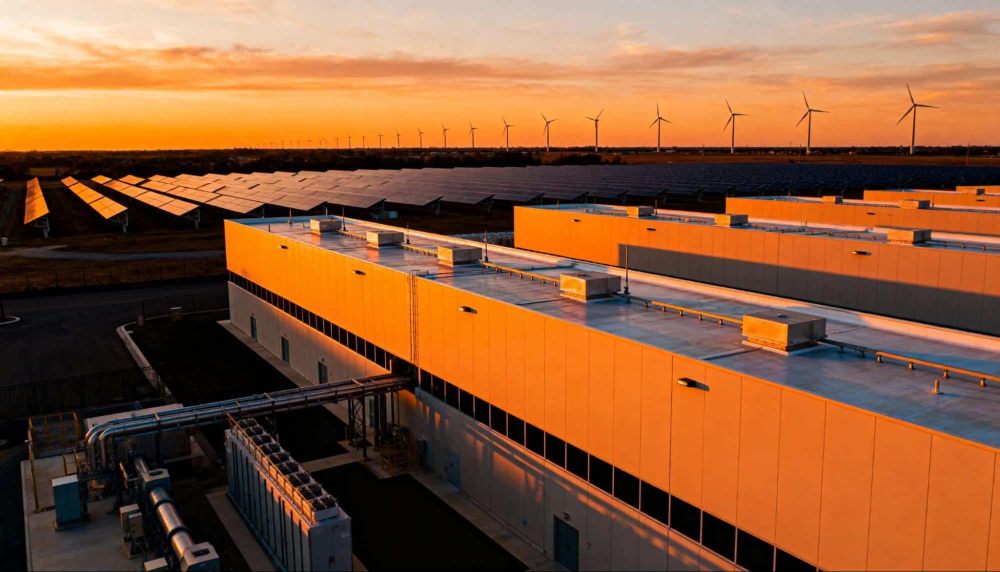

Tom Corddry’s recent two-part series in Post Alley, “Datacenters over America,” described the impacts that come up most often in the argument over data centers: electricity demand, water, noise, and land. On cooling, it described radiators, liquid cooling, and the possibility of moving heat into a large cold body of water such as Puget Sound.
Those are all ways to get rid of heat. I have spent the past several months looking at what else could be done with it.
I have long been fascinated by AI and what it could make possible. As AI has advanced, I have also noticed growing attention to the environmental and economic impacts of the data centers that power it, including here in Washington.
Lawmakers have focused on electricity rates, grid capacity, water, clean energy, Tribal resources, and community impacts. House Bill 2515, a major data center proposal, passed the House but did not receive final Senate passage before this year’s session ended.
As I learned more, one question kept coming back: if data center servers produce heat, why not put that heat to work rather than simply treating it as waste? That question is not prominent in the state’s formal policy discussion. The phrase “waste heat” does not appear in the Data Center Workgroup’s preliminary report.
The answer is not simple, but it is worth exploring because data centers are already part of Washington. One industry directory currently identifies more than 100 facilities in the state, while another reports five under construction in Quincy alone. Whatever Washington decides, many will keep operating around the clock.
Projects overseas have shown waste heat reuse is feasible. In Odense, Denmark, Meta and the local utility recover data center heat for district heating. Washington does not have the same network of heating pipes, so we need approaches designed for our own communities and industries.
Heat is difficult and expensive to move over long distances, but the value created from that heat can travel. A greenhouse, food processor, aquaculture operation, or drying facility near a data center could use recovered heat to make products. The nearby business could support permanent jobs.
In Central Washington, Grant County and City of Quincy planning records show 33 parcels within about six-tenths of a mile of four mapped data center locations around Quincy’s M Street cluster.
That number looked promising, but proximity alone says little. Some land may already be committed to buildings, substations, stormwater systems, or expansion. Public data do not show heat temperature, infrastructure cost, or partner interest. Among the existing businesses I could verify as possible heat users, none was within about 1.2 miles; the closest was roughly 2.6 to 2.8 miles away. That shifted my focus from piping heat to a distant user toward locating a compatible business near the heat source.
Seattle already has working examples. Since 2016, the Westin Building has sent data center heat across Sixth Avenue to Amazon’s campus. An engineering case study says the system can transfer up to five megawatts. It calls the project a “win-win” because Amazon uses less energy for heating, while the Westin earns revenue and lowers cooling costs. Seattle Resolution 31544 gave conceptual approval for pipes beneath public streets.
The University of Washington offers another path. Its UW Tower Energy Improvement Project included design, permitting, and equipment to move data center heat into the office tower. Heat-recovery chillers would replace inefficient electric boilers, with new controls and possible heat storage. Together, Westin and UW show that urban heat reuse can work when the heat source, user, route, building systems, permits, and costs line up.
Quincy and Seattle point to the same lesson: no one model fits every site. Rural clusters may suit agriculture or industry; urban facilities may connect with nearby buildings. New facilities can preserve reuse options in their designs, while existing facilities may offer opportunities during equipment up-grades or nearby development. The goal is to find places where the heat, a nearby user and the economics align.
The Westin project also shows the limits. Data center heat is usually between 77 and 104 degrees Fahrenheit, although some systems produce hotter water. Heat pumps can raise the temperature, but they add cost and complexity. The Westin has a short route and a large customer. Even so, it cost more at the beginning and still rejects heat when Amazon does not need it, especially in summer. Full cooling capacity is still necessary.
Other businesses and public facilities may need heat throughout the year. The U.S. Department of Energy identifies drying and lower-temperature food processing as possible uses. Wastewater plants may be another option. An EPA case study describes a digester kept at 95 to 105 degrees. A 2026 study examined using data center heat to keep treatment tanks warm and dry the solids left after treatment. Whether another project works will depend on temperature, distance, year-round demand, ownership, permits, and cost.
These examples support a practical, site-by-site approach. Utilities and economic-development groups can bring operators, communities, and potential heat users together around existing facilities. For proposed facilities, that review could become part of utility planning, development review, or an application for a tax preference. In findings accompanying Washington’s data center tax-preference law, the Legislature encouraged environmental stewardship through practices including redirecting waste heat and industrial symbiosis.
There is no general answer to the main obstacle: How much will reuse cost, and who will pay? A site review should compare possible energy savings, productive output, and local jobs with construction and operating costs. Where the public benefits are strong but a financing gap remains, a targeted tax incentive tied to actual investment and measurable results could bring operators and heat users together.
Data centers are rightly under scrutiny. Waste heat reuse can add something practical to that debate: useful energy, local work, and more value from infrastructure Washington already has. Preserving reuse options in new designs, and exploring retrofits at facilities already running, would be a constructive place to start.
Aaron Wang is a rising junior at Skyline High School in Sammamish researching how data center waste heat could create practical local economic and environmental value in Washington. His sources and analysis are posted at aaronw6489.github.io/washington-data-center-heat.
Discover more from Post Alley
Subscribe to get the latest posts sent to your email.


Good article, Aaron. Keep thinking about turning liabilities into assets. In terms of distributive heat, there is the example of Seattle Steam downtown. But so far, the extra heat from data centers is just dumped in the atmosphere, the same as using carbon based fuels. Economists refer that as an externality, meaning that the cost is just borne by the planet.
Data centers that produce their own electricity by burning natural gas are a double hit on the planet, first by burning gas and then by needing to cool the computers. All this with global warming. Please, get to work!
Thank you for researching this, Aaron. There’s plenty of growing room for you and plenty of need for innovation in this field.
Excellent thinking, Aaron. I hope you are able to keep digging on this topic.
ICYMI, Here’s a pretty good resource: https://www.sciencedirect.com/science/article/pii/S1364032123006342
And thanks for the shout-out!