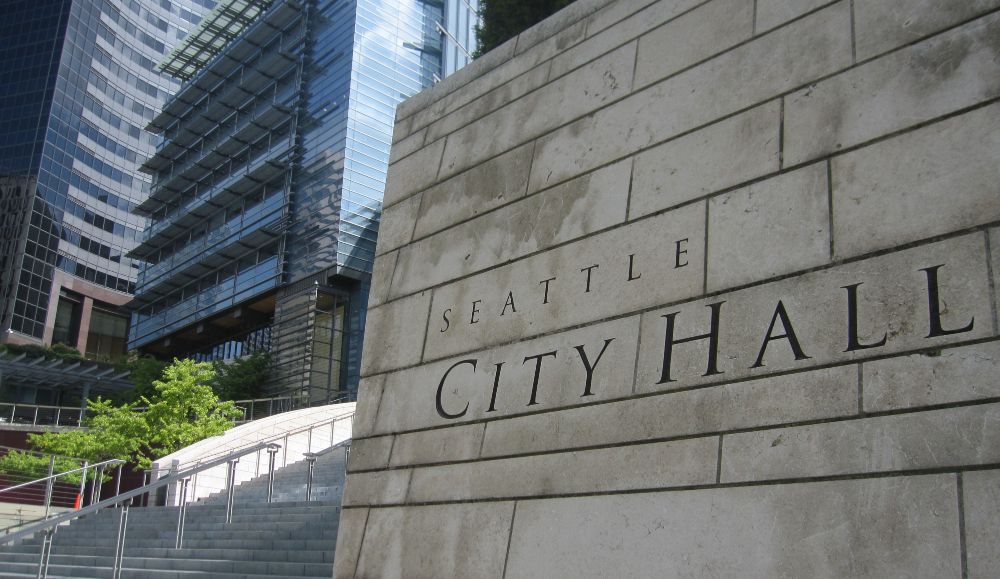

Last week, Mayor Katie Wilson sent her proposed 2027-2028 budget to the City Council for consideration. It included no new or increased taxes, a move that surprised many, since she campaigned last year for higher revenue.
The mayor presented her budget as a prudent approach that, through 2030, eliminates the annual deficit the city’s general fund has faced since the COVID-19 pandemic. (Read the mayor’s budget address, watch the video of the address, and review the budget documents provided to the City Council.)
Now it’s the City Council’s turn to weigh in. Here are some observations on public safety and social services that I believe the Council should consider.
Doing the Most Good by Doing it Right
We should rigorously follow the evidence on what works, even when it comes from another city. This is especially true for social services and violence-reduction efforts, where evidence abounds. We don’t have to start from scratch.
When implementing a research-based program, we should rigorously follow the methods and protocols that produced its success elsewhere. Deviating from proven methods will change outcomes. That’s why experienced, program-specific managers who know how to measure outcomes are essential.
We should never allow a siloed approach to a problem; it guarantees failure. Social service and community safety programs need cooperation, clear, measurable outcomes, and evidence of success. Integration of effort and collaboration should be required, not optional.
Improving Community Safety Through Proven Strategies
Mitigating gun violence, ensuring accountability for offenders, and addressing the needs at the locations where such incidents occur are highly challenging tasks. These efforts require proven, research-based strategies, dedicated staff, and close collaboration among police, prosecutors, public health and social service workers, and the residents and workers near the violence.
A highly collaborative, holistic approach to crime prevention boosts effectiveness and improves lives in areas where crime concentrates. These micro places aren’t just crime hot spots — they’re also areas of social and physical disorder, fear, and health challenges. Police alone can’t solve crime problems in specific places; it takes an approach that integrates police with other government services, such as public health and social services. Despite well-intentioned efforts, without cooperative integration, crime cycles will repeat.
A place-based, frequent-offender focus is essential. Groundbreaking research by David Weisburd and his colleagues in Seattle over a 13-year period (1989 to 2002) found that 50% of reported crime occurred on just 4.5% of the city’s 25,000 street segments, establishing the law of crime concentration. A similar pattern likely holds for the people responsible for concentrated crime, and it follows the business community’s 80:20 rule: the most destructive harm is caused by very few people. When attempting to reduce violence, we must focus on the places where it is concentrated and on the few people responsible.
The week before she sent her proposed 2027-2028 budget to the City Council, the mayor announced a new approach to reducing gun violence and shifting responsibility for coordinating those efforts from the city’s Human Services Department to the Community Assisted Response and Engagement Department (CARE). That’s a structural shift, but what’s needed is a hard look at how the city approaches gun violence, including the city-hired contractors who receive little direction, face no accountability standards, and have limited integration with the police. We should adopt successful programs from other cities, such as those used by the National Network for Safe Communities (NNSC), whose focused deterrence approach is a proven, research-based strategy that emphasizes collaboration among everyone involved.
Physical Environment Improvements to Reduce Crime
Another effective and relatively inexpensive way to reduce crime in specific locations is to modify the physical environment. Research shows that cleaning up trash, trimming overgrowth, converting abandoned lots into gardens or mini-parks, removing structures that conceal illegal activity, and increasing lighting all reduce crime. We should be more assertive in improving the physical environment where crime is concentrated.
Seattle has implemented lighting improvements at City Hall Park, on Third Avenue near Virginia Street, along the Bell Street Parkway in Belltown, in the Chinatown-International District, and in part of the Capitol Hill nightlife district. The Third Avenue lighting was originally designed to extend south to Yesler Way; that stretch should be completed. (See “A Cheap Fix for Urban Crime” by Elisabeth Glazer in The Atlantic.)
Police Department Staffing Levels
No national standards specify how many officers a city needs. Determining the right number requires assessing 911 call volume, call types, geography, and response times to Priority 1 incidents (imminent life-threatening danger, serious injuries, or extreme risks), as well as whether the “rule of 60%” is met: 60% of all officers are assigned to patrol functions, and those officers spend no more than 60% of their time on 911 dispatches, leaving 40% for proactive, community-focused policing. Seattle’s police service does not meet the 60% rule or the Priority 1 response goal in each precinct because we are short by hundreds of officers.
Police staffing directly affects how quickly officers can arrive at the most dangerous incidents and whether investigators can solve crimes and hold people accountable.
The police department has a seven-minute median response-time goal for Priority 1 dispatches. Through June of this year, this goal was met in the East (5:30 minutes) and West (5:54 minutes) precincts but not in the North (8:36 minutes), South (7:18 minutes), or Southwest (8:00 minutes) precincts.
Consider the North Precinct’s median response time for Priority 1 dispatches. The precinct doesn’t meet the seven-minute goal, and half of responses took longer than eight minutes and 36 seconds. The North Precinct is nearly twice as large as the city’s other police precincts in square miles and nearly three times in population. If it were a separate city, it would be Washington’s second largest by population.
SPD’s response time clock starts when a dispatcher receives incident details, not when the 911 call comes in — the call-taking process typically adds nearly another minute. SPD should measure response time from the initial 911 call, so the metric better reflects what the public experiences.
While comparing crime rates and officer staffing with other cities has real limits, given how different each city’s circumstances are, it still offers useful context and shows historical trends. You can review this post to see how Seattle’s crime rates stack up against the West Coast Seven cities that Seattle has historically used in collective bargaining, which were chosen decades ago for their similar policing environments.
The following chart shows the number of police officers per 1,000 residents in each West Coast city, including Seattle, as well as officers per square mile. There is no standard rule for how many officers a city needs, but the chart provides useful context and a historical trend line.

Past assessments have indicated that Seattle needs nearly 1,400 officers, a ratio of 1.8 per 1,000 residents, very similar to the 2019 ratio before the pandemic and the mass officer departures that followed the turmoil after George Floyd’s killing in Minneapolis.
The mayor’s proposed budget assumes a police service of 1,250 funded officer positions. With too few officers, response times slow, detectives lack capacity for follow-up, and minor crimes—especially property crimes—receive little attention.
Fire Department Staffing
A quick comment on fire department staffing. The mayor’s budget cuts funding for fire department overtime. Seattle’s fire department needs 222 firefighters on duty at any given time to staff each engine, ladder truck, medical unit, and the specialty units that respond to hazardous spills and trapped persons. When all 222 aren’t available, overtime covers the shortfall. Reducing overtime funding risks brownouts, leaving units unstaffed and slowing response times. The Council should weigh that risk carefully. As with police officers, Seattle residents, workers, students, and visitors deserve a timely response when they need a firefighter.
The mayor’s proposed budget covers far more than public safety and related social services. However, community safety is a top priority for any major city, and how the mayor and City Council respond will directly affect Seattle residents’ quality of life. It will also define their tenure in office.
Discover more from Post Alley
Subscribe to get the latest posts sent to your email.