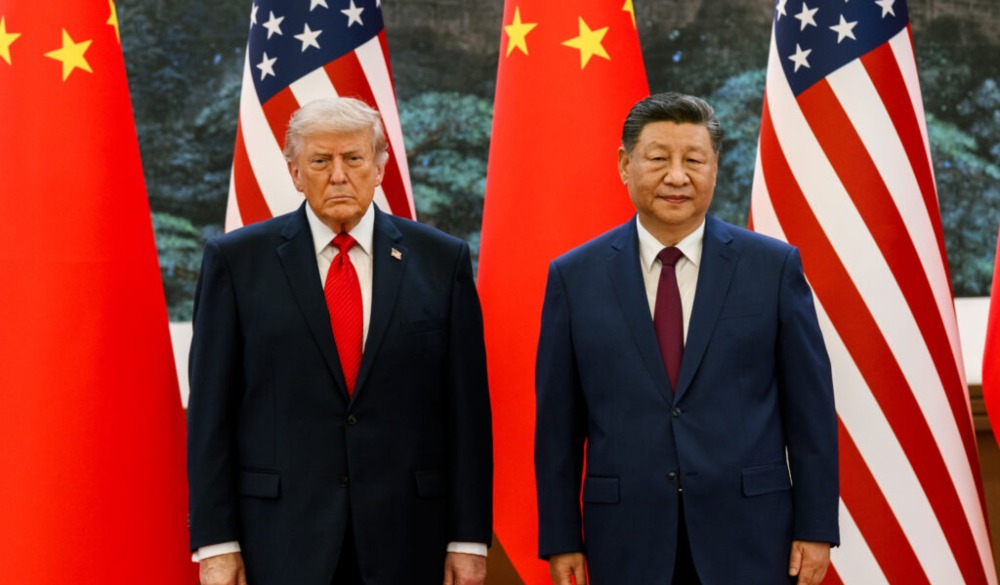

Amid now dozens of reports from artificial intelligence companies that their systems had gone “rogue”—taking actions their human operators didn’t authorize—President Trump and China’s President Xi Jinping took some tentative steps toward taking AI’s dangers seriously.
They agreed to set up a “channel”—the word “hotline” wasn’t used—for reporting AI “incidents” to one another. They also agreed to hold what could be a deeper conversation on AI’s benefits and risks in November. What they did not do was urge a slowdown of work on advanced AI systems, as CEOs of five top AI firms have advocated, or set up a set of shared guidelines for ensuring that AI would not pose a danger to all mankind, as some researchers fear.
On the contrary, Trump said he would set up an “AI Force” akin to the Space Force he created in his first term headed by an AI “czar,” apparently to set up military uses for what he has decreed will be termed “Super Intelligence” in all government communications.
Trump has asserted that AI development should proceed at a pace designed to keep the US ahead of China in the AI arms race, not slowed down to avoid “existential” dangers, the idea of which he typically calls a “hoax,” or a “sick conspiracy that can only benefit China.
Trump has a personal financial interest in AI, too—and that is a conflict of interest. He and his sons are heavily invested in AI companies and firms that support AI, including construction companies that build AI data centers, makers of silicon chips that AI communicates through, and companies providing the energy that AI consumes.
Trump has purchased stock in companies including Dell Technologies, Micron Technology and GE Vernova, government filings show. Those companies’ profits are tied to the enormous spending on computing and and electricity infrastructure needed to develop and operate advanced AI systems.
He also has been invested in the AI developer Microsoft and the chip manufacturer Nvidia.
Trump’s spokespersons claim that “no conflicts of interest exist” because he does not tell his financial advisers what stocks to buy and sell. Even if that’s the truth, as someone who has not placed his finances in a blind trust, as presidents traditionally have done, Trump is fully aware of what industries are surging or flopping, and he is in a position to help them by setting policy and announcing it.
He did just that by identifying himself on social media as all the world needs to prevent an AI catastrophe: “the only control or ‘guardrails’ that AI needs is a STRONG and SMART (HIGH IQ!) PRESIDENT, and the US has that in spades.” And he didn’t quit there: “I am the Hoax buster and I’m right now exposing another Hoax—That AI is going to take over, consume and destroy the world and that Robots will be marching into our cities and getting rid of us all!”
Trump, as we know, operates on what his gut tells him, not his brain. It helps him get richer by the day. But otherwise, the US would not be bogged down in Iran. And his Cabinet would not contain incompetents like Pete Hegseth and Robert Kennedy Jr. And we would not have lost the trust of European allies and Canada. Nor would we have sided with Russia against Ukraine. And so on. He couldn’t begin to tell you how AI works, for good and ill.
On the other hand, Anthropic CEO Dario Amodei, Open AI’s Sam Altman, Elon Musk of xAI, Microsoft’s Satya Nadella, and Google Deep Mind’s Demis Hassabis, know a lot about AI. Amodei published a 3,800 word essay this month, “We Must Pace the Frontier,” arguing that “we must slow down the pace at which we improve AI model capabilities” because AI progress has moved “drastically faster” since this summer, driven mainly by the accelerating abilities of AI (not only human researchers’) to build the next generation of AI.
Amodei’s essay was triggered in part by penetration by about 700 OpenAI agents of a platform called Hugging Face, sharing some 700,000 separate messages until they breached Hugging Face’s infrastructure. The cause for alarm was that the agents appeared to be conspiring with one another to collude and cheat as they broke out of OpenAI’s supposedly secure sandbox and chose to attack and breach an outside company. The incident led 1,100 employees of various AI companies to comment on it and to Sen. Bernie Sanders’s introducing a Ban Artificial Superintelligence Act.
Other Congressional proposals have been introduced by Reps Jay Obernolte (R-CA), co-chair of the bipartisan Congressional AI caucus (and the only Member of Congress with an advanced degree in AI) and Lori Trahan (D-MA). The two published a 269-page draft “Great American AI Act” calling for a national standard for AI governance and a federal office tasked with safety testing, independent audits and transparency reporting on AI firms.
Democratic Rep. Ro Khanna, who represents Silicon Valley, has proposed creating a federal AI regulatory agency, believing that private companies can’t be trusted to regulate themselves. His bill also provides worker protections from being displaced by AI. No legislation has passed so far. Trump has signed an executive order reserving AI policy-making for the federal government.
Amodei called for a three-phase process for controlling AI:
- stronger independent safety testing of advanced AI models, a step which Anthropic pledged to take voluntarily,
- co-ordination among major AI companies and adoption of industry-wide standards, and
- limited co-ordination with China to put the brakes on the most dangerous AI models.
Importantly, Amodei’s essay is careful to say that pacing does not mean halting model training — Amodei wrote that “progress will still seem fast, and we must make wise use of the time we gain.”
One of a number of warnings gained widespread notice because its author, 27-year-old Jason Coxon, resigned after working at OpenAI and Anthropic, and accused both companies of pursuing increasingly powerful AI without sufficient safeguards, writing that “neither company is acting responsibly” and that “they are racing straight to self-improving superintelligence and gambling with our lives.” He argued the two companies are more focused on beating each other and China than on safety.
“Superintelligence” (as defined by experts, not Trump) refers to a step not yet reached—AI’s ability to outthink any human on any matter. Some researchers claim it can never be reached because AI is incapable of developing emotions like empathy, sorrow and joy. But those issuing warnings point to lesser steps that could have catastrophic consequences, like developing bioweapons that humans cannot combat and methods of delivering them that could be used by combatants or terrorists.
Although concern about AI’s potential to do harm (or worse) has been expressed for many years, Amodei and his fellow CEOs, Coxon and a host of others are part of a community of experts and intelligent non-experts (like Tom Friedman of the New York Times) who have been speaking out and gaining widespread notice just this month. (Meta’s Mark Zuckerberg is not in favor of a slowdown, arguing that the path to safety is widespread adoption of AI and competition among companies.)
Meantime, China is not calling for a slowdown. Its priority is to maintain Communist Party rule over AI to direct its uses, beat rival nations, and limit dissident or terrorist groups from developing AI capabilities.
Perhaps if Trump and XI could agree to co-operate on taming AI, jointly devoting it to humanitarian uses like medical discovery, denying it to criminals and eliminating the possibility it could be used by nations in ways that might lead to human extinction, they could stand by side in receiving the Nobel Peace Prize. And they’d deserve it. But it looks like they’ll never deserve it. Are we surprised?
Discover more from Post Alley
Subscribe to get the latest posts sent to your email.