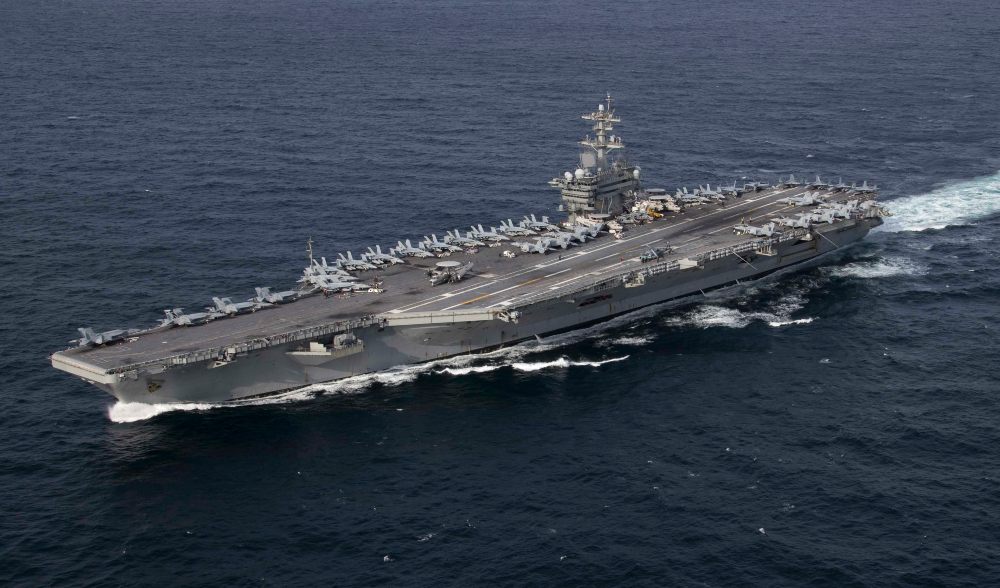

For the 5,000 sailors and air crew aboard the USS Abraham Lincoln already at sea for nine months, daily life is a cascade of hardships and homesickness compounded by broken toilets, moldy showers and shortages of decent food and personal hygiene products to keep themselves clean and healthy.
The delayed departure for the Lincoln’s homeport in San Diego has taken a toll on the morale and emotional stability of some crew, evidenced by reports that despair has driven a few shipmates to jump overboard.
I am watching the reports about the aircraft carrier supporting President Donald Trump’s fraught war against Iran with an unsettling sense of deja vu. The Lincoln was subjected to an earlier surprise and demoralizing mission extension from late 2002 through spring 2003, when I was among 30 American and European journalists embedded with the carrier crew in the Persian Gulf for the first month of the Second Iraq War.

The embedded-reporters project had begun with a “boot camp” in November 2002, when 60 U.S. and European journalists were invited to a weeklong spree of security briefings at the Pentagon, simulated combat operations at the Quantico Marine base in Virginia, and a 40-mile voyage from Cherry Point, N.C, for an overnight stay on the USS Iwo Jima amphibious landing ship. The approach to the massive vessel that carries tanks, Jeeps and troops to shore occurred aboard a catamaran-like LCAC (Landing Craft Air Cushion) that skimmed such turbulent Atlantic waters that most of the journalists lost the lunch they’d consumed on the bus to the departure pier.
We ended the action-packed training week with a visit to the USS Harry S. Truman in another Virginia port and advanced first-aid training for dressing wounds and self-administration of Epi-pens to combat life-threatening allergic reactions from exposure to harmful chemicals.
Most of the Lincoln’s 2003 cohort were circumspect in their complaints about the boomeranged deployment. But disappointment was obvious and understandable. Family reunions were scratched, weddings postponed or called off, fathers not knowing when they would see their babies born at home while they’d been at sea, last chances to see aging relatives missed.
The Lincoln was three-quarters of the way home to its port in Everett at the end of 2002 when the ship received a surprise order to return to the Gulf. The George W. Bush administration needed the carrier back in the war theater for support as it pursued Iraqi dictator Saddam Hussein’s alleged stockpiles of WMD—the feared but nonexistent weapons of mass destruction.
There was no immediate shipboard announcement as the behemoth Lincoln made a U-turn in the Pacific Ocean overnight. One officer who liked to jog on the flight deck around sunrise during the aborted trip home told me of his confusion when one day a distant view of the Australian coast loomed on the port side of the carrier and the next morning on starboard.
Much like the sudden U.S.-Israeli bombardment of Iran necessitated repositioning of naval assets elsewhere in the troubled world, last-minute redeployment of carrier groups was necessary in the weeks ahead of what was to be the March 21, 2003, “Night of Shock and Awe” over Baghdad.
Conditions aboard the Lincoln sound more dire this time, and it must feel like insult to injury when Trump dismisses the extension of their mission as “not nearly long enough” and Defense Secretary Pete Hegseth rejects reports of declining morale as exaggerated.
CNN’s Pamela Brown visited the Lincoln in July and footage from her interviews with enlisted and officers on board has portrayed a disturbing environment of physical discomfort and emotional dismay. Many of the young sailors interviewed likened their monotonous daily routines to the film Groundhog Day in which actor Bill Murray is caught in a monotonous cycle of uncertainty over when that maddening redundancy will break.
I was volunteered for the unique effort at press-military collaboration ahead of the Iraq war by my editors at the Los Angeles Times, where I had been a correspondent in Eastern Europe and the Balkans throughout the tumultuous 1990s covering violent rebellions and armed conflicts.
The hazards of war of the type waged in Iraq and now in Iran pose challenges quite different from what journalists covered in wars like Bosnia and Kosovo where we are supposed to remain neutral observers but as a result are regarded with suspicion by all sides.
On board the Lincoln, the promises of extraordinary access to every element of the ship’s crew dissipated from the get-go. Our stories went through a security review portal where layers of public affairs scrutinizers held up or nixed certain details and named sources for no apparent reason, often delaying stories past deadline or scratching them altogether.
I learned early of another undesirable consequence of a prolonged mission among a crew of average age 19 with raging hormones. Women sailors were turning up pregnant despite the long stretch since a port call.
At lunch in the officers’ mess one day about a week into our cruising around the Gulf waiting for the war to begin, I sat next to the ship’s chief medical officer who commented to a colleague that they’d had to “shore” another pregnant woman from the crew. My news meter soared. I asked him if it often occurred that there were pregnancies among women—11% of the 5,500 crew—while the ship was at sea. He said the carrier averaged about 20 pregnancies and shore transfers per deployment. He explained the consequences of conceiving onboard, which could get the offending lovers fined, demoted and discharged if the conception clearly occurred after the last port of call.
Each of the journalists on board had been assigned an escort, who was charged with accompanying us everywhere, including to the bathroom. I asked my escort how couples could be having sex when at least the enlisted members slept in bunk rooms with narrow and shallow berths and many others around them.
My enlisted escort showed me the favorite places where a couple could find or buy privacy for a forbidden tryst. It turned out the ship’s quarters for distinguished visitors, which were mostly unoccupied when the ship was at sea, was the most popular spot for an amorous couple to book an hour or two for $50 slipped to the right supply worker responsible for handling keys.
The Mary Todd Lincoln VIP suite was where six of the nine women on the embedded reporters program slept, me included, explaining why some of the enlisted crew were less than pleased to have us occupying their love nests-for-rent.
My story ended up the target of the rear admiral commanding the three carrier groups in the Gulf who told the PAO to kill the story. I fought the censorship of on-the-record interviews with Lincoln medical, legal and mental health officers, citing the promises made by the Pentagon press secretary during a preceding journalist boot camp that “no story will be off-limits.” I was told by the PAO that “It’s the admiral’s ship and he can do whatever he wants.”
An appeal on the grounds that there was nothing undermining security in my story was sent up the chain of command and it was eventually cleared. It ran in the LA Times under the headline: “It’s the Navy, not the Love Boat.” It was easily the most-read story of my month-long stay on the ship.
At the end of the Lincoln embedding project as the ship was allowed to head home again I learned the carrier’s commander, Capt. Kendall Card, had cleared the story. At a farewell gathering for the bedraggled embeds he noted that “It’s not the admiral’s ship and he cannot do whatever he wants.”
Discover more from Post Alley
Subscribe to get the latest posts sent to your email.


28 Feb 26, our heedless commander-in-chief capriciously directed his casting couch Secretary of Defense to attack an enemy that understands the most efficient use of their resources and weapons.
Iran attacked and severely damaged the U.S. aircraft carrier support depot in Manama, Bahrain on 28 Feb 26, the day the U.S. and Israel attacked Iran, which explains our failing support for the Lincoln.
No wonder we’re running low on ammunition.
Heaven help us.
Carol, Thanks so much for sharing your experience as an embed aboard the Lincoln. Apparently a far less fraught mission than the present one. Dreadful to think of the present and the plight of personnel who are enduring substandard conditions with no end in sight.
Again it was good to have you set the stage.
The human cost of such a long deployment really comes through here. Missing births, weddings and time with family while dealing with difficult conditions at sea must take an enormous toll on sailors and their families.
If the toilets weren’t working due to the long deployment, then heads will roll as a consequence, unless the port-a-potties were destroyed in the Bahrain attack.
The detail about the Australian coastline appearing on the opposite side of the ship the next morning is extraordinary. It captures the confusion of a sudden redeployment brilliantly. Your struggle to get the story about shipboard life published also shows why independent reporting from military deployments matters.