
Editors’ note: This is Part I of a two-part report.
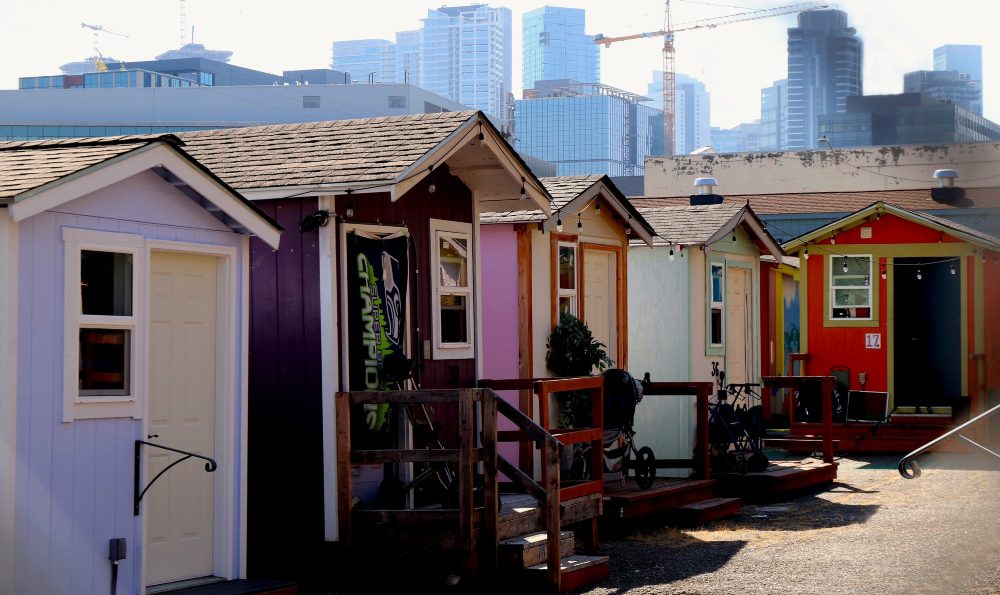
Homelessness today is seen as primarily a problem confronting cities. Causes include a shortage of affordable housing, substance abuse, undue permissiveness, and more, and are much debated. Possible solutions range from building public housing to streamlining permitting processes to erecting tiny houses to wraparound services to removing encampments, and that’s not a complete list.
I’d like to propose a different frame. We should consider it a consequence of our dynamic and wealthy economy, which expects people to be able to adapt constantly to substantially new ways of living and working. Not everyone can adapt so frequently and fundamentally, and those who can’t are at risk of falling into a life of homelessness.
Solving this problem will require a nationally funded effort, and cost significantly more than the combined efforts of cities and states today. It would be worth making that effort.
Homelessness today
Seattle/King County ranks third, behind New York City and Los Angeles, in absolute numbers of homeless people within its “metropolitan continuum” (the Department of Housing and Urban Development’s term). To be sure, we’re not a close third, but we’re a much smaller city and we’re ahead of a dozen larger metropolises. Homelessness has been a hot-button issue that plays directly into the polarization of our metro area politics: we’re a blue community that doesn’t like to harshly treat unfortunate people living on our streets. But we also don’t want to have to deal with homeless people in our public spaces.
As a relatively generous city, Seattle is something of a magnet for people whose housing is precarious at best: King County is home to about 30 percent of the state’s population, but about 50 percent of its unsheltered homeless; the city of Seattle proper is home to about 35 percent of King County’s population, but 70 percent of its unsheltered homeless. The wealth which makes generosity possible also makes it harder to be poor here. Housing, food, and many other necessities are more expensive than in other, less-wealthy communities. Wealthy blue cities like ours simultaneously attract people at risk of homelessness and make it more difficult for them to avoid homelessness once they are here.
Nationally, there were about 700,000 homeless people as of January 2026, according to the Department of Housing and Urban Development’s annual Point-In-Time count. About one third are unsheltered. In the same annual count the total homeless population in King County is about 18,000, of which about 12,000—two thirds—are unsheltered. For Pierce County, the January 2026 Point-In-Time numbers are about 3,000/1,500 and for Snohomish County 1,200/500. These are point-in-time counts; over the course of a year, at least twice as many people are estimated to be homeless at some point according to King County Health Care for the Homeless.
Roughly two-thirds of the homeless population nationally appears to suffer from some degree of mental disorder, with about a third of these being serious mental illness, according to the Journal of the American Medical Association. Thirty to fifty percent suffer from substance abuse, according to a major peer-reviewed study by Psychiatry Online. Not surprisingly, there is significant overlap, and homelessness can be either the cause, or the effect, or both for each of these conditions.
These are difficult diagnoses to make, since the widespread use of high-purity methamphetamine from Mexico in recent years triggers symptoms indistinguishable in some cases from organic mental illness, “mental illness” is a very broad term covering a multitude of conditions, and people living on the street are generally unlikely to present themselves to psychiatrists for careful evaluation.
Despite widespread substance abuse and mental illness issues, homeless people are not all living in extremis. Some are only homeless because they lost affordable housing suddenly and haven’t been able to find new affordable housing quickly. For these people, a more abundant supply of affordable housing would be a solution.
Others are working and taking care of themselves but simply not making enough money to cover housing as well as food and basics. For housing to be affordable it would need to be subsidized. Some have been hit with a financial catastrophe of some kind—medical treatment, for example, or loss of a home to fire or natural disaster—and lack the resources in the short term to re-house themselves. Relatively short-term housing options will frequently be all they need, or some kind of national catastrophe insurance program.
Some have been recently released from incarceration and have been unable to find both housing and employment quickly because of the criminal conviction on their resume. A more abundant supply of affordable housing would ease this problem by making rental housing more of a buyer’s market.
Many in these categories end up in the “sheltered homeless” category and are not directly on the street. Their situation is precarious, but they have at least basic protection from the elements and some protection against theft, assault, and other risks of street living, and a reasonable chance of returning to the world of people with actual homes. A comprehensive solution to homelessness needs to address the needs of these people as well as those living on the street under dire circumstances.
Every proposed solution seems to come up against hard limits: it’s too hard to build new housing; publicly-built housing seems to cost about twice as much per unit as units built by the private sector; resolutely blue single-family neighborhoods are resolutely up in arms against multifamily development too close to home; a significant percentage of those living on the streets do not wish to accept shelter or housing or are not acceptable for behavioral reasons to the providers of shelter or housing; a majority of those living on the street are dealing with some combination of drug and mental illness issues and many are coping with trauma, either as a reason they are on the street, or as a result of being there.
Services are provided by dozens of independent entities, with resources brokered to them by the famously inept King County Regional Homelessness Authority. Seattle’s City Council and Mayor are at daggers drawn over the acceptability of RVs as de facto homes for the homeless. Every week seems to bring another news story about the causes and consequences of a large population of substantially disadvantaged people living rough on the streets of the Emerald City, and it’s hard to know what to be for or what to be against if one wants to see the problem productively addressed.
The city experimented with a relatively comprehensive intervention operation in Pioneer Square prior to the World Cup. It appeared to be effective, persuading 70 of the 80 people it approached to accept shelter and services that got them off the street. To date most have stayed off the street. Its comprehensiveness was its apparent recipe for success: not only putting a roof over people’s heads but also assessing their other challenges and addressing them.
The question is whether it can be scaled up. The city is going to try to take a next step, but it’s an expensive solution per capita. New York City has a right-to-shelter law and consequently shelters close to 100,000 people on any given night. The annual budget for its homeless programs is $4.4 billion in 2026, for a city with about six times as many homeless as Seattle/King County. $4.4 billion divided by 6 is $730 million, roughly double what Seattle and King County currently spend on homelessness. Note that estimates like these vary depending on who is estimating, but the direction is clear.
New York’s homeless population includes a large surge of asylum seekers and accordingly has a lower rate of drug and mental illness issues, meaning our challenge here could be greater per capita. It should be noted that New York City’s expenditure does not appear to solve the problem, only reduce it. For insights into the situation in New York City, I highly recommend a deeply-researched new book by Anand Giridharadas, The Man in the Mirror. It examines the death of a homeless man on a subway car, and in the process digs deeply into the entire world of homelessness.
Reframing the problem
Now let’s consider a different framework. It’s this: our modern economy and society are not easy for everyone to master, and those who don’t are likely to fall into very deep economic holes from which returning to the surface is exceptionally difficult in our rich (and therefore expensive) country.
The price of nice things for some is economic distress for others. A meritocratic society which prizes fairness of opportunity is a liberal bedrock value, and progress toward this ideal has delivered many benefits. But it inevitably defines some people as least fit for the demands of whatever the current economy requires, and punishes them for their bad luck in proportion to the success of others. Exactly what makes one person more or less fit than another changes over time.
Humans live in a complex world, and there are many ways to be successful, but there will always be people who draw short straws—of temperament, of intellect, of health, of parenting, of personality, of charisma, of physical strength, of stamina, of childhood trauma—bad luck has many faces. Such people face bleak chances that cannot be overcome by mere equality of opportunity.
The US economy is the most dynamic in the world—that is, the most driven by rapid change in its technological underpinnings. The faster things change, the more people are likely to be rendered, in a term borrowed from evolutionary biology, “less fit.”
This terminology revives ghosts of Social Darwinism, a set of beliefs which besmirched Darwin’s name a century ago. The great sin of Social Darwinism was concluding that by simply eliminating the least fit people the problem could be solved. This morally bankrupt conclusion led to horrific actions, and was simply untrue: fitness is relative, and economies adapt themselves to serve those who thrive under the rules of the day, inevitably condemning others to be found less fit.
A thriving economy also operates at a greater elevation above rock bottom, making the fall worse and harder to reverse. The misery of a few million Americans is an inevitable “externality,” a cost not fully borne by the creators of modern life nor its lucky beneficiaries.
From this perspective, there will never come a time when, without intervention, everybody’s doing well and nobody’s struggling to survive. There will always be people whose aptitudes and circumstances are the least-well-matched to the requirements for relative economic and social success, and who have a long way to fall if their adaptability falls short.
The faster technology repeatedly disrupts the status quo and changes the rules of the game, the larger the number of people who will come up short. The most visible symptom is homelessness, but it is a symptom, not the problem itself.
The solution isn’t to freeze progress, but to recognize that there is an irreducible human cost created by our accelerating progress, and that our current response, in which a pastiche of governments and other entities patch together reactive semi-solutions is not only wrong in scale but wrong in kind; it’s not addressing the underlying problem, just bandaging the symptoms.
To thrive in today’s world, it helps to be literate, numerate, articulate, persuasive, reliable, healthy, well-groomed, and adept in the use of a host of devices and services: smartphones, PCs, tablets, online working, online banking, online shopping, online socializing, a whole host of special-purpose technologies in the workplace and, suddenly, using AI chatbots and agents to achieve all manner of goals.
The rapid colonization of our economy by AI is changing the rules again: some people will be newly advantaged, others newly disadvantaged. Those for whom AI is most beneficial will be economically rewarded. Those entirely left behind by AI will be at increased risk for falling down the steep slope to homelessness.
The beneficiaries of AI, including those who created it and those who benefit the most from using it, may understand in a generalized way that AI is disruptive in what could be cataclysmic ways, but they don’t naturally proceed from that insight to feel responsible for protecting newly externalized fellow-citizens from harm.
When encountering a person folded over by Fentanyl on a city sidewalk, it’s normal not to make the leap that this person got here by simply experiencing too much friction trying to live in the modern world, and that AI, even as it provides many benefits to many people, will inevitably push some new people out onto the street, and that Fentanyl will snare some of them.
If, as some people fear, AI takes over so many human functions that it radically reduces demand for human workers, falling through the cracks may suddenly threaten a much larger share of the population. It would behoove AI’s creators and beneficiaries to get ahead of this risk and contribute to a public conversation about how to take care of those rendered at least temporarily disposable by modern life.
Part of the solution needs to be national, and ideally multinational, to prevent businesses and wealthy individuals from simply hopping to a location that won’t require them to engage with this problem.
Fundamental to any solution will be persuading people that taking care of the disadvantaged is a cost of doing the businesses that create so much advantage for everyone else. This problem has been around for a long time in various forms: the transition from hunter-gatherer societies to those based on agriculture changed the rules, rewarded some, and damaged others.
There were undoubtedly more than a few great hunters who turned out to be lousy farmers, and plenty of farmers who never got very good at factory work. Periods of stasis where little changed from one generation to the next persisted for many millennia; agriculture disrupted hunting and gathering, but then agriculture itself changed at only a glacial pace for millennia. It took thousands of years for horses to replace oxen as pullers of plows, for example. In the modern world there is no longer any stasis. The requirements of economic utility and daily life change constantly, and the rate of change only increases. AI promises to steepen the curve even faster.
Many of today’s homeless are only temporarily so. If efforts to enlarge the availability of affordable housing are successful, many of these people will be able to escape homelessness for good. These are the people who best fit the term “unhoused.” House them, and their most urgent problem is solved.
However, there remains a large share of our homeless population that is sufficiently disadvantaged by our ever-so–dynamic modernity that they’ll never be safely housed again without sustained assistance in addition to housing. Unless we want to keep feeling bad about avoiding their encampments, stepping around them on the sidewalks, and fearing them on buses and trains, we need a durable solution that accepts that their existence is a cost of the systems than improve our existence.
In Part II of this essay, I’ll report on organizations offering good examples of how such a solution might work, and will argue that the Federal Government, which greatly reduced its role in providing housing for homeless people during the Reagan administration in the 1980s, needs to return to the arena in force.
Discover more from Post Alley
Subscribe to get the latest posts sent to your email.