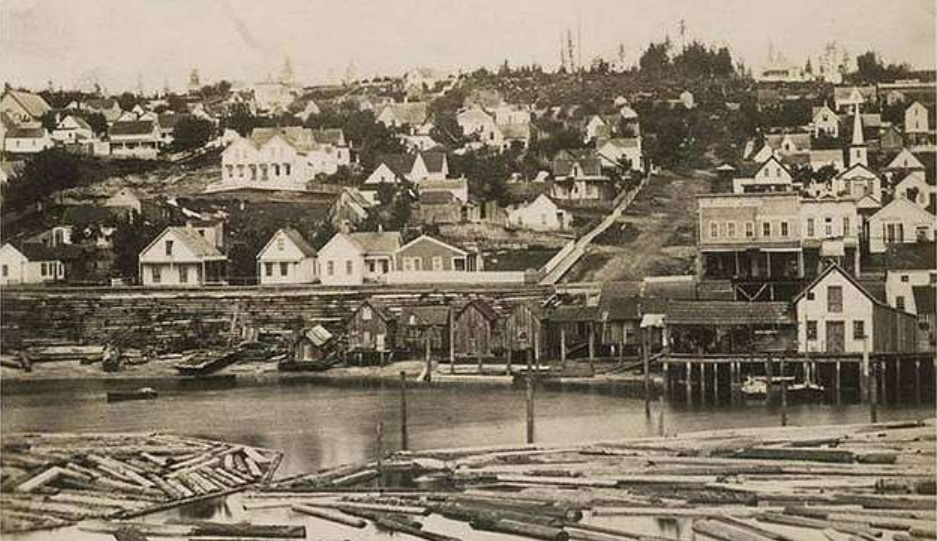

David Lewis is a young Seattle native, an uncommon researcher and an accomplished writer. As one who writes, I know how taxing and tedious coaxing a narrative from a blizzard of obscure sources can be. But in his new book, The Burning Of Moses Seattle, he weaves a remarkable account from a web of sources, to produce what promises to be a classic of northwestern biography.

In 1872, Julia Stiluta, wife of Chief Seattle’s son, James, gave birth to Moses Seattle. By then, most of James’ other children had died, and Moses was said to have been conceived from the blood of ghosts.
Lewis describes the winter solstice night ceremony carried out by Dr. Steve, a Suquamish shaman, who, with fellow ceremonialists, made the perilous journey to the land of the dead. There he fought ghosts, clubbing one and capturing a “red, jelly-like mass” on his weapon. Returning, he put this into the hands of Julia who, nine months later, bore Moses, a child from the land of the dead and born with no bones.
By January 1856, the Duwamish, Suquamish and other Puget Sound groups signed the Treaty of Point Elliott which, after ratification by the U. S. Senate, gave them one year to leave their extensive rich homelands now claimed by the Americans.
Thousands were exiled to small, often sterile reservations. The Port Madison reservation on the Sound’s west shore, the Suquamish homeland where Moses was born, had no salmon river. On the eastern shore, a rich and productive Duw, “Inside,” made up of the Cedar, Black (the old outlet of Lake Washington) and Duwamish Rivers drained the Duwamish homeland and supplied both. But because coal had been found there and a railroad coming, it was thought too valuable to set aside even a small acreage for a reservation. The Duwamish who refused to leave were made refugees in their own country. By the time Moses was born, native groups once free from want lived impoverished lives as wards of a distant preoccupied government.
Lewis introduces us to individuals not likely to be met beyond his pages. William Shelton, Snohomish leader and creator of the story pole, the Puget Sound version of the northern heraldic ‘totem’ pole, would write books on mythological themes, the first books by a local Native American.
S-AHKW ahl, Chief Seattle’s warrior son, carried out raids and vendettas throughout the Puget Lowland like his father until shot through the spine during a bloody raid on a Chimakum village. John Yoskadum, immense and immensely strong, “The Bull,” could pick up and carry a huge boulder beside Old Man House on Agate Passage, one of the largest early wooden structures built on the Sound.
Plece-sum-kin, a Lake Union man mistakenly lynched by a roaring Seattle mob but cut down at the last minute by Sheriff Carson Boren, subsequently changed his name to Cheh shi ah hud, referencing his near-death experience. He and his wife, Madeline, a most elegantly dressed couple on the Sound, lived above Portage Bay. As she lay dying at home, he sat Chief Jacobs, the Suquamish Catholic lay leader, on one side of her bed, and Lu lish, a shaman “…steeped in ancient magic…” on the other to intercede with visitors from both traditions. Others like Port Angeles Bob, Swinomish George, Shilshole Curley and Skookum Joe fill out Lewis’s picaresque ensemble.
Moses’s cartilage became bone, but he grew only four feet tall; “the dwarf from the land of the dead”. Attending reservation schools, he gained a reputation for strength and gymnastic ability. Lying flat, he could jump upright without using his hands, a feat often repeated for public amazement. He played baseball with children into his adult years, his furious running gait making him an object of mirth and ridicule on a raw frontier.
He briefly joined a circus as a “Little Wild Man From The Spanish Flats” who ate mud, but also displayed stolid courage as a ferryman, saving Lillie Sparks, a pioneer girl, when his small boat capsized in a tide rip. Her brother drowned, but Moses’s diminutive lower body let him bob like a cork until the two were rescued.
An ability to speak and read English helped him navigate a developing economy. Picking hops in the 1880s, he served as a contractor and possibly a union organizer. He played the accordion at rural polka and square dances into the early hours; speded-up tempos and loud shouts pointing to a drinking problem that Lewis points out put him with a rough crowd seeking to isolate their brutalized lives with alcohol.
Lewis describes forgotten passings: the increased danger and wholesale slaughter of cougars as lumbering and settlement destroyed their habitat; the bantering laugh of elders on Ballast Island gathered ‘round pots of boiling fish, and of older white men who came to show they could still speak the fading Chinook Jargon.
Fully a third of the book is devoted to the terrible events leading to of Moses’s death. In 1891 land was purchased for a naval station on the Kitsap Peninsula, the strategic northwest “corner” of the continental U. S. A year later construction began on Drydock #1 and a shipyard took shape. Nearby towns: Charleston and Bremerton gained sordid reputations for saloons and brothels where sailors and Marines, when not mauling each other, fought local police. The situation became so dire, town residents avoided the worst areas, and disgusted naval administrators sent ships to California for repair. In a panic, Bremerton banned alcohol sales in 1904.
But off-duty sailors brought whiskey and beer to native parties offering women and beach fires away from the towns. It was at one of these where, during a stumbling brawl, that Moses fell into a roaring fire but used his trick to stand upright unscathed. Impressed, drunk observers threw him back to see him do it again, then again and again until he was ablaze and screaming. The fire put out, Moses lay comatose on gravel, fearfully charred. Fearing arrest, onlookers fled.
Returning two days later to find him still alive, they dragged him to a filthy Charleston stable. A local doctor gave him morphine to ease the pain, but unwilling to associate themselves with the crime, residents refused further aid. Newspapers ferreting out accounts heaped outrage on the towns and those identified as culprits.
Eventually, a naval surgeon specializing in burns, Dr. Archibald Fauntleroy on the cruiser, U. S. S. Philadelphia, a hospital ship moored at the yard, rescued Moses. In his report, Fauntleroy passed on a spurious tale about him falling asleep in a house that caught fire, but more seriously described his patient’s third degree burns covering half his body. He found him still drunk: a three-quarter empty whiskey flask still in his coat. During 16 days of treatment on board ship, Fauntleroy believed he would survive and even be healed with skin grafts. He and staff developed novel strategies to improve treatment, devising a new bed later used by burn patients.
During his hospitalization, a beautiful, elegantly dressed woman visited Moses: Lillie Sparks, who drew a huge smile from him despite his pain, and the two shared happier memories. But at 6:10 AM, February 24, 1905, he died of heart failure. The account of his torment and ground-breaking care appeared in The American Journal of Medical Sciences and the British Journal of Dermatology.
David Lewis’s remarkable book is self-published, and, as yet, has no endnotes, a serious lack needing remedy. I believe that will secure its place among the classics of Northwester biography. It is a rare and thoughtful portrayal of a unique but little-known figure, suffering people and a difficult period in our shared history that we must embrace.
Discover more from Post Alley
Subscribe to get the latest posts sent to your email.

This sounds like a book that perhaps UW Press should consider. Thanks for the excellent review David.
Excellent writing and insight. Do we recognize that what we did to America’s indigenous people was America’s Holocaust? My people literally executed thousands and thousands of natives and sent many of those not killed to the concentration camps called “reservations”. And, not satisfied with that, in WW II we sent thousands of Japanese Americans to concentration camps — which is what we are doing to immigrants today.
This book was a fun read. I can always appreciate when someone uncovers a buried piece of local history and, through meticulous research, is able to bring the story to the surface for the rest of us to enjoy.
As is not unusual, it falls to David Buerge to bring forward important teachings from others’ research, his own deep scholarship, and even sometimes from the rich lode of oral tradition he is always committed to mining.. Thank you for this highly interesting post, David.