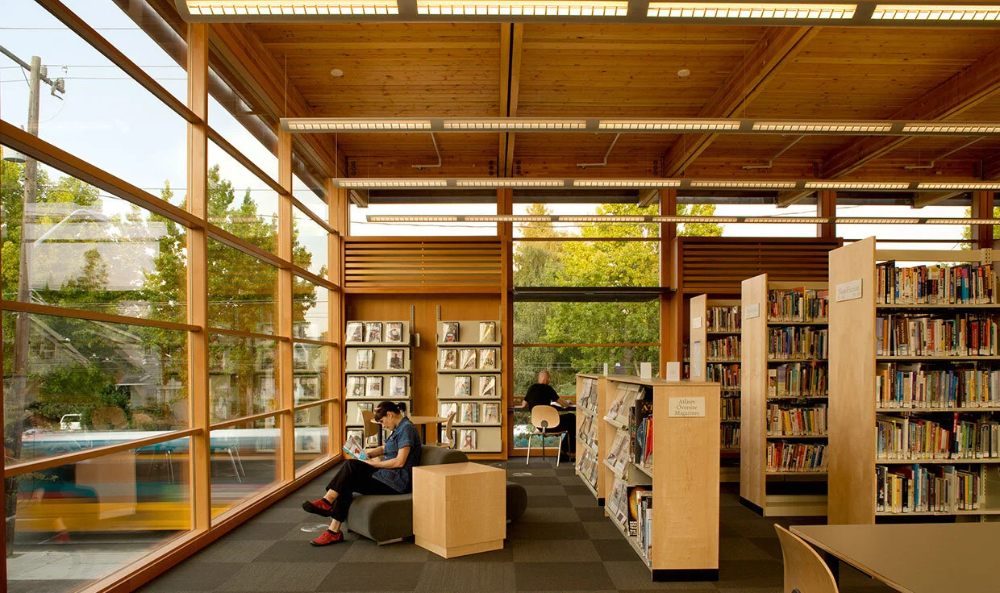

Seattle residents will make one of the year’s most important decisions on Aug. 4 voting on a critical issue: whether to replace the seven-year Library Levy that expires this year.
Much rests on the outcome. The Seattle Public Library with its central library and 27 branches is among this city’s most valued assets. It’s impossible to overstate the library’s impact. Consider the numbers: Seattle’s library now has 430,000 active card holders. Last year the library scored 3.4 million in-person visits, 1,300 story times, 6,000 students enrolled in after-school Homework Help, 400,000 hours of computer time, 2.1 million pages printed, and 5,800 programs including author events, business help, English and citizenship classes.
The Library Levy is essential; it makes up more than a third of the library’s budget and funds a quarter of its staff. The Levy invests in buildings that are neighborhood cornerstones and increases access to education and knowledge at a time when our basic values are under attack. The library is in the forefront fighting censorship and protecting democracy.
Failure to pass the Library Levy would be a disaster in so many ways, certain to result in branch closures, hour reductions and staff layoffs. Half of the budget for books and materials would need to be cut. Failure would fall heavily on digital books, 57 percent of all checkouts, because they cost libraries between 3 and 5 times more than print books.
Seattle life would suffer from a Levy loss since access to books and library services are the foundation of an affordable city. Estimates are that every dollar put into collections returns more than $16 per capita. Also benefitting according to the Urban Libraries Council are Seattle’s small businesses that net more than $8 million in value each year.
There is indeed a powerful case for passing the Seattle Library Levy; but there also is reason for some concern. It’s troubling to learn that the proposed replacement levy would cost more than twice the one approved seven years ago. Cost to the average homeowner will be $16 per month as opposed to $7 a month for the 2019 levy.
Why has the Library Levy more than doubled? Fact is that it’s unfair to try to compare the new Levy’s costs with those from the past seven years. The new amount was set to account for inflation and adjusted for budget offsets projected over time as well as allowing for aging buildings and their increased maintenance needs. The system’s newest branches turn 20 this year while the oldest one is nearing 120 years.
Taxpayers sometimes ask why the Library Levy money can’t be raised elsewhere. The Library is one of five public services specifically named in the Seattle charter and, while it’s the city’s responsibility for funding, the Library’s share of the General Fund has remained flat or reduced under some budgets. That leaves the Levy as the primary mechanism to keep up with costs and demand. The independent five-member Library Board of Trustees is charged with oversight of Library Levy spending and has amassed a creditable record over the years.
The Seattle Library was founded in 1869, just 17 years after the Denny Party settled here. But it took a group of women organized as the Ladies Library Association to bring the fading library venture back to life in 1889. The first public reading room opened on the fifth floor of the Occidental Building, prior to the library moving into the First Hill mansion donated by Henry Yesler. The townsfolk hoped to persuade philanthropist Andrew Carnegie to contribute to the library. But the steel magnate dismissed requests saying Seattle was “nothing more than a hot air boom town.”
In 1901, a New Year’s Day fire destroyed the Yesler mansion along with 25,000 books. The Seattle Post-Intelligencer carried a story hinting at possible arson and noting darkly that “the man with the strongest motive” was Librarian Charles Wesley Smith who had been complaining about his cramped quarters. But nothing was proved and the fire served to draw sympathy from Carnegie who promised to donate $200,000 to help rebuild.
In 1904, the Central Library building opened in downtown Seattle on the block bounded by Fourth and Fifth between Seneca and Madison. The first book checked out was Mark Twain’s “Innocents Abroad.”
Carnegie donated funds to build three neighborhood branches in 1908 and then money for two more branches in 1911. Over the years the Library has continually added new services and programs. In early years, it began by offering Braille and non-English books. The Library now schedules classes in English learning and citizenship preparation, as well as income tax help. The Levy makes possible the library’s role in digital equality, providing free access to technology for everyone: computers, printing, Wi-Fi hotspots, job searches and digital newspapers. It also preserves the popular Peak Picks program and has expanded it to include e-books.
The library’s list of programs and services runs to more than 70. Included are Immigrant and Refugee Services, Genealogy appointments, free museum passes, Veterans Services and “Seattle Reads,” the city-wide book club originated by librarian Nancy Pearl in 1998 as “If All Seattle Read the Same Book.”
Today the Levy is also doing important work upgrading the Library’s defenses against pandemics and countering cyberattacks like the devastating one that occurred in 2024.
In these times, it may take a push to okay the Library Levy, but for Seattle, a city of readers, renewal seems basic. Keeping the system strong will benefit all and honor Seattle’s long and colorful library history.


You are correct, and financing the libraries will turn out better than you expect. A levy passed here in Portland and is being used to rebuild the libraries. They are gorgeous with light and space, and new technology for checking in and out books, that would make you come back to the library if you haven’t visited in years.
Well stocked and well maintained public libraries are a bedrock of democracy. Seattle has a wonderful library system staffed by erudite and dedicated professional librarians and their fellow workers. It is critical that this precious municipal resource be generously supported and sustained well into the future. Thank you Jean!