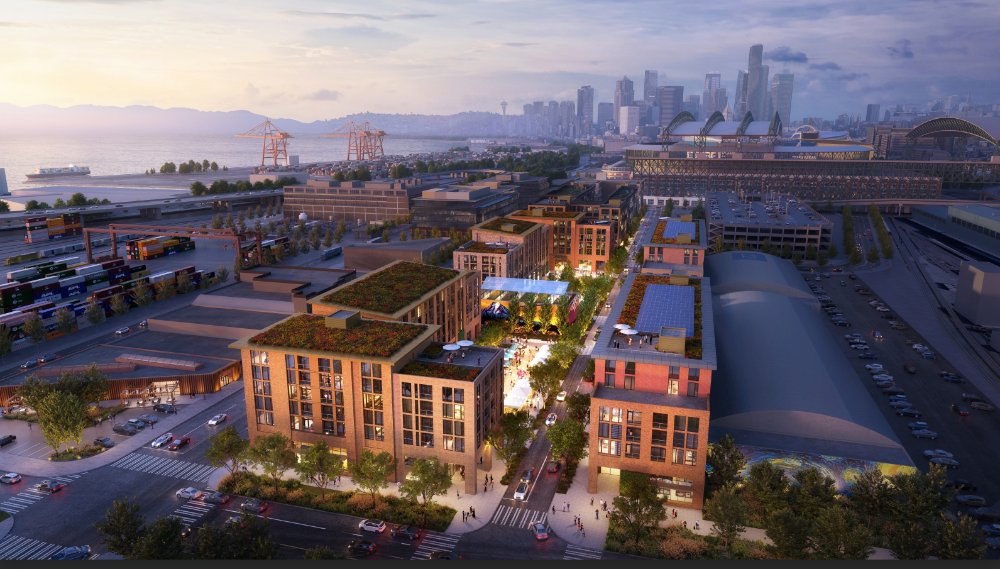

The deck seems stacked against opening the area around Seattle’s sports stadiums to housing. The City Council unanimously repealed last year’s ordinance favoring development of about 1,000 housing units, and more recently Mayor Katie Wilson’s planning office proposed a permanent ban on residences within the SODO manufacturing district.
Even so, it is certain that one of the city’s longest and most bitter political controversies will continue unabated.
Proponents of housing, chiefly the T-Mobile Park public development agency and Seattle construction unions, have appealed the planning office’s recommendations and the environmental review. They contend the city’s proposed residential ban ignores the city’s housing crisis and seemingly contradicts Wilson’s own promise to boost housing everywhere.
But is there a way out of the endless fight? An unlikely voice says a compromise could be possible.
The Port of Seattle has long opposed stadium-area housing and commercial development close to its Duwamish River terminals. But Port Commissioner Fred Felleman suggests the Port may be willing to ease its opposition to limited residential development in the SODO Manufacturing and Industrial Center (MIC) — although not near the stadiums but further east.
The Port and its maritime business and labor allies have been unbending in fighting any loss of the city’s scarce industrial-zone land, citing potential conflicts with freight movement and port activities.
Felleman, however, said allowing housing on the eastern edge of SODO near Airport Way and I-90 — near where auto dealerships were approved over some controversy years ago — could help solve the housing crisis and a way out of the perennial battles over conflicts with maritime operations.
Housing in industrial areas removed from Port activities would “show the community that the Port is not oblivious to the needs of the region,’’ said Felleman. “The Port has fought very hard to protect the MIC, but at the same time we have to recognize the world in which we live.”
Commission President Ryan Calkins credits Felleman with trying to find a path out of the perennial development battles. “I don’t know that we would advocate for it, but we would probably not oppose it.”
The area Felleman eyes for housing is near the property proposed for a sweeping South Downtown plan proposed by Greg Smith, head of Urban Visions development firm. That plan was launched in 2023 but has seen no recent action.
Housing proponents cheer the suggestions by Felleman and Calkins, but they say those ideas don’t go far enough.
After years of losing fights with the Port and its longshore worker allies, housing proponents were heartened in 2025 when a split City Council approved a bill that would have allowed apartment development on land south of T-Mobile Park, along with ground-level “makers’’ spaces for small businesses and craftspeople. Then-Council President Sara Nelson championed the bill as a way to build housing supply and create affordable space for businesses while also addressing growing public-safety concerns near the stadiums.
The Port appealed the action to the state Growth Management Hearing Board, which faulted the council legislation for Comprehensive Plan conflicts and procedural errors. The council, acknowledging the criticisms, repealed Nelson’s legislation. The fight over the legislation soured her relations with the Port and maritime industries, and Nelson lost her re-election bid.
The city delivered another blow to the housing effort earlier this year. Calling the MIC “a pillar of the city’s economy,” the Office of Planning and Community Development (OPCD) released recommendations for the MIC — including the stadiums’ special zoning district — that would bar housing permanently.
The draft policies would “encourage a broader mix of uses’’ including hotels in the area, “but do not allow any residential uses and do not amend codes to allow even limited residential uses” near the stadiums.
The politics around the decision by Mayor Wilson’s planning office are complex. Wilson rode to office on pledges to speed up housing development, fund new projects and knock down regulatory barriers. She had the backing of many labor groups. In this case, however, Wilson sided with the Port — some commissioners had endorsed her election — and the International Longshore Workers Union against the formidable Building Trades Council.
Joshua Curtis, executive director of the ballpark Public Facilities District (PFD), said he cannot explain Wilson’s seemingly contradictory action. The planning recommendations would represent a major setback for the baseball and football stadium authorities that have long sought to boost development in the area.
“We did our best to talk to OPCD and the mayor to try to find a solution with the Port and ILWU,’’ Curtis said. “We just ultimately didn’t get there. We feel like it’s the wrong move for the city.”
The PFD and the construction unions are challenging the planning recommendations, while also appealing the environmental review to the city Hearing Examiner.
“The Stadium District Commenters are committed to partnering with the City and other stakeholders to identify a zoning framework for the (stadium district) that respects both the sports facilities and the vision for the Stadium District and the long-term viable operations for industrial users in the northern MIC,” Curtis’s group said in its comment letter.
Later, the letter claims that “nowhere else in the entire Comprehensive Plan does the City impose such a drastic blanket ban limiting the City’s ability to amend its own land use codes to respond to future conditions or circumstances.”
In its environmental appeal, ballpark and building trades called the proposed ban on potential housing in the Stadium District Overlay is “a significant adverse housing impact.’’
“There is cognitive dissonance with the city. We say we have a housing crisis, but we don’t act as if we do,” Curtis said.
As expected, the Port is seeking to intervene in the environmental appeal.
“Residential uses in or adjacent to active industrial and freight corridors create foreseeable land use conflicts, including conflicts related to truck traffic, rail and port operations, nighttime activity, noise, emissions, safety, and pressure to limit or modify industrial operations,” the Port said.
In the meantime, a second development controversy over critical property near the stadiums is playing out in slow motion. The five-acre WOSCA site, formerly a shipper’s warehouse now owned by the Washington Department of Transportation, is sandwiched between the stadiums and Port container terminals.
A myriad of uses have been proposed for the site, including apartments, hotels, a park, headquarters for the state ferry system, and maritime workforce training. To come up with options for the site, WSDOT and the city partnered in 2024 with C40, a global network of city leaders that promotes innovative sustainable and equitable urban development. Twelve development concepts were received, but the proposals remain secret.
The review process seems stalled, however, until the Legislature takes action to give WSDOT authority to engage in public-private partnerships, long a controversial topic itself.
Port officials have long eyed the property for possible maritime uses, and as a bulwark against commercial encroachment. The state seems unwilling to let it go. Nevertheless, the Port’s real-estate office is conducting its own assessment of the site’s soil and building conditions as a first step in determining if there is a financially viable path for the Port to acquire the land.
That might be tall order for the cash-strapped Port, but potentially it could engage in some partnership venture with the state to develop the property and protect Port interests.
Felleman, for one, hasn’t given up. He said the Port should have pushed to buy the site years ago. “We had an opportunity,’’ he said. “As a public entity we had the responsibility to step forward.”
The Commission, however, has yet to take any formal action.
Ultimately, the City Council will have the last word on how stadium area will be developed. Council members Rob Saka, Joy Hollingsworth, and Maritza Rivera, who voted for Nelson’s bill last year, all voiced support for considering the housing issue again.
Councilmember Eddie Lin, who chairs the Land Use Committee, said he favors trying again for a compromise solution. But asked recently if he has any specific ideas, his office did not respond.
Although no one seems happy, the stalemate seems likely to persist for years to come.
###
Discover more from Post Alley
Subscribe to get the latest posts sent to your email.


Politicians and industry who are convinced that a waterfront port and associated industry will never be of any value to our seaport city, won’t be the ones who suffer if they’re wrong.
Industry advocates who perennially push for more residential zoning, will never be confronted with the lack of observable results in increased housing production.