
I’ve been writing a lot about the bowdlerization of the White House and the grand historic landscape that unites it with the National Mall. I fear some readers are put off; after all, a badly made building addition pales before the much more serious dismantling of the democratic system America was founded on. At no time in the history of the country has such commercialization, politicization, and trivializing of Washington’s most sacred precinct been countenanced. This is the physical (and possibly permanent) expression of the violence being done to the nation itself—so ironic as we attempt to celebrate 250 years of our liberation from monarchy.
By bike I spent June 8 and 9 roaming Washington’s monumental core, an area that encompasses much more than the greensward that sweeps from the Capitol to the Lincoln Memorial. I am seeking to convey the nature and scale of the alterations underway, even though they change daily. This is the first of a two-part précis of what I learned.
Washington has such a vast, grand public realm thanks to Pierre Charles L’Enfant’s 1791 plan for the city, with its rigid grid dotted by public squares and crossed by grand diagonal boulevards. It emulated the kind of Baroque city plans laid out for Popes and monarchs, but it has well accommodated institutions of representative government and the commercial city that filled in the city’s street grid.

The other transformative era in Washington’s growth began in 1901, in an era of great wealth concentration and imperial ambition (unfortunately echoed today). A Senate commission drew up what’s known as the McMillan Plan, which was led by the elite architectural and landscape designers of the day. They banished incursions that had eroded L’Enfant’s vision, but also pumped up the grandeur, festooning enormous new government buildings with limestone columns and pediments in the prevailing Beaux Arts style. American leaders wanted the world to know that it was dealing with a newly wealthy great power prepared to use might to make right. (If you would like more background, have a look at this excellent New York Times explainer. ) The monumental core has constantly evolved since but largely within the L’Enfant/McMillan framework—until now.
Fortified White House
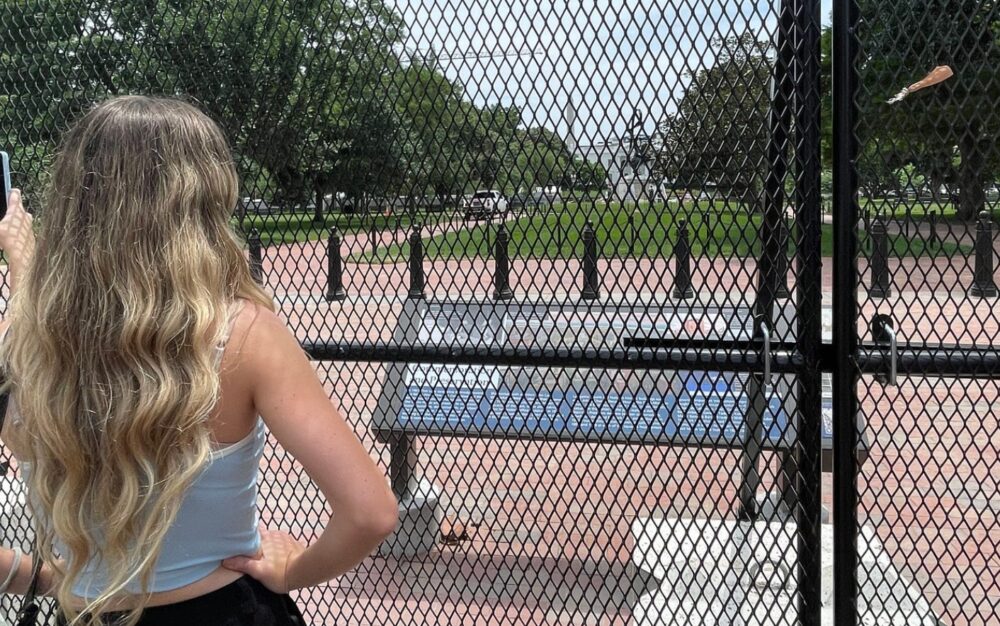
The White House ballroom wing is Trump’s signature effort to remake the symbolism of the White House and bend it to his own gilded reality. But for a towering crane, not a glimpse of the enormous construction site was possible when I visited, since enormous fences, many opaque, have been erected around the White House grounds and the green swath that unites it with the Mall proper.
I joined other visitors peering through a high fence along H Street, the northern border of Lafayette Park, which has been closed for months of renovations. (The White House ignored the approval process required before starting work.) At that distance the White House was only indistinctly visible.
Contractors who forged relationships with the White House received no-bid contracts to restore fountains, lawns and paths in Lafayette Park. There appear to be no garish new Trumpian gee gaws, though that assessment awaits reopening, promised by the National Park Service for June 28. The park has not only been a coveted recreation space for city residents, it is the public space closest to the executive residence, and therefore frequently where people can voice their displeasure with the occupant via protests, a longtime tradition. None of that can go on nowadays.

As to the ballroom wing itself, construction apparently continues at speed, though a federal Judge ordered the White House not to take construction above grade. The stop-work order is on appeal and the appeals judge has sat on the case for months. Failing to put construction on hold plays into the the administration’s hands. It is trying to establish “facts on the ground” that would preclude stopping the project, should it be deemed illegal. It’s just too far along, goes the argument, given the impossibility of restoring the former East Wing.
Stopping this senseless vanity project is essential. An independent assessment of what the White House actually needs is essential. At that point the project could be partially or fully demolished, paid for by the slush fund Trump created, and construction of what is demonstrably needed could proceed with a design that is appropriate for the White House and its legacy, not the product of Trump’s whim.
By the way, The Washington Post reports that Clark Construction, which received the no-bid contract to build the ballroom, submitted estimates that placed construction costs at $600 million, with taxpayers on the hook for more than half. Trump first touted the project as $200 million with not one cent to come from public coffers. The idea that all of us would not foot the bill, predictably, was a fiction.
Scorched earth Ellipse
The Ellipse, the vast 52-acre park space south of the White House grounds has also been closed and fenced for months to accommodate the tents, trucks, stages, and light towers erected to produce the crude UFC fight that Trump commanded to celebrate his 80th birthday. (The cage fight occurred just after my visit.) Conscripting the White House as a status-enhancing backdrop proved futile once a fighter crudely insulted Michelle Obama.

The equipment has quickly been dismantled but the damage to the trampled landscapes at both the White House South Lawn and the Ellipse is shocking. The National Park Service once predicted reopening by June 28, but full restoration will probably keep this public space off limits until late next spring. Of course UFC and the birthday boy should be on the hook for these costs, but no commitment to paying the millions in restoration costs had yet been made as I write this.
Or the president may decide that he needs nearly 100 acres around the White House to be kept off limits to the public so that he feels safe.
Since there was nothing to see and nowhere to visit, crowds of tourists trudged south along 17th Street—walled off by fences—to E Street, which divides the White House grounds from the Ellipse. E Street is the traditional vantage from which pedestrians could view the iconic image of the White House with its semi-circular South Portico.

But E Street was—and remains—closed to visitors. (The National Park Service says access will reopen June 28. But it may not want to expose visitors to the devastation of the landscape.)
At this and other cross streets that serve the White House complex, the usual gates, bollards and anti-ram barriers have been augmented by a chaotic array of high fences, vehicles, parade barriers, surveillance cameras and other paraphernalia of fortification. Presumably all the hardware and all the personnel are intended to intimidate gate crashers, but the scenes read as too many cooks stirring the security pot.
Maybe there is method in this fortification madness, but it is repellent to visitors who may have been drawn to DC to appreciate its museums, monuments and lush landscapes but instead confront the confiscation and militarization of space that is supposed to be open to all.
The visitors kept trudging toward Constitution Avenue, more than a half mile from H Street, where they hoped they might catch the famous view, even if at a much greater distance. The street was lined with trinket hawkers and provisioned by food trucks with their sputtering, belching generators. What people found was not a view toward the hallowed house of the nation’s executive, but the garish trappings of the cage fight.

Though I had seen plenty of cheerful hoopla for the World Cup in a recent visit to Seattle, and New York City has gone nuts for the Knicks, I saw no fans sporting UFC caps or T shirts, no street flags, no welcome banners on the endless fences. Clearly this wasn’t about the rest of us.
Abandoned Kennedy Center
I glided down New Hampshire Avenue to the Kennedy Center, which sat like a stranded rectangular iceberg amid the tangle of I-66 freeway collector ramps that leave it in not-so-splendid isolation. It was three days before Trump’s name was required to be removed. A federal judge had ruled that only Congress could change the name of the center.

I remember past visits when visitors wandering the halls were abundant even when no events were imminent. This time the guards outnumbered the visitors and were happy to chat in the echoing silence, though they were very careful in what they said. One pointed out to me that the Trump name had been removed from some signage.
The multi-venue 1971 complex was not architect Edward Durell Stone’s finest hour. The severe white-marble box attempted to deliver the grandeur that Washington expects. Cold as ice inside and out, it insists on its dignity yet succeeds only in intimidating the visitor. The vast but dated Grand Foyer is decorated with an ocean of red carpet, towering green draperies, and bright-brass chandeliers. It is tall but not very wide and the venues are recessed so they have no visibility and thus zero allure.
Because the Trump Administration was preparing to close the building and spend $257 million on unspecified improvements, the building and grounds were eerily empty. The center used to bustle with some 2,000 events a year—that’s more than five a day. These were not just high-culture enterprises like orchestra concerts and operas. The center offered many free performances, especially in The Reach, the sinuously sculptural complex designed by Steven Holl to accommodate smaller, less formal events.
Making the place more welcoming would be a costly job, though certainly merited in the nation’s capital. A process that invites everyone into the conversation about the center’s future is not likely to happen until the end of Trump’s term.
Trump has said he is abandoning his project, which is a victory. The Associated Press reports that the board feels no obligation to resuscitate programming, since the judge did not specifically command that. Such a board needs to resign now in favor of one that will cast a non-ideological net to again fill the place in a way that engages all Americans.
Heroic advocates
Two organizations have been essential to stopping the destruction of Washington’s heritage: The National Trust for Historic Preservation, a widely respected and apolitical nonprofit, has pugnaciously led the fight to stop the ballroom. It punched back hard when the Department of Justice, using Truth Social-style rhetoric (the Trust was “FAKE NEWS,” for example) included brazen lies in a legal filing, one that the Trust accurately stated, “makes no legal argument.” Clearly it had gotten under the president’s skin.
Similarly, the Cultural Landscape Foundation, a small nonprofit, has long punched well above its weight in advocating for man-made landscapes of artistic, environmental and cultural importance across the country. Its deep knowledge of Washington’s extraordinary land-design legacy has made it a credible advocate and drawn widespread media attention to ignored issues. It has attracted the resources to file and join essential lawsuits. The work of both these organizations—facing the massed forces of a captured federal government—is heroic.
Discover more from Post Alley
Subscribe to get the latest posts sent to your email.