
Is it utopian to think that a city squeezed between high tech’s algorithms, the rapacious hunger of private equity and the Master Builders’ Association can “grow gracefully?” Recently I attended an event sponsored by Design Review Reboot Coalition and Allied Arts to hear a panel discuss “Creating Buildings and Places that Enhance our Neighborhoods: An engaging discussion on how residents and developers can collaborate to help Seattle Grow Gracefully and help the Comp Plan succeed.” The evening was part of the recurring “Beer and Culture” series sponsored by Allied Arts, the storied organization that helped to save the Pike Place Market.
When I had my design office downtown I was on the Allied Arts board, the only artist among planners and architects. I loved the camaraderie and sense of possibility the gatherings inspired. After a period of dormancy during the pandemic, it is exciting to see new energy in this group. The collaboration with Design Review Reboot has brought together people from across the city who care about sense of place, and who understand the importance of urban design.
Design done well fosters the intangible values that make a city not just livable, but lovable: an environment where arts and culture can thrive. Culture is under assault right now in the unnecessary war between those who want affordable housing (and see maximum density as the only way to get there) and those who want Seattle to retain its gardens, its low-rise business districts and existing single family homes during the growth process.

Urbanists have rebranded Seattle’s low-rise garden neighborhoods as “suburbs” inappropriate to a “city.” These leafy, often historic areas, filled with Craftsman homes, post-war “neo-sheds” and modest bungalows, are portrayed as enclaves of rolling pristine pesticide-laced lawns, filled with wealthy, white, complacent NIMBY’s who do not want renters or people of color next door. This caricature bears no resemblance to what I see as I walk around Greenwood and Bitter Lake, nor is it accurate for many of the rest of Seattle’s neighborhood residential zones.
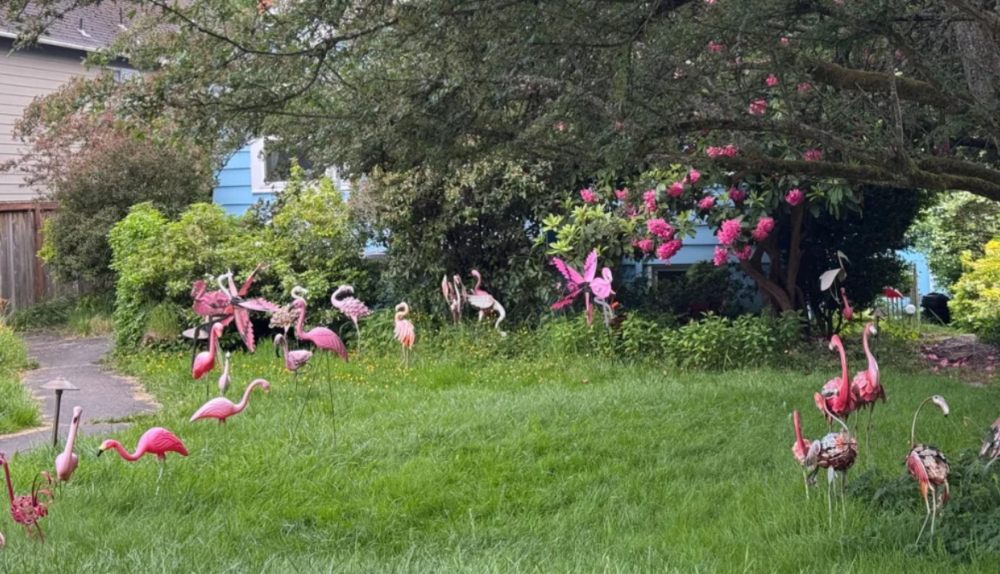
I see lawns supporting vast populations of clover and bees, green in spring and dormant brown in the summer. I see front yards used as installations for art and politics and wild, personal expression. Yards confronting the trauma of climate change with flocks of plastic pink flamingos. Grizzly bears carved out of stumps, and shady refuges of bonsai, river rock and ponds.
I see third generation gardens filled with zinnias and sunflowers and corn, tumbling grape arbors and runner beans reaching for the sky. I see children and families, barbecues, swing sets, chalk and rust Camaros stacked on blocks waiting for a tune-up. Here and there, increasingly rare, I come across a garage and hear the percussion of an actual garage band.

Every time I step outside my gate to prune the Camelia people stop to talk, or to offer me a chain saw when I am tackling the hedge, and I talk to them too: walking around and seeing people outside in their gardens is how I have met almost everyone in my neighborhood. When we tear down these homes and subtract the yards we subtract an irreplaceable opportunity for human connection.
The supposedly monolithic affluence and exclusionary privilege of residential neighborhoods is belied by the prevalence of rentals. A house just-sold around the corner from me (hidden behind 80-foot firs and a rainbow fence of reclaimed doors) housed three young men as an affordable rental home.
The doors and the renters will all be removed for a cluster of Hardie Plank structures that look exactly like every other structure being built, selling upwards of $800,000. Within a 2-block radius of my home there are 12 rentals, tucked away behind shrubs and trees, indistinguishable from homes lived in by their owners. In the rush to densify the city, all of these rentals are vanishing – and with them some of the only available housing for families.

The discussion of zoning, design review, growth and grace is not abstract. It is the lived, visceral experience of Seattle residents. I hope that in the next installments of Design Review Reboot we can hear more from community members about the effect of development on displacement and tree loss and look at how harmonies of scale and greenspace can be thoughtfully protected.
The changes already finalized in Phase One of the Comprehensive Plan are huge, yet few people know about them until they see the house next door torn down, replaced by four new taller houses, and find strangers looking directly into their bedrooms.
The changes being proposed in the next phases under the banner of Taller Denser Faster, go far beyond this. Leading voices on Seattle’s land use committee are pushing for ever greater expansions of areas zoned for apartment buildings from 1/4 to 1/2 mile on either side of bus lines. No attention has been paid to buffers, and low rise one and two story homes will potentially be pushed up against 6-story apartments.
All of this is being done under an insistence on the urgency of a housing emergency, guided by the unproven assumptions that growth in supply leads to affordability, and that there is not (and should not) be any limits to growth.
There has been no acknowledgement of the drastic upheaval in the tech sector that has fueled growth, the current 35.8% vacancy rate in downtown office buildings and indications of a housing glut in the residential sector. There has been no good faith effort to study the effects of Seattle’s already passed upzones and to analyze whether they address our actual needs.
This despite the hundreds of testimonials at city hearings and what we can see with our own eyes happening in every neighborhood: Under Seattle’s new zoning the average new home being built in Seattle is priced at $961,460, a price requiring an income of between $200-$260k. The for-profit sector does not build the family-sized affordable rental housing we need, and we are tearing down what we have so that builders can charge prices of $550-$650 per square foot to the wealthiest buyers.
The “missing middle” housing promise of Washington State’s HB1110 – that was supposed to bring affordable duplexes and backyard cottages – is nowhere to be seen.
Not only are we not getting affordable housing, we are losing everything that has made Seattle a uniquely livable city. Nowhere in the city’s Comprehensive Plan is serious consideration given to the fabric of our existing neighborhoods, which relies largely on harmonies of scale.
In the interest of “affordability” we are told that all that matters is density, and more of it, at any cost. Words like “anti-displacement” and “equity” are taped onto proposed upzones (now disingenuously disguised as “rezones”) to legitimize pure market-driven deregulation of the housing market. The result is the exact opposite of the lofty redistribution of housing opportunity we have been promised.

To challenge this is to be called a “NIMBY,” and shamed for “privilege.” Why do we never hear discussed the enormous benefits to quality of life when people have a sense of place, and what is lost to physical and mental health when privacy, light, history, trees, gardens and creative spaces are erased? Why do we ignore the fact that in the face of added density we have not zoned for any new parks, and our tree canopy is going down with each building permit? Since mid 2024 we have lost over 6,600 trees — the equivalent of Lincoln Park plus another 2,000 trees.
What is replacing sense of place and responsible stewardship of our environment is blanket upzones and an expedient architecture by template, designed to satisfy builders and the urbanist zealots that we have extracted as much monetary value as possible from Seattle’s buildable lots.
Sustainable development is not just heat pumps and electric car plug-ins, or the maximum warehousing of people. Any serious reboot of design review needs to look holistically at how the built environment affects our mental and physical health, and our cultural ecosystem.
For 24 years my neighbor and I have been growing our gardens next to each other. We both have ponds, and our yards are refuges for pollinators and birds. Each August the lilies bloom along our shared picket fence and the scent crosses over into my windows.
The house next door is small, yet as retired not-wealthy school counselors, my neighbors struggle with the astronomical rise in property taxes; as in every neighborhood in the city, their displacement is a real risk. I am grateful for every season of lilies, not knowing when it will be replaced by the season of the developer, the blasting song of compressors, and the scent of freshly poured concrete.
Sense of place, character, creativity, connection, these are values that have no dollars attached to them. My friends, how do you effectively organize to lobby for something with “no value?”

Discover more from Post Alley
Subscribe to get the latest posts sent to your email.


No affordable housing will ever be built by the private sector because it is not economically feasible. Even if land was free, the cost of construction and approvals is not affordable.
The self-righteous movement to increase density at all costs is disingenuous- it’s real goal is a socialist movement to get rid of older, established housing and the older, established “rich” people who live there.
I wouldn’t go that far. We still like visiting grandma in her old house.
Affordable housing via private builder does happen — it cycles down from up- to down-market as units depreciate over the decades. The author herself is lamenting the loss of this naturally occurring, private market affordable housing. These units will eventually serve people who need them; it’s a shame nobody saw this coming and started the necessary task years ago.
There is nothing socialist or ‘progressive’ about this. Working to eliminate older people, like their parents and grandparents, who earned their homes under the circumstances of the time is simple intolerance.
I agree with much of this — the equity/privilege shaming by “YIMBYs” and urbanists is reaching for a time worn morality weapon with which to club detractors. New units are NOT affordable, and displacement is real.
But… cities grow, change and evolve over time, and I’m not hearing any solutions from the author besides a blanket “no” to everything.
If I were queen of the city, I’d lean in to backyard cottages (technical assistance, loans) to boost LOCAL and small scale ownership of rental options and income streams. I’d take a good hard look at our tenant law and toss out burdensome regulations in favor of a functioning rental market and more small landlords in the mix. And if design is the main complaint of new MF units, we can tackle that too—identify some cut and paste building concepts that meet some aesthetic value and run with those.
Change is hard, and guarding space is a fundamental human urge. But I think there are solutions out there to ease anxiety about it and chip away at the barriers for achieving the goal of more affordable housing, and doing our planet a solid with livable, walkable communities over urban sprawl.
Thank you for your comment. It is not the task of this particular piece to layout the affordable housing remedies: that is an additional three articles. Instead, this piece comes from the vanishingly small Lobby for the Intangible. If you would like to read more about solutions, I would urge you to visit Medium and The Green Urbanist, where I have several pieces addressing alternatives to blanket upzoning. (I don’t think it is advisable to post live links here, but it comes up if you simply put the green urbanist on medium into a web search.)
That said, embedded in this piece are the facts of displacement, as the rental houses are torn down and replaced with luxury homes for those in the top 10%. I was one of the first homeowners in my neighborhood to create a backyard rental cottage. The original ADU ordinance was intended to allow and encourage that. It has morphed, under the influence of MBAKS and the developer-adjacent city council and “abundance” ideology of Olympia into something else entirely: 3-5 units of market rate housing that cover nearly the entirely of the surface of the lots and max out at 2,200 square feet.
The most obvious way to insure affordable housing options was there in the design of Phase One of the Comprehensive Plan: limit FAR (the floor area ratio.). We are mandated by Olympia to permit 4+ houses per lot, but Olympia did not legislate the size of those homes, and it DID provide model ordinance language that stated the new houses should “be compatible” with neighborhood character and scale. When houses are smaller they are cheaper. And there are hundreds of small developers who build this kind of house who would gladly step in to do this. Instead, our city council went with the maximum FAR, added 2 feet in height, and thus encourages the most expensive new housing.
Private Equity companies have been banking properties for years in anticipation of this, and are now beginning the tear-downs and the newest crop of high end housing. If you do some research on Portland you will see them doing something very different–and they actually have new duplexes (just like we were promised on the brochures for One Seattle!) that sell for $400,000!
I live in one of these rental houses. New Urbanists are – and I don’t say this lightly – my enemy. To nowhere near the existential degree that the actual MAGA Nazis are, mind you, but my enemies nevertheless. The smug entitlement and arrogance is almost South Park level at this point, and watching the mutual admiration society at Publicola is almost comical (don’t even start me on The Urbanist). Ron Davis getting his know-it-all a** handed to him was one of the happiest political days I’ve had in recent memory.
I think they really believe that their simplistic view of supply and demand helps lower and middle income renters, and speaking as someone who has been on both ends of that scale as a Seattle renter for 40 years they’re dead wrong. Many thanks to the author of this piece for a great summary of what the real world looks like.
Watching Davis lose again was a summer highlight for me. Seattle urbanists don’t grasp how preachy and top down they are perceived. Promoting another tech bro to solve the world’s problems was a big miss.
It’s also a problem that local urbanists favor market deregulation to build new housing units while simultaneously propping up rigorous regulation of rental units. Housing creators = good, landlords = bad? No, they are the same person! We cannot have a functioning rental market if the burden of renting property is too high. Even the institutional low income housing providers are asking for relief.
There are very good reasons why The Urbanist blog does not allow public comments.
Seattle’s tech sector is slumping right now, but with another job boom of any kind, all the high-cost problems we are facing now will come roaring back. Our supply-side response is solving nothing.
Your points in both posts here are well taken.
You give me hope for humanity.
“Sense of place, character, creativity, connection” is what makes us human. There may not be any “apparent” financial incentive to support this way of life, but protecting it should be our highest priority.
Let’s meet and find our collective voice.
Terrific piece! My new film is about the unsustainable consequences of growth.
OK Spielberg!
Beautiful exposition of the lived experience of so many of us whose modest and mild families and roots go deep here.
Well said!
Wonderful insights. We will not know what we are losing until it’s gone. Some blocks in the city are ‘gone’… when strolling Ballard south of NW 61st street or in Whittier Heights at 13th Ave NW, for example. Imagining a city completely replaced by ‘warehousing of people’ living environments seems to be acceptable to council member Strauss who states he an advocate for the urban trees, but bullies fellow council members to disregard tree accommodations except for trees that might be located within the 5-foot radius of the corners of a lot (no joke).
Without trees on private land, and even if we found a means and budget to double the existing amount of street trees, Seattle’s average tree canopy cover would reduce from 28.1 % to somewhere around 18%. While city’s like NYC and Tacoma with just 18+\-% canopy cover are now trying to find any way to achieve the canopy cover Seattle has today. Ironic or ignorant?
It’s not reasonable to say that every lot in the city could be stripped of all its trees.
David Moehring.
Maybe you are against even the mildest changes?
You were one of those people who in 2018-19 opposed what is now current DADU law. No?
An incredibly easy perspective to have when you’re already a homeowner. This is just guilty NIMBYism. Of course you don’t want anything to change – you got yours, so screw everybody else. You talk about the home prices as a justification for not developing more, and not a word about the urban growth boundary that artificially increased the home prices.
The bees will be fine. They can build their home anywhere. Unlike us humans, who have decided that only the rich or elderly should be allowed to own a home, because the neighborhoods are charming. What about the bees? What about the trees?
What about your fellow Seattleites who weren’t lucky enough to buy a home decades ago?
Lots of us rent older houses- or at least until they’re torn down to make way for $800K-1.2M ones (as is occurring just down the street from me).
Older apartment buildings are also threatened by these policies. If you melt down every 2009 Toyota Corolla to build new Rivians and Teslas it doesn’t make cars cheaper.
The NIMBY slur is losing its power.
This is a sample of tech bro minion troll speak.
Nimby! Nimby! Nimby!
Those of who can are trying to build DADU’s in the backyard – for us!
We’ll let some young family live in the house.
Change is the only constant. Old people know that better than anybody.
And the trees, birds and bees won’t be fine unless we design and build around their continued existence. We need developers that get that. We need developers that want to build family condos so that ownership is in reach for the sub 80% of AGI.
For profits will never meet the market need. They don’t care about you.
You want to own a home in Seattle and you only have a <$150k income?
Be prepared to build it yourself! Quit whining that its not being given to you!
The “ADU” built next door to me fills the ENTIRE (once) garden by developers and sold separately for over 800k, along with a 2 million dollar home in front which is 7 feet from our 1890 home towering like a skyscraper. Progress for the rich.
I suppose they could have stripped a 5-acre lot in Sammamish.
This is the big fallacy of all Seattle urbanists since the first Comprehensive Plan was adopted 30 years ago – the notion that increasing density in Seattle will prevent development at the outer fringes of the Urban Growth Boundary. It hasn’t and won’t – have you actually been out to Maple Valley or Mill Creek lately? Nothing we’re building in Seattle is preventing that development because it’s a fundamentally different market. Seattle should stick to the urban village strategy and focus new development near actual transit (not proposed – like the upzones for a monorail that never came) and job/retail centers and disabuse itself of the notion that we can solve the region’s problems on the backs of Seattle neighborhoods and taxpayers.
Oh, and count me as being firmly in the Rhett Butler camp with regard to giving any priority to the problems of people who can afford to buy an $800K house.
“… you don’t want anything to change … justification for not developing more …”
Nope. Nothing anyone has in mind, is going to come near achieving that fantasy.
One of the big unexamined fallacies in this business, is that we don’t have any land to build housing on, unless we keep upzoning. There’s a lot of land, and that’s how it has been possible to sustain very high rates of housing production over the past 12 years or so.
When the big upzone to 4 units on every lot happened last year, developers bought up land, but weren’t so excited as to file a lot of permits to start developing housing on it. The realities of housing production turn out to center on finance costs, availability of labor and materials, perceived future demand. Interest rates are up, tech sector looks like it’s shedding employees … hardly surprising.
High density residential has its place, literally. The way we used to do it, before Olympia waded in, we put multifamily residential in core areas, where the numbers would add up for walkable retail streets, transit etc. That really depends on the existence of surrounding low density. Spreading out high density, is a contradiction in terms, it’s a recipe for an automobile-oriented settlement pattern.
Greg, you have a point: many of the people you say are guilty of NIMBYism grew up in or moved to Seattle decades ago, when housing prices were lower and reasonably affordable to more people. But is it a moral failing that they bought houses in neighborhoods of mostly single-family homes, and they want to keep living in them without a 5-story overlooking the backyard?
Consider for a moment — for residents of long-established neighborhoods mostly zoned for SFH, resisting change is not really “screw everybody else-ism,” it is “preservationism”. It is not a strategy aimed at would-be owners; it is intended to preserve a way of in-city living that has characterized Pacific Northwest cities for the past century. (Of course, tastes differ.)
Promoting ever greater density by allowing developers free rein to build and the characteristic human-scaled neighborhood most of us love will be lost, probably forever, to the detriment of everyone. (If people want density, there’s New York or Chicago, to name just a couple of options.)
In the meantime, the good life can still be lived outside of Seattle city limits. Still yearning for that buzzy urban vibe? Consider the upside of renting in the city, rather than owning property: not having your capital tied up in “dirt”, outsourcing maintenance issues, enjoying the freedom to change locale and lifestyle as jobs and family needs change, etc..
Good luck finding the balance that works for you.
Iskra thank you for that piece.
You summed up the culturally bankrupt nature hating urbanist vision succinctly.
To the other commenters – actually, there are and were multiple solutions offered to the City Council when phase one was being pushed through.
If you want to find out more, try Tree Action Seattle, or the Seattle Parks Foundation.
Just to be clear – the One Seattle Plan is a Private Equity sponsored coup de tat to maximize profits and create mortgage backed securities for the global market.
They don’t care how much money they spend to win.
If you care about this city, get involved politically.
This is data centers on a larger scale.
Yes, we need more residents to pay for all of the infrastructure that is failing. Infill development is the way to achieve that and preserve and create better neighborhoods.
Make your voice heard.
Reach out to opposition groups.
Taller, denser, faster is a real estate scam!
And stop voting for urbanist tech bros – they don’t give a shit about you.
‘ No attention has been paid to buffers, and low rise one and two story homes will potentially be pushed up against 6-story apartments’
Are the lives of those that live in one story homes really that much more valuable than the lives of those who live in apartments? People who live in apartments are people to – and their ability to exist should not be banned by a few one story low-rise neighbors.
If we ban new housing, we just get more poverty, more money spent on rent, and more people that lived here their whole lives being pushed to Texas. Cities grow, and the same people opposing change now would’ve also opposed Seattle becoming a city in the first place, they’re just against change.
Older apartments and the unsubsidized affordable housing they contain are also being displaced en masse by undiscriminating pro-density policies.
“If we ban new housing, we just get more poverty, more money spent on rent, and more people that lived here their whole lives being pushed to Texas. Cities grow, and the same people opposing change now would’ve also opposed Seattle becoming a city in the first place, they’re just against change.”
Were ANY of these ideas included in the article? I can’t tell you how many times I’ve heard an urbanist come back with unrelated arguments. It has never been a helpful response.
When I read this and similar comments I want to pull my hair out. No one is saying NO GROWTH. But what if we more mindfully placed the growth where it makes the most sense. Increase zoning where apts exist. Increase heights on Cap Hill and adjacent to downtown. Yes, also around light rail. But to blanket the city with apts without thought to what that will look and feel like is just plain ignorant. Keep in mind that almost all new housing is what developers can make the most money on. This is a “developer enrichment program” on steroids, not a thoughtful approach to provide more affordable middle housing.
EXACTLY!
“Increase zoning where apartments already exist” means that the bigger apartments that get built displace the more affordable older apartments that several commenters here think we need to preserve… we are the largest city north of SF and west of Chicago. There are a lot of tech folks that are willing to live in apartments and condos when they’re available, and will buy up the old, more affordable housing stock if we continue disallowing reasonable density in much of the city.
Actually, I’m rather for no growth. No one can convince me that we are better off for having increased 20% population over the recent past. Housing pricing, traffic, noise, homelessness, less trees, etc. And for what purpose other than importing people who live here for 2-7 years to get their vesting at a tech company and move to the next job in another city. I’ve gone to city after city in the US that has stable population and is improving the life of citizens.
You’re not allowed to say “no growth”! That taboo is a result of the utter failure of most people to understand that ‘limits to growth’ are very real. Adding current energy and resource consumption levels we arrive at “peak everything” (title of a great polemic by Richard Heinberg). It is clear to competent scientists that we are heading into a time of huge ecological, social, and political disruptions from climate change combined with population overshoot. But we can’t talk about the need to start for major changes to our political economy. Just try…
No growth, no growth, no growth. See how easy it is?
Beyond your points about global limits, I just can’t figure out why we need more people in Seattle.
When I propose that we’ve done it to ourselves with the massive growth surges, and if we don’t like it, the obvious thing would be to rein that in … is responses that suggest people haven’t thought about it at all.
Which they haven’t, as in the main, people dont’t think about stuff that hasn’t been dragged across their field of view with lights blinking and horns sounding, and for sure no one is going to invest a lot of promotion for a policy shift that’s by definition less lucrative.
Jobs is an easy sell, even if it turns out to just be jobs for people swarming in from outside the area.
People disparage home owners’ ineffectual opposition to sprawling multifamily zoning, claiming that it’s because they want housing shortages to increase the value of their holdings – generally not true – but it never occurs to them that this is exactly what economic growth is for: enriching land owners.
It remains a standard of “success”, because people blame its costs on anything and everything else.
Kudos and I’m on your team. We don’t have room in our country. Look around the world and ask why people should give up their culture, their health and safety to accomodate people who don’t share those values. Why is it more important for someone to move to Seattle than for people who already live in Seattle to keep our neighborhoods? We can cut down all the forests and keep building but at what point do we stop?
“Design done well fosters the intangible values that make a city not just livable, but lovable: an environment where arts and culture can thrive.” So well said. Planning without consideration of a sense of place is not only half baked, but downright dangerous to any city. The city leaders up zoned all SF properties to now allow a minimum of 4 units and has yet to confirm how many untis this would yield over time. Instead, they are rushing off to up zone the rest of the city without regard to real impacts from such growth. Just look at our own neighborhoods. When they remove one SF home and replace it with 4 others, what do those units sell for? That is NOT affordable housing and to keep repeating that density is necessary to begin us affordability is just nonsense. WE CAN SEE IT WITH OUR OWN EYES! Thank you for this truly well spoken piece.
For too long, developers have been permitted to “buy out” of required affordable units so that money goes to a less efficient housing authority building economic ghettos in the suburbs rather than creating more diverse communities where they are most needed. I believe we are about to learn that we have a market rate apartment surplus and the market will do what it always does with over abundance.
Thanks Iskra, I hope Eddie Lin reads this. He certainly needs to listen and respond.
Bravo Iskra. I point readers to the Green Neighborhoods Coalition.org website also.
Thank you Iskra for the thoughtful piece. I fear that if we don’t give consideration for scale, history and the aesthetics of the buildings that we are putting up, we will ruin the very neighborhoods that attracted people to Seattle in the first place.
Once you mow down old growth timber, it is never coming back. Similarly, once the “charming “ neighborhoods are mowed down to accommodate greater density, they too will not come back.
What “old growth timber” are you referring to? I’ve not heard any urbanists proposing Seward Park or Schmitz Park should be developed
There are lots of 100+ year old majestic and mature trees in Seattle. But you knew that.
I was using an analogy. We once had old growth timber in Washington State. Sadly, most of it is now gone.
Thank you, Iskra
A cogent essay describing the literal facts on the ground.
The Urbanist credo of the 10 (or is it 15 or 20) minute city is their cruelest hoax: Three of the nearest groceries to us are gone. There were once two garden stores, now none. There were once two hardware stores, now none. The pharmacy that was a short walk is a restaurant now. Metro eliminated the two closest bus stops to our place.
Meanwhile, thousands of housing units – ‘units’ not houses– have been built or are under construction a mile to the West and South. To the North, lower density townhouses have replaced single family homes. The thousand-square-foot, shingled bungalow is almost extinct.
I do know those in my cohort who have adjusted: they now live on floors 20 and above using Uber to move around. We, apparently, aren’t that flexible. Up there, it’s hard to keep that 4’ x 12’ tomato patch watered and grilling a side of sockeye ain’t happenin’.
Emmett Watson remains my hero.
Dear fellow boomers: Until quite recently, you were able to freeze Seattle as an old-fashioned lawn and garden show, especially in your lovely North End nabes, preserving 75% of this city for single family homes. You did this for nearly three decades while the city was adding 300,000 new residents. The result was predictable: a huge housing shortfall with skyrocketing rents and a deepening homelessness crisis. Now you act all outraged by the outcome you created, and the logical efforts to fix your exclusionary, selfish behavior. Please make up your minds: Would you like to live in a city that manages to grow taller, denser faster while preserving tree canopy (like they do in Paris and many other very dense, European cities) or do you just want to continue to screw all the younger, less housing-secure folks while you enjoy rising property values and pretend like this is still 1996?
Nice try. North Seattle didn’t get like that through deliberate boomer intention; it is like that because of neglect. Maybe that’s a good thing. However, there are very limited sidewalks, and flooding remains a problem. The local Thornton Creek watershed is so contaminated that school children are not allowed to release salmon into it. No shortage of poverty either. https://www.researchgate.net/figure/Map-of-Seattle-Census-Tracts-Color-scale-by-disadvantage-index-with-circles-sized-by_fig1_349884396
With our current market-driven housing policy, when the next economic boom comes along, housing prices will spike once again. This is happening in San Francisco right now with the AI bubble
Well, you’re half right. The boomers are fighting hard to retain their leafy privilege in single family neighborhoods (concentrated in north Seattle), but — yeah — the origin of this does predate them. In fact, it goes all the way back to 1923, when Harlan Bartholomew drew up a zoning plan he said was designed to “preserve the more desirable residential neighborhoods” in Seattle, and to prevent movement into “finer residential districts…by colored people.” Later, the boomer’s parents used redlining and racial covenants to preserve those “desirable” (white, single family) neighborhoods even further. So yes, I agree that we shouldn’t blame the boomers for Seattle’s north-south inequity. But you’re wrong to suggest that what we observe (tree inequity, for example) was accidental, or a function of “neglect.” Our white ancestors worked hard to make it look this way. And we boomers are largely responsible for the fact that young people of various stripes, as well as lower income folks, increasingly struggle to pay the rent here.
Walter, “leafy” is key here. Greasing the way for developers to throw up housing to the developable limit reduces our canopy. That is very serious because it reduces the ability to reduce heat gain and lessen runoff.
One person’s ‘leafy privilege’ is another person’s holistic response to climate change. And I disagree that North Seattle has not been neglected. North Seattle was only annexed to the city in the mid 50’s. Promises were made that have not been kept.
I won’t dispute that bad behavior has deep roots. We all know that. You’d think we’d want a housing policy that could at least begin to repair the damage, but our reliance on developer-driven methods will never get us there.
Seattle is already a heat island. Tree removals and tall buildings in close proximity make that worse. Seattle’s cherry-picked response to climate change will result in a less beneficial outcome for all residents.
Ruth: If you worry, as I do, about climate change, you should favor greater density in Seattle. In addition to pushing rents even higher and causing even more people to end up homeless, the status quo (“leafy privilege”) alternative will bring more sprawl,, even longer commutes (more fossil fuel consumption), deforestation. Also, if you really care about tree canopy, as I do, I hope you will join the Green Seattle Partnership or other groups planting and maintaining leafy spaces in places like Chinatown ID or Beacon Hill, which have been the victims of longstanding exclusionary, “preservationist” policies and practices in this city.
Gosh Walter, you are so full of propaganda and stereotypes that I wonder how you are able to swallow a glass of water. White people? Perhaps that is how you see the world. I love that you bring up racism. The Central District has a whole host of people decrying that black people have been priced out by gentrification. Exactly the same phenomena in these “white” neighborhoods except here they call it progress. And the data is in, density raises the price of land and increases the price of housing. That is the fact that anyone can see and the research backs it up. If you can slice up the land into smaller units and sell each one for a million, then future Seattlites will have smaller and smaller pods with no trees, congestion and electricity shortages. Which means killing more salmon to create more electricity for all these people, plus Water shortages and sewer outflow and treatment. A nasty city with no salmon, no orcas, no trees and a host of dense ugly high rises is the future you are envisioning.
During that time, developers also added 10-13K units per year. That rate is going to stand as the peak, despite recent and future upzones – the amount of units that can be produced in a year in Seattle is limited by other things than zoning.
Don’t blame boomers – if any boomers have held power with city hall, they’re real estate developers and the public servants that serve them. No effort to curb upzones or other developer give-aways have succeeded in decades.
The results of growth surges like Seattle had in the mid 2010s are predictable and unavoidable. They shouldn’t create a mandate to trash the city.
Homelessness is not ever going to be solved simply by building more unaffordable housing units.
“Would you like to live in a city that manages to grow taller, denser faster while preserving tree canopy” — This is a flat out falsehood if you mean Seattle. Seattle’s tree ordinance is designed to allow scraping of lots when “taller, denser” happens. Please deal with Seattle’s political reality Walter, not what you might wish had happened.
I wonder how much of the responsibility of incoming migration falls on a city and it’s current residents to accommodate. And lumping homelessness into this issue is a stretch.
Thanks for your essay, Iskra. It resonates. Years ago I was an urban affairs writer for the L.A. Times. Southern California is a war zone over density. These debates go on there endlessly. I was a guest memeber of an architectural/urban planning group in Orange County for awhile. The internal discussions were quite frustrating. Local cities lacked the resources to implement the well thought out plans of the urban planners. Developers were told to go build new housing 20 to 50 miles away. That approach created the sprawl that is there today. It doesn’t work anymore. In all my discussions with neighborhood representatives from areas similar to Seattle’s Magnolia, there was a common thread: “Leave us alone.” In other words, no changes, please. That’s what allows a 1940s-60s 3 bedroom house to soar to over $800K or higher–very beneficial for generational wealth. But is that greedy? Some would say yes, others no. It certainly isn’t a solution for Seattle. Someone must have a better idea.
Nothing in my essay suggests “no growth.“ The original HB1110 “missing middle” legislation imposed by Olympia was supposed to provide the modest homes needed by the middle and lower income populations, and the campaign to pass the legislation was marketed with pictures of garden courts, duplexes, and 1-story backyard cottages that would be affordable: and also compatible in scale with existing neighborhoods. Anyone can see that we are not getting that with the recent upzones.
By placing the preferred profit margins of the bigger development companies and private equity above the need for affordable housing that fits the environment, we have simply accelerated the gentrification and displacement process.
When I turned my backyard garage into a modest rental in 2014, regulations would not allow anything larger than 800 ft.², and if I did an upper story, it had to be set back 10-20 feet from adjacent properties, so as not to affect the light and privacy of neighbors. I could not pave over more than 35% of my entire lot and they came out and SDCI actually counted the bricks in my courtyard.
All those rules are gone now. You can subdivide or do other sleights of hand and build a 2000 square-foot two or three story structure in what used to be the “backyard.” You can go virtually to the lot line of your neighbors. With our loophole-ridden tree ordinance, you can take down every tree on the lot if you claim the trees are in the way of development. I do not believe it is development itself that the neighbors are objecting to, but the key issue of scale.
People do not just buy a house, they buy a neighborhood. So the people who have bought their houses in Seattle’s neighborhoods over the last 30 to 50 years, thought they were buying amenities like light, privacy and nature— which are inextricably tied in to setbacks, side yards, limits to impermeable surface, and height. The deregulation of construction under the new Comp Plan takes all of that away. If developers purchase the houses on either side of a typical 1-2 story older home, it results in a three story house looking directly into the windows and yard, shading gardens, and cutting off light. Lose-lose for the quality of life the homeowner thought they had purchased.
Alternatively, we could zone for much smaller homes (that were actually affordable to the 30,000+ people who need them in Seattle) without destroying the fabric of the neighborhoods. This is being done in Portland, (although they are losing far more trees than they should,) and as a result, there are new homes being added there that cost $400,000 instead of $900,000.
This is not a fair comparison. Median priced homes in Portland are closer to $550,000 — it would track that their ADUs sell closer to that price than Seattle.
Iskra Johnson,
“Alternatively…”????
How?
What do you mean? I’m intrigued by your suggestion but don’t understand it. Are you for example suggesting
3 houses on one lot but bigger house max of 1500 with two of them must be less than 1000SF each?…. Something along those lines?
Great response, Iskra. Thanks for your article.
“Alternatively…”????
How?
What do you mean?
3 houses on one lot but bigger house max of 1500 with two of them must be less than 1000SF each?
The townhomes added in downtown Fremont after it was designated an “urban center” amounted to a land rush with a run of cheaply built townhouses that do not support families or aging in place. They look awful now, 20 years later. Rather than terming a goal for a place, I think that organic development is much preferable. Infill is much more in keeping with neighborhood character.
I agree that we need to rethink the Comp Plan. Here’s why.
We know that if backyard cottages and mother-in-law apartments were built to complement single family homes citywide, we would build density while we build community. We would retain tree canopy, wildlife habitat (birds, squirrels), and the pollinators and places for children to play outside unsupervised. We would grow the city as a humane and beautiful place to live. A place where all feel welcome and supported. A place to call home.
I know this is true because we built a DADU in our backyard under the previous zoning that limited lot coverage, unit size, had a parking requirement, and a requirement of owner occupancy of one of the units. While we doubled the footprint of a single car garage and went up a story, we retained every tree and the garden, providing habitat in an increasingly concrete jungle. Importantly, we preserved a 125 year-old house.
Across the street, two rental bungalows that housed families and a single family home occupied by an elderly couple whose extended family visited regularly have been demolished and replaced by 16 empty, overpriced townhomes that are destined to remain unoccupied for the foreseeable future. Priced from $860,000 to over a million, these units might have been previously snapped up by single tech workers who are now threatened by layoffs and AI, not to mention high mortgage interest rates. They are not investing in expensive real estate.
These townhomes are featureless with flat facades that look like they came directly off the computer screen. The construction materials are cheap and the process of building was fast and slapdash. The coup de grâce is the coverage of the entire lot with concrete pavers–not a tree, a blade of grass, an ounce of natural habitat. These 3-story townhomes of 1200-1500 square feet have staircases that use up precious living space. With multiple stories, these are not suited to families with young children or elderly people with mobility problems. The market is narrow and getting narrower. Meanwhile, we are ruining our neighborhoods and neighborliness.
The Mayor’s and developers’ dream of “taller, denser, faster” is not a vision for a better city. It is a recipe for disaster for a livable city. Four walls and a ceiling does not make a home. The quality of construction matters. The quality of design matters. The quality of life matters. We need to be talking not just about housing but about what kind of a city we want to have. Some cities have done a much better job of adding density and preserving and even improving livability. Denver is not usually a city that comes up as one of those but a recent visit reaffirmed that it could be done, recalling former Mayor Federico Pena said “imagine a great city.” He did and it is. Seattle needs that kind of leadership desperately if we are going to grow out of our current morass.
“…townhomes are featureless with flat facades that look like they came directly off the computer screen… construction materials are cheap…3-story townhomes of 1200-1500 square feet… are not suited to families with young children or elderly people with mobility problems.”
Thank you for raising these points, Ellen.
My conclusion?
The nimby’s are wrong.
They were complaining about and even delaying through a BS SEPA appeal the DADU amendments in 2018-19
….and what was the result? Zero.
Zero in the sense of zero negative impacts.
So I’m not some big supporter of the City Council (my Rep in D5 is particularly dull ) but the anti-growth people are just so full of exaggerated fears.
Why is anyone that wants to save some of the character of a neighborhood while we increase density considered a NIMBY? You remove the character of the neighborhood enough and people will flee to the suburbs where there is some character and trees. I’d say that the upzoning is a cause of urban sprawl as well as gentrification.
And I’m not a fan of the D5 rep either. She was not elected and does not interact with her constituents.
The City of Seattle and other governmental agencies ALREADY OWN enough land to build, literally, thousands of multi-family dwellings.
It’s tragic we don’t unleash this already -public land for development.
Why? Basic lack of imagination and development competence.
It would be funny except it’s not a laughing matter.
If you want to challenge me about the numbers — fine, but the numbers are there.
Great article. In the rush to make a denser city without considering the quality of a neighborhood, we’re losing both first time homebuyer housing stock and family homes in favor of bottom-line cheaply constructed yet expensive generic boxes. These new buildings will be tear downs in another few decades. What a waste. I’ve seen yards with ancient rhododendrons and large trees scraped, with meager “replacement” tiny little stick trees. Plants filter the air and cool it as well. Neighborhoods with few trees and plants are significantly hotter and unhealthier, problems that will compound and temperatures continue to rise. It’s so shortsighted of this city.
Based on the comments here — almost all of which are to some degree correct/reasonable, even though they’re in complete opposition to each other — illustrates why it’s such a tough job to be on the Seattle City Council.
Tough job to get on the council – a person needs all the help they can get, and unfortunately they don’t really get that kind of help from people like us.
That’s why, once they’re on, you’d never guess they’re struggling with these opposing viewpoints – because they aren’t. We’re relevant to the council only to the extent we can elect council members who will listen to us, and we don’t even make much of an effort. We had one ray of sunshine in 2019, but he deserves most of the credit for running a strong campaign to eke out a narrow victory against an SDA flake. We don’t have an organization, we don’t have money, and we’re up against development industry that has both, all the way up to the global level.
Yes!
I appreciate this sentiment. We are currently being outbid by a developer on the home we have not only lived in but have spent money improving for 7 years and were promised to purchase by owner. We can’t compete with the deep pockets of development. I think the whole NIMBY hysteria is due largely by activistic folks.