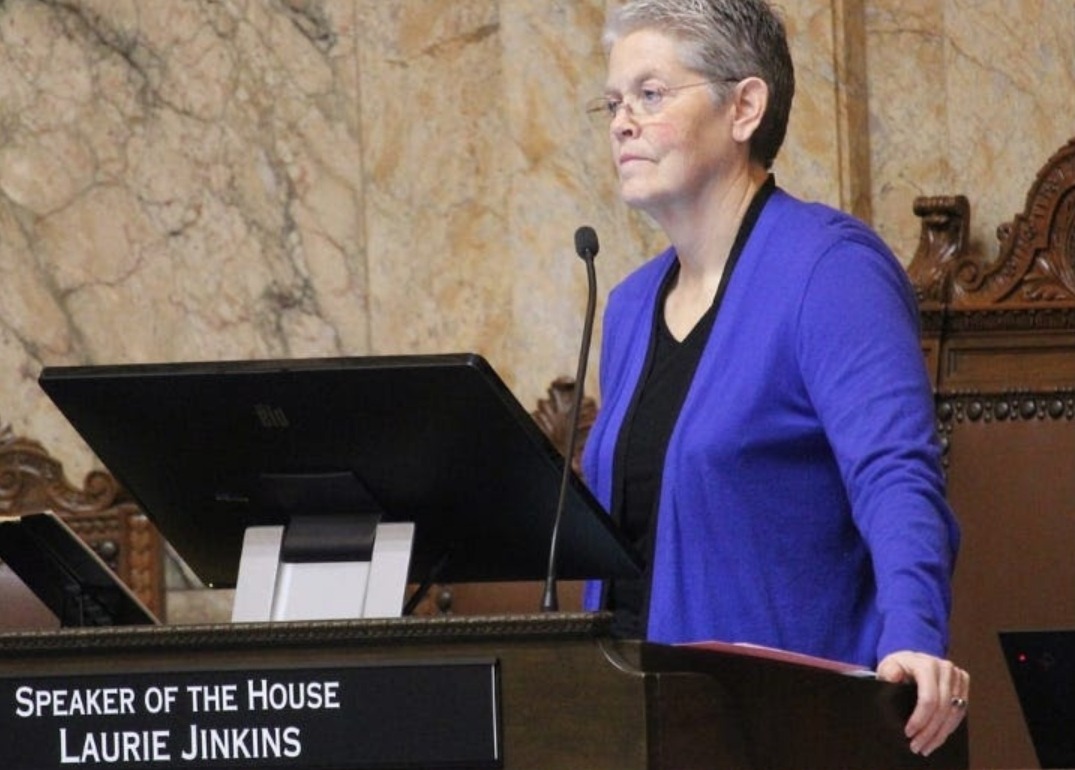

Counting votes to depose the Speaker of the House is a common parlor game in and around legislatures all over the country. Somebody’s always cranky with the speaker, and every statehouse features folks who see themselves as better suited for the big office than its current occupant.
But it was surprising to see House Speaker Laurie Jinkins herself surface the brewing competition to oust her via Jerry Cornfield’s piece in the Washington State Standard, in which she disclosed a conversation with would-be ouster April Berg, the chair of the House Finance Committee.
While the leadership aspirations of Berg, (D-Mill Creek), had been widely rumored (We floated said rumor ourselves in our Winners roundup at the end of the session; Berg jokingly blamed us for the current kerfuffle), Jinkins dragging them out pulls a contest that at least nominally won’t happen until late in the year into the present, at least for discussion purposes.
We got Berg on the horn and she reiterated that she’s focused — for now — on defending her seat in Snohomish County’s 44th Legislative District and that any discussion of the next Speaker should wait for at least the results of the August primary, if not the main event in November.
This is a little bit of an eye-roller. While the 44th has been purple or even red in living memory, it’s been solidly blue in recent cycles. Berg, first elected in 2020, shrugged off GOP challengers in 2022 and 2024, winning with more than 55 percent of the vote both times. It’s not clear that this year’s challenger, property manager and yoga/wellness coach Tonya Stadlman, is up to the task. Berg has a massive campaign cash advantage and the smart money on the right is on the sidelines for the moment in what looks like a Democratic year.
So let’s unpack the depose-the-speaker idea a bit:
Despite her embrace of the role of House architect of the state’s new income tax on its highest earners, it’s not really accurate to describe Berg as left of Jinkins. The caucus is full of overlapping ideological factions, which can shift depending on what issue they’re wrangling over.
The primary knock against Jinkins’ leadership is the chaotic way in which the House’s Democratic majority conducts business, especially when its collective back is against the wall at major procedural deadlines. We’ve been writing about this paradigm for years, including its endless closed-door caucus meetings, marathon midnight debates, and occasional collapses. Chaos breeds opportunities for minority Republicans and the business lobby to deploy clock-management strategies that ultimately lead to important-to-some legislation dying at those deadlines.
Jinkins empowered committee chairs rather than consolidating power in her own office, the latter of which was the hallmark of the late Speaker Frank Chopp, whose top-down style frequently frustrated his members in different ways. Exactly how the House gets to a better set of systems isn’t clear. Herding a caucus of nearly 60 members ain’t easy.
One issue we’re hearing about in that context is juvenile rehabilitation. Overcrowding and general chaos at juvenile institutions, especially Green Hill School, put wind in the sails of progressive lawmakers wanting to divert more kids away from lock up in the past two sessions. But the bills have generally died in Democratic caucus fights over the optics of a juvenile crime surge, with the arguments distilled by a regret-ridden Seattle Times op-ed by Rep. Lauren Davis, D-Shoreline, penned just before the 2026 session.
Some other issues likely to come into play:
Generational change
Jinkins turns 62 just before the August primary. Berg is a decade younger. Rep. Liz Berry, D-Seattle, chair of the Labor & Workplace Standards Committee and another aspiring speaker, is another decade younger than that. Recent elections have ushered in a cadre of even younger Democrats who might chafe under graying leadership. Existing norms against challenging established incumbents are breaking down in general. Several members of the majority, including business-friendly moderate Amy Walen of Kirkland, and Majority Leader Joe Fitzgibbon in the West Seattle-centric 34th LD, face intraparty challengers.
A Speaker of Color?
The caucus room has been getting more diverse with each election and the Members of Color caucus now comprises roughly half of the Democrats’ majority. Representation matters, as the saying goes, and this could play out similarly to the rise of U.S. House Minority Leader Hakeem Jeffries, whose quest to be the first black Speaker of that House is outlined in this fine read in the latest edition of The New Yorker.
One dynamic to watch here is how much the actual people in the majority change. There could be many as new members in that organizational vote at the end of the year. That could spur a move for new leadership.
Or this could all turn out to be a collective navel-gazing exercise after which the House Democrats decide not to rebuild the airplane while it’s flying. In any case, expect some closed-door drama at the end of the year.
Discover more from Post Alley
Subscribe to get the latest posts sent to your email.