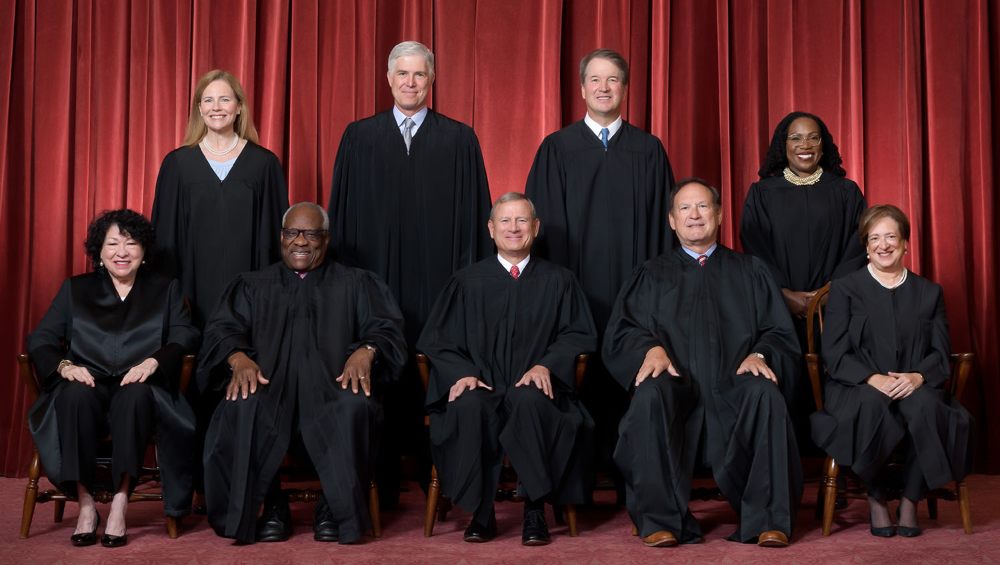

The Supreme Court last week ended its session with a swath of decisions and some deceptively rosy headlines: heralding the 5-4 ruling in favor of birthright citizenship. But relief that President Donald Trump’s life-long obsession with birthright citizenship had been quelled – at least temporarily — was mostly wishful thinking.
What legal scholars are seeing behind the smoke screen is far darker. They say the single most radical thing the court did wasn’t confirming birthright citizenship, but instead it was the dismantling of barriers that had long insulated a broad sector of the federal government from raw presidential control.
In Trump vs. Slaughter, the court approved Trump’s firing of Rebecca Kelly Slaughter, a Federal Trade Commissioner, and the last Democrat remaining on that commission. The issue was decided by a straight 6-3 ideological vote, allowing the president to fire without cause the regulators who had been protecting us from the exercise of raw executive power.
For nearly a century, Humphrey’s Executor v U.S. had been the precedent, requiring presidents to show cause, unusually defined as “inefficiency, neglect of duty or malfeasance of office,” before removing the heads of regulatory bodies like the FTC and other agencies created by Congress. Now a president can fire commissioners because they disagree with him or simply because he simply wants to.
Chief Justice John Roberts wrote the majority opinion, one that he had long been seeking, convinced that executive power is indivisible and the president is its boss. Roberts’ reliance on a unitary chief executive conflicts with those who argue that it ignores the separation of powers and is a misguided precept leaving room for self-dealing, favoritism and corruption no matter which party controls the presidency. It is no surprise to find the court’s decision perfectly suits Donald Trump who has been turning repeatedly to the Supreme Court “to give me the right to do whatever I want as president.”
The effect of the ruling is that it sidelines Congress and creates a government run by a small number of people who work at either the Supreme Court or in the White House. The single exception to this hobbling of government agencies emerged in the case of the Federal Reserve which the Court exempted apparently because of its long history.
But left at risk were such important commissions as the Securities and Exchange Commission, the Federal Communications Commission, the Nuclear Regulatory Commission, Federal Elections Commission and the Food and Drug Administration along with a dozen other full-time boards and commissions that Congress had intended to be independent, operating with bipartisan representation.
Since the beginning of his second term, Trump had already been targeting Democratic membership on the most important commissions, leaving them with only partisan representation and answering to him.
In her 49-page dissent against the Court’s 6-3 majority opinion, Justice Sonia Sotomayor was joined by Justices Elena Kagan and Ketanji Brown Jackson. She deplored the discarding of the democratic regime created by Congress in favor of one that distorts the structure of government. It’s worthwhile — although downright chilling — to read from Justice Sotomayor’s dissent.
In part she writes, “For most of the Nation’s history, Congress and the president together have decided that some government functions should operate at a distance from partisan politics: management of nuclear energy, security of the money supply and safety of the American workplaces, consumer products and chemical hazards. Today this court undoes centuries of political practices and decides all three branches have been acting in defiance of the Constitution all this time. In holding otherwise, the Court gives the president power unknown even to the English Crown, against which the Founders revolted.
Her dissent continues: “The result is a President who emerges with greater power than ever before. It is a power that neither the People, nor Congress or the Constitution bestowed upon him. In granting the president this unbridled authority, the court upends its precedent, misconstrues our history and shreds the pretense of judicial modesty. I respectively dissent.”
It is perhaps one of the most distressing decisions that the court has issued and a decision that makes us wonder about the 250th anniversary that we are marking this year, maybe not in celebration.
Discover more from Post Alley
Subscribe to get the latest posts sent to your email.


As Donn Cave and I were discussing (in comments on a different article), this is the dismantling of bipartisan administrative excellence. That excellence is perhaps one of the most important qualities that distinguished our messy democracy from others, and made our systems the envy of the world. Not so much now…
In addition to this was the gutting a few weeks ago of the 1965 Viting Rights Act. This is a corrupt and politicized Supreme Court.