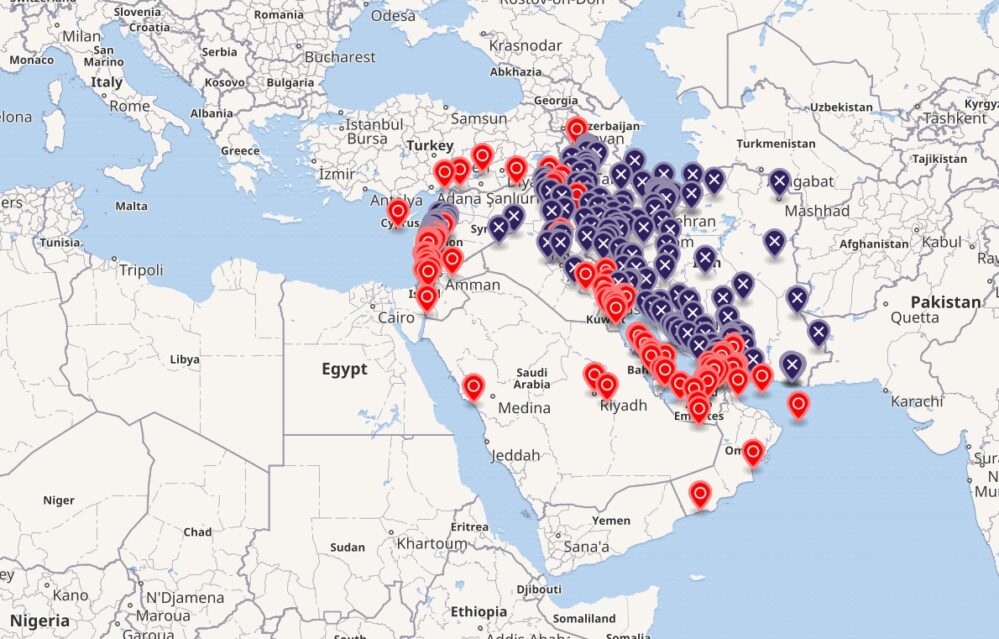

From the first day of his war on Iran (Feb. 28) Donald Trump has claimed victory and said the conflict would be over in a matter of weeks at the latest. He said “it was over in the first hour,” that it was “a perfect victory” and that Iran’s military had been “obliterated.” “They have nothing left,” he said. And, it was “the greatest military success in history.”
But wars’ winners are not determined by bravado. They are judged by whether the goals set—preferably clearly and in advance (at least by a competent commander)—were actually met. By that standard, Trump’s war is no triumph. It’s a strategic failure that leaves the US weaker, Iran richer and the region more unstable.
From the beginning, Trump’s objectives shifted—sometimes by the day. He wanted to destroy Iran’s missile arsenal—until he didn’t. He wanted to permanently stop Iran’s nuclear weapons program—until he punted the issue into the future. He wanted the Iranian people to overthrow their despotic government—until it became clear the war had strengthened the despots. It swiftly became clear Trump had no coherent strategy at all.
Now, thanks to Trump starting this war, Iran has discovered a coherent strategy: it can control shipping through the Strait of Hormuz, threatening a global economic meltdown, which terrifies Trump.
US military forces performed admirably in executing tactical operations: they destroyed more than 120 of Iran’s 145-ship navy and much of its 650-plane Air Force. US forces destroyed more than 7,800 Iranian military targets, including missile storage and launch facilities, drone production sites and command-and-control nodes. At least at the outset the US and Israel maintained unprecedented operational co-ordination: Israel deployed the munitions that killed Iran’s Supreme Leader, Ali Khamenei and up to 40 of his top aides, but the US contributed intelligence, technological and operational support. The US deployed two aircraft carrier strike groups, including their advanced fighter planes to maintain continuous attacks of Iranian targets. But tactics, however brilliant, aren’t the same as brilliant strategy. And any number of studies show that wars are not won by bombing alone.
Trump said US forces destroyed “almost all” of Iran’s missiles, but US intelligence reported that it retained a “significant” number, which Iran has used to attack US bases and allies in the Gulf region as well as Israeli targets. Allied nations had relied on the US to deter Iranian attacks, but as some of the allies attested, Iranian attacks have undermined reliance on the US. It didn’t help Trump’s credibility that the missiles issue was not even included in the MoU he reached with Iran. Or when he said “Other countries have (missiles). It’s a little bit unfair for (Iran) not to have some.” Also, despite US attacks, Iran still has a majority of its pre-war drones— “thousands,” according to US intelligence and no limits were placed on them in the MoU either.
Trump has asserted, as a war goal, that “Iran must never possess a nuclear weapon.” Iran has long claimed that its nuclear program is strictly designed for peaceful, non-military purposes, but given its record as a sponsor of terrorism the world can be forgiven if it does not simply accept its assurances.
That was the impetus for the “EU 3” (France, Germany and the UK) to begin secret nuclear talks with Iran in 2003 after the International Atomic Energy Agency reported on undisclosed Iranian uranium enrichment. The three were joined in 2013 by Russia, China and the US, forming the P5+1. The purpose was to limit Iran’s progress toward building a nuclear arsenal in return for the lifting of sanctions that were stifling Iran’s economy.
It took 20 months to hammer out the final Joint Comprehensive Plan of Action (JCPOA), known informally as the Iran Nuclear Deal, agreed to on July 14, 2015. Even then, Iran had to complete a gauntlet of tasks before Implementation Day, January 16, 2016: reduce its uranium stockpile from 10,000 kg to 300 kg, cap enrichment at 3.67%, far less than weapons grade and ship its excess material out of the country. Also remove and store two-thirds of its purification centrifuges, and accept enhanced, short-notice IAEA monitoring. All of this had to be done before the West would begin lifting sanctions.
Trump (and most Republicans) denounced the agreement as “the worst deal ever negotiated,” “a horrible, one-sided deal that should never been negotiated,” and “paved Iran’s path to a nuclear weapon.” Trump objected to its 15-year end-date for limits on enrichment (which Republicans claimed was just 10 years.) And they ignored its permanent ban on nuclear weapons-related activities. Trump pulled the United States out of the agreement on May 8, 2018. Iran began a phase-out of its agreed-on steps, increasing enrichment, expanding centrifuge use and limiting IAEA access. It withdrew from the agreement in 2025.
For all his disparagement of JCPOA, Trump just signed a Memorandum of Understanding that is manifestly weaker than the 2016 pact. Trump claims his pact—such as it is—is “tougher” than JCPOA, an assertion that would be laughable were it not so…Trumpian.
JCPOA was a 159-page, legally operative agreement that imposed verifiable, quantitative restrictions on Iran’s nuclear program. Trump’s MOU is not even a nuclear agreement. It is a 1.5 page, 14-point framework. Nuclear talks were scheduled to during a 60-day ceasefire following the MOU’s signing, but they’ve been postponed. Iran will benefit financially immediately when the Strait of Hormuz opens to Iranian oil shipments and Iran (presumably) begins charging “fees” for other nations’ ships. Trump claims Iran gained $150 billion in sanctions relief under JCPOA, but that was the total of Iranian assets held by foreigners. Experts put the actual liquid and spendable Iranian benefit from JCPOA at $29 billion to $50 billion.
Under the terms of the MoU, Iran will immediately receive $8-9 billion in sanctions relief, plus several billions more (exact figure unknown) from oil sales permitted during the 60-day negotiating period (which almost certainly will have to be extended). Free of sanctions, Iran will be able to export 2 million to 2.5 million barrels per day, earning tens of billions a year. If Iran imposes “fees” of $2 million per ship (estimated at 120 per day) transiting the Strait of Hormuz, Iran could get an additional $87 billion per year. And on top of all that the US is pledged in the MOU to work with regional powers to develop a plan to give Iran at least $300 billion for “reconstruction and economic development,” which Iran might well hand off to “proxies” like Hezbollah.
Why would the US enable Iran to reap all these benefits? Two reasons: the Trump administration seemed to think (mistakenly) that it achieved regime change in Iran. “They love their country,” Trump said of Iran’s leaders, calling them “far less radicalized.” Vice President JD Vance said the MOU would strengthen Iran’s “pragmatists” as opposed to its “hardliners.”
But expert observers say that Iran’s current leadership is more hard line than its former one, which mowed down hundreds of demonstrators protesting the killing of a 22-year-old woman by religious police. Thousands of others were wounded, including hundreds who were permanently blinded by security forces who intentionally fired at their eyes.
For reasons not entirely clear, Iran broke the truce June 25 by attacking a giant Singapore-flagged cargo vessel in the Strait of Hormuz, triggering days of tit-for-tat raids by both sides. Iran may have been testing how the US would respond—if it backed down, it would have signaled that Trump was desperate for a deal. Or it may have been that the vessel used a US-sponsored Omani channel through the Strait instead one near Iran. Or it may be that Iran was asserting its claimed right to manage the Strait. Or a combination of the three.
Some commentators say the exchanges have threatened the shaky ceasefire, but neither side has declared that the war has resumed. In fact, the two sides announced Sunday they were resuming negotiations.
The second—and main—reason for signing the MOU, according to a blistering editorial in the Wall Street Journal, was concern about the world and US economy, the midterm elections and his place in history. “Without the deal,” Trump said in a press conference last Wednesday, “the alternative would be a worldwide depression.” The Journal added: “In so many words, the President said the Iranians had him over a barrel—of oil.” If he had fought on, “the market would go down to levels never seen before, except perhaps in 1929. The one President I don’t want to be is the late, great Herbert Hoover.”
“There you have it,” the Journal concluded, “Mr. Trump was driven by fear of higher oil prices and a falling stock market going into the mid-term elections.”
Trump was willing to hit Iran once after it hit first, and followed up with more retaliatory strikes, but would not, he said, keep the war going for “three weeks, two weeks, four weeks…two years. You would never see the Straits of Hormuz open.”
On Sunday, as Iran and the US said they were resuming negotiations. Trump threatened that if Iran did not live up to its MoU obligations, the US would “militarily complete the job we successfully started” and “Iran will cease to exist.” Do you believe that? I think Iran has proved it will survive anything Trump can throw at it.”
Personal note: my wife tells me I should write shorter and more often. I’m going to try it: more Trump Outrages soon. (He perpetrates them a mile a minute.)
Discover more from Post Alley
Subscribe to get the latest posts sent to your email.


This is a thorough writing about what has transpired to date. And, no, it’s not too long. It doesn’t even come close to the length of a Trump speech. But this is common knowledge, as it’s been all over the media. But, still important for those who don’t watch or read much news. As for further commentary by Mr. Kondrake, I would like to hear his observations about what can be done to move forward in a positive direction with this administration and this country. We are really in a mess. Yes, I’ll vote, and will do so carefully, in November. I think that voting is on a majority of American minds at this time. We’ll see.
Cards? What cards?