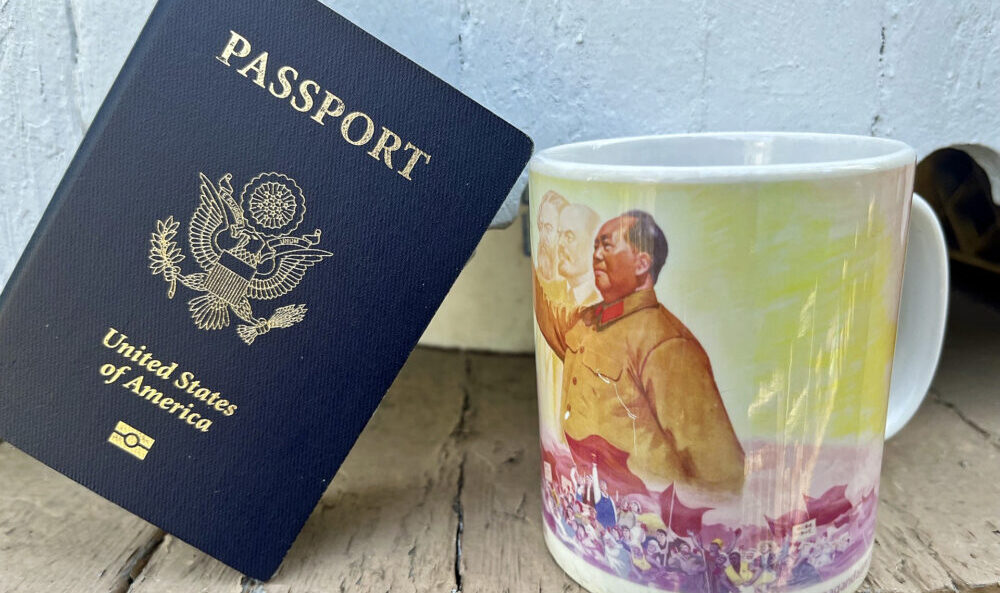

An old friend sends me a link to a piece by Natalie Winters, a 25-year-old influencer who offers “journalism against the ruling class.” This “populist nationalist” Republican gives her piece the clickbait title, “REVEALED: Here Are the Mainstream Journalists on China’s Payroll.”
And she names names: Ezra Klein and Matthew Yglesias, co-founders of Vox; Ron Brownstein, CNN political analyst; Catherine Rampell, former economics columnist for the Washington Post, and many others. She might have named me if I’d had a national audience. In March 2012, I committed the same sin they did.
Our transgression was going on free trips to China paid by a group said to be an agent of the Chinese government.
A professional journalist would not say we were on “China’s payroll.” That’s a lie. I was on the Seattle Times’ payroll. On the trip, I would see what my Chinese hosts showed me, and maybe some other things. But I would write what I wanted.
The sponsor of these trips was the China-United States Exchange Foundation, which is based in Hong Kong and funded by the companies there. That it was not a Chinese government tour made it easier for American media employers, mine included, to let their people go on it. And the tour did not feel like a program designed by some government propaganda office. There was too much private sector in it. I think the PR shop in Hong Kong designed it. Of course, some government office in China must have approved it. Our guide was a member of the Communist Party — I asked him — but he was a guide, not a cop.
Still, why would an American newspaper let me go on a trip like that? Didn’t it come with propaganda? It did. Well, I was 60 years old. I had been writing opinion for the Times for 12 years, as a member of its editorial board. I was used to propaganda. My dictionary defines propaganda as a program of “selected information… used to propagate a doctrine.” I dealt every day with political people and their selected information, which they politely call their “talking points.”
Several times a week the Times’ editorial board would meet in our offices with the governor, maybe, or the mayor, the county executive; other Democratic and Republican honchos, “activists” of all stripes and, during campaign season, every Tom, Dick and Alice running for the state legislature. We sat in rooms with diplomats from Canada, Mexico, Israel, India, South Korea and Taiwan, each of them with their talking points. Other times PR people would take us to lunch: sandwiches, French fries and talking points.
Truth be told, I like propaganda. It tells you what the other side wants you to think, and what they think you are likely to believe — which is to say, what they think of you.
Was China trying to influence us by offering a trip? Of course. Nothing wrong with that; the U.S. Department of State hosts foreign journalists. Lots of governments do it. Each wants to tell its side of the story. Well, just as today, in 2012 China was in the news all the time, and often not in a favorable light. I wanted to hear — and see — China’s side of the story.
I can hear the ethics prigs saying, “The Times should have organized and paid for its own trip.” Dream on. Newspapers are not in the tour business. They don’t have the contacts and know-how to organize a trip like that, or the money, either. The choice was China’s trip or none.
So I went. With me were three other American newspaper men of mature age — from the Nashville Tennessean, the San Francisco Chronicle and the Dallas Morning News. Our hosts filled our time. In Shanghai we visited an elite junior high, where the kids had learned English. In Kunming we visited a manufacturer of ointments, a distribution center for cut flowers, a solar-power plant and a tourist spot called the Stone Forest. At Beijing University we had a roundtable with graduate students. I recall one of them who declared that China was not going to be “fooled” by President Obama’s appointment of a Chinese American as U.S. ambassador. Gary Locke, he said, was American.
“Of course he’s American,” I said. “I know him. He’s as American as I am.”
Our tour was supposed to include a meeting with Locke at the U.S. embassy, but he was out of town. At the embassy we met with another official who gave us the U.S. government’s point of view. It was our hosts’ way of saying, “We’re not showing you all one side.”
Much of the trip had little propaganda content. One visit that did was in Shanghai, where they took us to the offices of Huawei, China’s top tech company. We were ushered into a room where two men began telling us that Huawei was a private-sector corporation, independent of China’s government. Huawei was no different from Apple, Hewlett-Packard, Dell, or any of our good American corporations.
Huawei was rebutting a report by a committee of the U.S. Congress that the company’s technology was a security threat to the United States. I should have known about the accusation against Huawei, and I didn’t. My companions had not boned up on this either. We had to deduce what the accusation was based on the denials.
The strangest thing was the guys flacking for this Chinese company were not Chinese nationals. I wrote about it in Seattle Times, April 8, 2012:
“For our meeting, Huawei’s spokesman is a Singaporean. The other presenter, David Wolf, is an American who says he does not work for Huawei. I listen to him for a while, and interrupt:
“Who are you? Why are you here?”
I was my way of asking, What’s going on here? Wolf was slick. He gave me a brief answer and moved on. I described this encounter in my Times piece to show Seattle readers that I wasn’t bamboozled. The spiel at Huawei was all talk anyway; we were offered no documents, no equivalent of the Securities and Exchange Commission Form 10-K. And if Wolf and the Singaporean had offered such a thing, it probably wouldn’t have settled the question.
The political intentions of Huawei, I wrote in the Times, were “not something I can know from a visit.”
As for David Wolf, I see that his obituary on LinkedIn says he was a pioneering public-relations professional in the People’s Republic, and that “as far back as 2012 he was advising Huawei of how to handle a U.S. ‘fear of China.’ ” I also see that Huawei has effectively been banned in the United States, Canada, Australia and the U.K. because of security concerns. It seems that Wolf’s PR didn’t work.
I see also that Natalie Winters’ “REVEALED” hit piece on American journalists is based on paperwork filed under the Foreign Agents Registration Act. In that paperwork, the Hong Kong PR shop that set up my trip, Brown Lloyd James, describes its business purpose as “defending and promoting China” in the U.S. media. (The company is now BLJ Worldwide, and is based in Qatar.)
Our internet influencer makes this sound like a spy novel. One of her followers writes, “Just as I suspected, mainstream media has been bought and paid for by communists. They sold out their country for a few dollars and the damage they did is tearing the U.S. apart.” Another writes, “This is treason. The CCP is our enemy.”
You bark like dogs.
Good journalism requires mature judgment. So does the American relationship with China. We have our differences with China, including matters of ideology, form of government, trade, weapons sales and so on. China is a competitor, but it is also an investor, supplier and customer for the United States. The decision to open up to China was made more than 50 years ago by a Republican president, Richard Nixon. It was the best decision he ever made. It’s done, and it would be hugely disruptive and dangerous to undo it. Neither China nor America can afford not to get along.
That is my opinion, which I expressed in print before I went on the trip to China, which is probably how Brown Lloyd James got my name. It is my opinion today. But suppose I was wrong, and that in 2012 China was really an adversary. Is it wrong for an American journalist to listen to what an adversary has to say? A lot of people do think that. Recall the outcry in 2024 when Tucker Carlson interviewed Vladimir Putin. He was giving Putin a platform! Terrible! Putin lies! Yes, some of the time. But is in our interest to listen only to the propaganda of our own government? Have our leaders never lied us into a war?
Natalie Winters’ expose of “mainstream journalists on China’s payroll” is an argument, with a libelous title, for the American people to cut themselves off, to refuse to know how foreigners think and how their governments want us to think. It’s an argument to swallow our own spittle and call it lunch. It is not a strategy that works.
Discover more from Post Alley
Subscribe to get the latest posts sent to your email.


I don’t always agree with you, but I always read your articles (and did before). Well-written and well said.
On a slight tangent, social media has given voice to people whose opinions are best kept to themselves or their immediate friend/family circle. Alas, one cannot turn back the clock.
Enlightening piece, Bruce. From my newsprint days, I well remember fellow journalists taking foreign “junkets.” They were paid for by countries and concerns seeking to shape the views of “influencers” like yourself.
At one point, the biggest supplies of “free” trips was Israel. I recall any number of my fellow newsies benefiting. I was not so blessed. In fact I only once succumbed: I was “sent” on the first non-stop commercial air flight from Seattle to Helsinki, Finland. Although I wrote about the brief excursion and my introduction to the country, I don’t think I swallowed the propaganda or became an unsuspecting asset.
Natalie Winters’ search for Chinese Communist influence missed a prominent CCP asset in a president who praises and admires Xi Jinping and Kim Jung On. And let us not forget the Russians: the FBI investigation of possible Russian aid to Trump’s first presidential campaign was muffled and the ongoing search for Russian influence was scuttled. Her bias embarrasses anyone who appreciates judicious and ethical journalism.
Reminds me of the story of a gangster who gave money to a Salvation Army bell ringer. A passerby asked, “How can you accept money from a man like that?” The bell ringer replied, “I’d accept a donation from the devil himself because it’s for a good cause.” In other words, money is fungible. Like information and reporting, it depends on what you use it for. Tempest in a teapot. I’m glad you went to China. I hope the food was good.