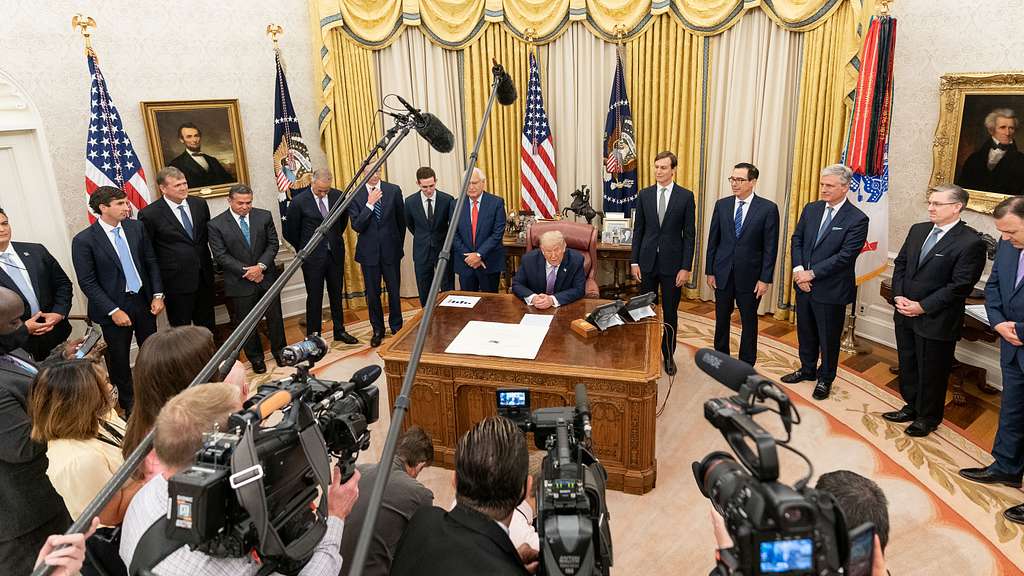

In his first term, President Trump branded press reports as “fake news,” called journalists “scum” and “enemies of the people.” He crudely attacked reporters, especially women. Now, barely two years into his second term, President Trump’s long-running media clashes have escalated, grown into an all-out campaign seeking to stifle and control free speech in America.
Just last Friday, Trump abruptly announced bans on three prominent media organizations, CNN, MSNow and Politico. By Saturday, journalists from those organizations were denied access to the White House grounds and forced to surrender their press badges. Asked to explain his action, Trump replied that the organizations were no longer allowed to participate “for constant reporting of fake news.” Trump indicated “other outlets” would “follow” but declined to specify which ones. The president’s ban on the three news organizations now faces legal action and a decidedly uncertain outcome.
On Monday, other broadcast participants in the White House press pool — ABC News, CBS News, Fox News, and NBC News — whose representatives follow and video the President, announced they would no longer cover the President if their fellow news outlets are barred from the White House. Photographers from wire services and major news outlets also refused to photograph the President. This resulted in a bizarre press conference where the President was inaudible because the press had not set up microphones.
Earlier in his second term, the president banned the Associated Press from the Oval Office and Air Force One because the service would not call the Gulf of Mexico by Trump’s preferred name, the Gulf of America. The AP ban is still being litigated.
Trump is waging his latest assault on the press making use of the tools of government across many fronts. The Justice Department has dispatched agents to reporters’ homes to serve subpoenas flashing a warrant to search one reporter’s devices. The Pentagon has fired the editor and publisher of The Stars and Stripes, by tradition an independent newspaper. The military blocked journalists who have refused to sign pledges that would limit their reporting solely to official Pentagon releases.
The administration has stripped funding from public television and radio. Regulatory agencies such as the FCC and FTC are using their powers – sometimes in new and dubious ways — to pressure and coerce media organizations. The FCC’s Carr, one of the most aggressive supporters of Trump’s anti-press efforts, said that the president is “reshaping the media landscape.”
Driven by his personal displeasure and by determination to shape the narrative to his advantage, Trump is enlisting all levers of the federal government to stifle free speech. He has attacked comedians and talk show hosts and the corporate entities behind them. He has instituted lawsuits, targeting journalists and liberal critics. He personally filed suit against a wide range of targets including The Guardian newspaper, journalist Bob Woodward and the Pulitzer Prize board. And he has opened investigations into the broadcast licenses of ABC News.
Free speech advocates say the president’s intent is plain: to punish, intimidate and silence dissenters. “There’s not a week goes by when they’re not taking a new step to curtail press freedom in this country,” according to Clayton Weimers, executive director of the North American division of Reporters Without Borders. “We’re seeing a substantial diminishment of press freedoms.”
Judges have been clear, repeatedly ruling on behalf of free speech and of press freedom. But the path to legal victory can exact severe financial and reputational costs for those that the president views as adversaries, a group that includes the New York Times, Wall Street Journal and the BBC. Each time the president assails what has long been considered protected speech, he is eroding norms and undercutting the role of the independent press.
Presidents before Trump have taken steps to curtail speech. Richard Nixon kept an enemies list and his aides threatened FCC action again broadcasters. More recently, George W. Bush’s White House expanded government secrecy, and the Obama administration went after sources through leak investigations.
But Trump’s administration is breaking new ground, unapologetic about its goal to achieve firmer control over national information. White House communications director Steven Cheung, writing in a social media post, called his assignment “Full Spectrum Dominance.”
It is a time of mounting pressure on news sources, a time when independent reporting is threatened, not only by Trump, but by the surge of social media influencers, partisan propagandists and AI bots peddling fear, outrage and misinformation.
Writing last week to mark the New York Times’ 175th birthday, newspaper publisher A.G. Sulzberger acknowledged that the future of America’s free press is uncertain and blasted Trump as “the most hostile president to the American press in modern history.”
Nevertheless, Sulzberger declared this is an opportune time to remind ourselves about how much the country depends on trustworthy sources of information. He called for all news outlets to recommit to original independent reporting. Expressing hope, he concluded that “Our nation has been through a lot and will find a way through — whatever comes next.
Discover more from Post Alley
Subscribe to get the latest posts sent to your email.