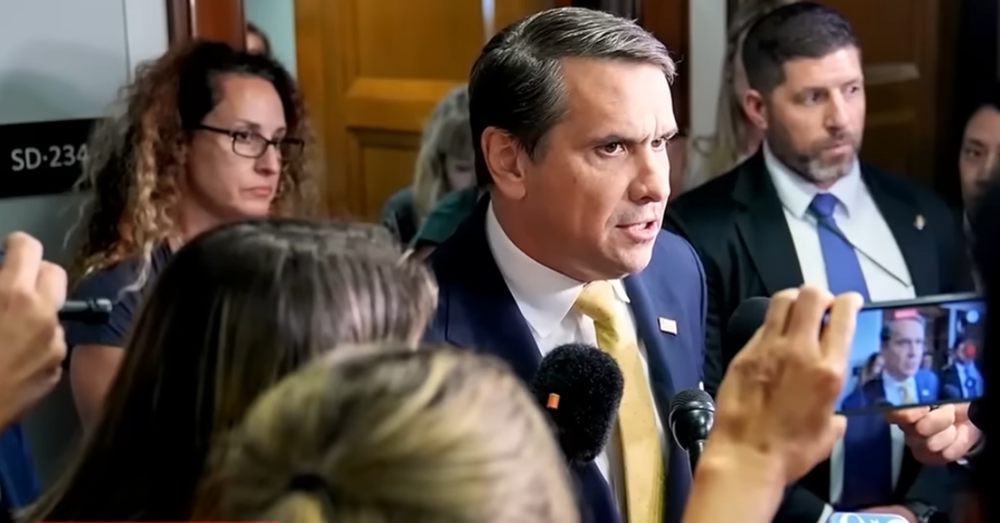

So, Todd Blanche, who serves as Trump’s lawyer, not the American people’s lawyer, is now the confirmed Attorney General. He was approved by the Senate Judiciary Committee when the only two Republican Senators blocking his confirmation caved on the issue of Blanche’s creating the $1.776 billion “anti-weaponization fund” and a grant of IRS immunity from financial audits and prosecution for Trump, his sons and their businesses. That alone is thought to be a $100 million taxpayer-funded gift to the Trumps.
As Blanche’s nomination moved to the Senate floor, only Sen. Susan Collins. (R-Maine) facing a tough re-election fight and Alaska Senator Lisa Murkowski voted against confirmation, one short of the number needed to deny him. Sen. Bill Cassidy (R-LA) did hesitate, then voted for Blanche. They joined every other GOP Senator—and no Democrats—who gave Blanche a pass on the multiple reasons his nomination should have been decisively rejected.
The two former Judiciary Committee holdouts, Sens. Thom Tillis (NC) and John Cornyn (Texas) agreed to support Blanche after the Justice Department issued a written statement they demanded saying that Trump’s $1.776 billion “anti-weaponization” fund was dead.
Trump wants Congress to revive it legislatively so he can add financial bonuses to the pardons he’s awarded to Jan. 6, 2021 rioters at the US Capitol. He said those he pardoned were treated “cruelly” by the Biden administration and deserved recompense. But that won’t happen unless Republicans win majorities in both the House and Senate this November, which is unlikely. Critics, though, assert it can be brought back to life if Blanche reverses his “dead” stance or the Trumps successfully sue to revive it.
Meantime, Tillis and Cornyn won only a partial narrowing of grants of immunity from federal audits and prosecutions for past financial wrongdoing invented and ordered by Blanche. Trump “associates” also were covered by Blanche’s original immunity order, but Tillis and Cornyn won their exclusion. However about 500 Trump employees would still benefit.
These are only two of the reasons the Senate should have rejected Blanche. He was fully in charge of reviewing and releasing the Jeffrey Epstein files. When he released a first tranche of several hundred thousand pages he said that was all that would be released, though the there were said to be 6 million files. Under the Epstein Files Transparency Act, identities of Epstein’s victims were to be protected, but each time Blanche released documents (five times) they contained names, addresses, phone numbers and nude photos of at least 43 victims, causing them trauma, fear and outrage. Victims said the Justice Department exposed them but not any of the men who exploited them.
Critics also said the releases contained numerous errors and extensive redactions. Blanche downplayed the errors, saying they amounted to less than 1 percent of the material he released.
Tillis said he wouldn’t support Blanche’s nomination unless he met with survivors. At first Blanche said that would violate the law, but then he relented. After the meeting, survivors said Blanche was abrasive, hostile, and condescending – and also dismissive, particularly about having exposed the survivors’ identities and images. They said he indicated no prosecutions of perpetrators would occur. Some survivors vowed to urge Senators to reject Blanche’s nomination. Members of Congress and survivors are still demanding release of 2.5 million additional pages.
In addition to supporting Trump’s initial opposition to releasing any Epstein documents, Blanche has obeyed him absolutely in investigating and prosecuting dozens of persons Trump identified as his enemies. They include former FBI director James Comey, former CIA director John Brennan; Jack Smith, the prosecutor who indicted Trump for attempting to overturn his 2020 election defeat and his concealment of highly classified documents at his Mar-a-Lago estate; New York Attorney General Letitia James, former Federal Reserve Chairman Jerome Powell, Sen Adam Schiff (D-CA), Minnesota Gov. Tim Walz, and liberal philanthropist George Soros. It’s ironic that the Trump/Blanche administration created an “anti-weaponization fund” for his supporters then made it a practice to weaponize his own Justice Department.
Other Outrages
Trump’s No-Win War
The Iran war has to end sometime, and the economic and political circumstances on both the US and Iranian sides would suggest it ought to be soon. But based on previous behavior of both sides, it probably won’t be.
There was never a clear strategy, so how do you declare victory? Where is the off-ramp? Trump wants out, but Iranians play the long game and have learned how to play Trump.
This is a deeply unpopular war (polls show that approval of it and Trump’s handling of it average 30 percent, and only 25 percent think it is worthwhile) and the average price of regular gasoline is $4.10 a gallon, up from $2.90 before the war. These are political threats with midterm elections less than 100 days away, and Trump is under pressure to end it soon. He seems to want to, but on his terms. The US repeatedly claims peace talks are under way and that Iran wants a deal. Iranians say they are not negotiating.
Whereupon Donald Trump orders another round of attacks on Iranian targets (now including civilian desalinization, energy and infrastructure installations) combined with threats of more violence if Iran won’t accept US terms: opening the Strait of Hormuz to traffic (which would lower the price of oil, gasoline and fertilizer) and agreeing not to ever build a nuclear weapon.
Iran is suffering from dire economic circumstances, suggesting it should want a deal that allows it to sell oil and earn a lifting of sanctions. But it also wants to control the Strait and charge fees to ships transiting it. It has promised not to build a bomb, but no one trusts that promise.
So it’s a stand-off. Most credible analysts say that despite Trump’s oft-stated claim that the US “won” the war or is “winning” it, they say Iran emerges strategically stronger because it has “weaponized” the Strait of Hormuz and will gain billions in revenue from tolls for transit in the Strait. This would be a setback for the US because before the war, the Strait offered free passage to all shipping.
Moreover, Iran-backed Houthi rebels are attacking ships in the Red Sea and threaten to block the Bab el-Mandeb strait, through which over 20% of world oil flows (Hormuz accounts for another 20 percent). Losing 40 percent of oil flows would dramatically increase US gas prices.
Trump may well order more punishing raids on Iran, thinking that will cause Iran to yield. But more US violence likely will not bring Iran to heel. Experts say that Iran has more to lose—namely the regime’s hold on power, given the restiveness of its population, while the stakes are nowhere near as existential for the US, and the quicker the US declares victory and pulls out, the faster Trump can begin trying to repair his economic and political situation.
Trump last week was threatening a major military escalation—“the biggest since World War II”—but suddenly called it off. The reason, according to the Washington Post, is that stocks of Patriot and THAAD air defense missiles and Tomahawk cruise missiles are seriously depleted—evidently a surprise to Trump, who upbraided Defense Secretary Pete Hegseth for allegedly keeping him in the dark. Hegseth (such a great leader) immediately shifted the blame to his deputy, Stephen Feinberg.
The war so far has cost the US $42 billion. Now Trump and his Defense Department are appealing to Congress for another $67 billion, which Hegseth told lawmakers was an “urgent, necessary” need to refill the military’s stockpiles. For the next fiscal year, the administration is proposing a record $1.5 trillion defense budget. Both requests are up in the air because lawmakers of both parties have difficulties with the costs. If Trump had never started this war, there’d be plenty of missiles to help Ukraine shoot down the lethal bombardments Russia is pouring into defenseless Ukrainian cities. Oh, I forgot: Trump’s on Russia’s side.
Play Post Office
The administration has been demanding that states turn over voter rolls so it can search them for non-citizens. The penalty for non-compliance was prosecution of election officials, but 38 eight states have refused to comply. The administration has ordered the US Postal Service to refuse to send mail-in voting materials to persons not listed by the states as valid voters or to non-compliant states and USPS has agreed to honor the administration’s order.
But federal judges already have sided with three states suing to be freed from the USPS policy—California, Michigan and Oregon—and two other judges have declared the administration’s orders invalid because the Constitution vests election management in the states and Congress, not the executive branch. The administration is appealing to the Supreme Court.
The administration claims to have identified 278,000 non-citizens as registered to vote, with Trump declaring the actual number is much higher because many states have not submitted their rolls.
But states tracking the numbers say the number is far lower. A study by 25 states found 28,000 potential (not proven) non-citizens registered to vote out of 84 million records cross-checked (plus 400,000 dead people still listed).
Michigan conducted a rigorous drivers-record-to-voter-roll audit of 79 million records and found just 16 non-citizens who actually voted—or 0.00028% of votes cast.
Contrary to Trump’s wild estimate, rigorous analysis demonstrates that non-citizen voting is, as they say, “vanishingly rare.”
All this and many more outrages should provide plenty of ammunition Democrats can deploy in the mid-terms. But they also need specific positive programs to offer to voters. Establishment D’s and Democratic Socialists won’t agree on which policies to advance. Each has to tailor its appeal to different districts and states. And, if they want to oust Republicans, they need to stay out of each others’ way. Stay tuned…
Discover more from Post Alley
Subscribe to get the latest posts sent to your email.


Thanks Mark. I feel that we’ll see a full-on press by the Administration for the next three months and that feeling can be overwhelming. We can counter with a full on campaign in every election. We are up against Musk’s billions and our own US Justice Department. It will be rough going but we must persist.
“U.S. acceptance of Iranian control over the Strait of Hormuz is an extraordinary outcome only made conceivable by an administration that squandered legitimacy, alienated allies, attempted regime change in a war it had not adequately prepared for and that is being forced to accept a catastrophic outcome without viable alternatives.” Foreign Affairs Scholar Phillip Gordon