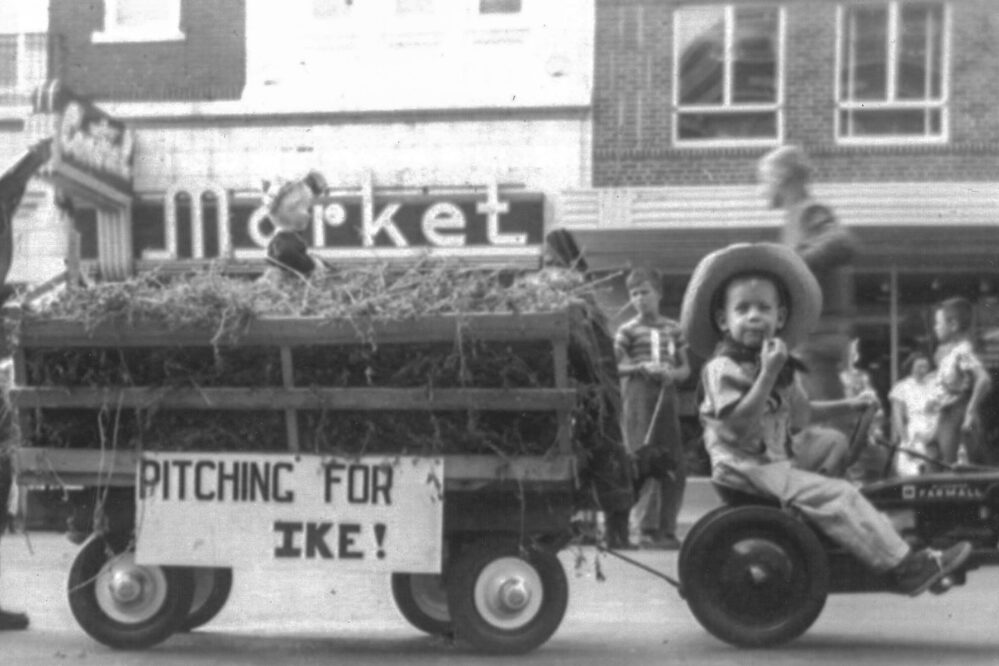

The first campaign I worked on in Washington was in 1964. I played a critical role by sitting on yard sign stakes in the back of an Econoline van, occasionally jumping out to install a yard sign or address envelopes by hand. That latter activity is often questioned by those who’ve observed my handwriting.
In 1964 I was, by family tradition, a Republican and worked on Republican campaigns, the most notable being Dan Evans run for governor. Evans’ political career started with the King County Young Republicans and by virtue of my work on his successful gubernatorial campaign, several of his volunteers invited the teenage me — attention unexpected at my age — to attend their monthly meetings at the old Ben Franklin Hotel. This led to organizing a high school Young Republicans (YR) club, assisting in organizing a federation of high school clubs in King County and ultimately the state, where I became the state chair and attended the state YR convention where MAGA took over Washington State YRs. But I’m getting ahead of my story.
It really begins with the New Deal and the failure of the Hoover Republicans to roll it back, in fact their inability to even nominate presidential candidates who advocated for repealing it. Their preferred candidate was Robert A. Taft, the senator from Ohio and son of President William Howard Taft. Bob Taft was an original America Firster before WWII and campaigned several times for the Republican nomination for president only to lose to “moderates” like Wendell Wilkie and Tom Dewey. But 1952 looked like it was his year.
In 1952, both parties recruited Dwight Eisenhower to run for president, but Ike demurred, liking his role as president of Columbia University. Nonetheless, he agreed to have lunch with Bob Taft to discuss the campaign. In the course of the lunch Ike asked Taft if he’d continue America’s commitment to NATO. Taft said, “No.” Ike, who led NATO after WWII, returned to his Columbia Office, called the Republican moderates and said, “I’m in.” And so the Eisenhower presidency. He didn’t want Taft as close to the presidency as the Republican nomination.
Taft died in Eisenhower’s first term. And 1960 turned out not to be the Taft wing’s year either. It was a contest between Richard Nixon and Nelson Rockefeller. No hard right candidate got any traction, and when Nixon and Rockefeller cut the “Fifth Avenue Compact” in Rockefeller Center, hard right Republicans went ballistic. The compact gave Nixon all of Rockefeller’s delegates securing his nomination and Rockefeller gained influence on the party’s platform.
When delegates showed up in Chicago, the hard right staged a revolt intended to nominate Barry Goldwater. The revolt fizzled: Goldwater had committed to nominate Nixon. In his nominating speech, Goldwater chided the rebels for not having done their homework. Nixon was nominated, lost and the hard right recommitted to their homework.
The effort launched in January of 1961 in a hotel at O’Hare Airport where a group of wealthy business leaders put money on the table to hire F. Clifton White to run the campaign.
Parties generally organize geographically, the atomic level being the precinct. Most states elect precinct officials as a ballot line in even-year general elections. In Washington, those officials, Precinct Committee Officers (PCOs), elected biennially, organize precinct, district, and county caucuses and the state party conventions. Ultimately, they manage the process of nominating a party’s presidential candidate.
Cliff White’s assignment: Identify empty or competitive precincts, recruit anti-New Deal candidates to run in them and take control of the party. King County and Washington State were targeted by the project and in 1962 White’s project succeeded in winning enough precincts to take control of the King County and state parties in 1963. King County selected Ken Rogstad to chair the county party and begin organizing for the 1964 nominating process.
In 1960, Dan Evans, Slade Gorton and Joel Pritchard, all Republican legislators, attended the Republican convention in Chicago. In 1964, none of them went to San Francisco; all delegates and alternates committed to Goldwater.[1]
Goldwater went on to lose the 1964 election in epic scale. Dan Evans beat the conservatives’ favorite Dick Christiansen in the September primary then went on to beat incumbent governor Albert D. Rosellini in the general, becoming the only non-incumbent Republican to win a governorship. The “liberal Republicans” thought that closed that chapter.
My experience after 1964 called that conclusion into question. High school Young Republican clubs aligned very closely with Cliff White’s team. My clubmates and I aligned with Evans who also contended with the party’s right tilt.
In 1967 as chair of the high school Young Republican federation, I attended the state’s Young Republican convention in Spokane. A high school senior, attending an adult political convention in the Davenport Hotel in far off Spokane? Heady stuff.
Friday night’s banquet celebrated Dan Evan’s 40th birthday, noteworthy as the “young” in Young Republican ended at 39. Speakers celebrated a YR ending up as governor and assured him he’d always be welcomed by YRs. But earlier that day the credentials committee had met and refused to seat several “liberal” clubs’ delegates.
While the party had blacklisted the John Birch Society, no one appeared to pay attention to William F. Buckley’s youth organization, the Young Americans for Freedom. The YAFers had organized and showed up in Spokane.
At the plenary session on Saturday, the convention endorsed the credentials report and, as the challenged clubs couldn’t vote, rejected the liberal club delegates. The convention then elected the conservative slate, ousting the Evans-aligned incumbents.
As a result of the victories in the state party and YR organization, the moderates faced a crisis. In 1967 Democrats held all the statewide offices except governor. Evans and his team wanted to change that but didn’t have an enthusiastic party behind them. The moderate’s solution? Create a new institution, Action for Washington, to organize the campaigns.
Action for Washington campaigned for Evans, Pasco African American civil rights leader and city councilmember Art Fletcher for Lt. Governor, Lud Kramer for Secretary of State, and Slade Gorton for attorney general. The success of the campaign: Evans, Kramer and Gorton won, while Art Fletcher narrowly lost.[2]
While I was involved in the 1968 campaigns including Action for Washington, the cynicism of the hard right devastated my view of party politics and led to less engagement through my college years and Air Force service. But after my service, now an adult and voter, I decided to run for PCO.
I won, and in 1977 participated in the biennial reorganization of the county party. I campaigned for Art Langlie, the Evans aligned candidate and son of the former governor. Art’s principle opponent, Gene Laughlin, aligned with the hard right. Both candidates secured a bit more than 40 percent of the PCO’s votes with the remaining votes going to a relatively unknown candidate. After several ballots, Langlie instructed us to switch our votes to the unknown. We protested, but Langlie argued that he committed to being even handed and not engage in the intra party battles. We changed our votes and he won.
Or so we thought. The hard right party funders pulled out of the county party, the county party descended into a fiscal crisis and some months later the district chairs organized a recall election.
One day, I got a call from asking if I’d be willing to meet with Congressman Joel Pritchard and Executive John Spellman. I was flabbergasted but agreed to show up at a vacant downtown office building. The agenda? They wanted to defeat the recall and to do so they needed to rid the party central committee of the hard right district chairs. Gene Laughlin was one of those chairs and a leader of the recall. He was also the chair of my district and Pritchard and Spellman wanted me to replace him.
Of course, naïve me agrees and I find myself the chair of the 41st District. Gene turns over the district’s bank deposits (my memory says it totaled about $12) and I blunder forward. An early blunder came at the first district meeting. I’d already phoned all the PCOs so I knew I didn’t have a lot of support, but I gamely dove into the agenda only to be pulled up and informed I’d forgotten to start the meeting with the pledge of allegiance and a prayer.
It didn’t go better when we got to the recall meeting held in the old Northgate Theatre (on the marquee: Shootout at the OK Corral). In the end, the recall failed with the 41st District delivering one vote against the recall. [3]
While the intra-party fight continued despite Ford’s winning the nomination over Reagan in 1976 in the State, the ground shifted after the Goldwater loss. The oligarchs realized the party wasn’t enough to repeal the New Deal. They needed to shift the Overton Window. To do this, they had started investing in the mid-1960s in propaganda tanks: Cato, Heritage, Committee for a Sound Economy, The Federalist Society and hundreds of others. With the changes in the fairness doctrine in the 1980s, they invested in Rush Limbaugh and what became the right-wing echo chamber. Then the two biggest astroturf investments since Cliff White: The Tea Party and MAGA.
For many years, I stuck with the party believing it could return to its Eisenhower-Evans roots. My decade in the legislature convinced me it wouldn’t and in 2008 I switched parties to run for the Senate only to watch the Democratic party turn hard left.
Trump pays off sixty-five years of persistent right-wing investment. Billions have been spent to deliver the chaos and division we experience today. I earnestly believe it will pass someday, but not until the adults in our country decide politics is too important to leave to the children enamored with hard right or hard left ideology. Perhaps seeing the interest rate on Federal bonds cross the five percent threshold and federal interest payments likely exceed the entire defense budget and certainly exceed all non‑defense discretionary spending combined will, in Samuel Johnson’s line, focus one’s attention.
[1] Cliff White wrote a memoir of this process well worth the read although he frames it as the most grass roots, bottoms up popular political movement in history. Actually, like the Tea Party and MAGA, the movement’s astroturf found funding from the same oligarchs who funded Cliff’s project.
[2] Fletcher went on to serve in the Nixon Administration, credited with implementing the country’s first affirmative action programs in Philadelphia. How things change!
[3] A coda from this story: When I ran for reelection to the Mercer Island City Council in 1983, my opponent’s two largest contributors: The 41st District Republican Organization and the King County Republican Party.
Discover more from Post Alley
Subscribe to get the latest posts sent to your email.

Gene Laughlin is here identified as a member of the “hard right.” I thought he was a Democrat. Am I wrong?
“Trump pays off sixty-five years of persistent right-wing investment. Billions have been spent to deliver the chaos and division we experience today.”
Fascinating article that mentions some details of how that was done. But those billions were misspent, am I right? It wasn’t wackos like Peter Thiel, it was just dark lords of industry who wanted a US run by and for big corporations, and right away they started gradually losing control of their creations.
In my view because they were captured by the Moral Majority and reaction to the civil rights era, and ended up on the troglodyte side of a divide their money helped create.
The outcome we’re seeing now, can’t be in the interests of US corporations?
I think you’ve got it backwards. The goal is reversing the interference of the New Deal. They’re making great progress on that. They’ve used cultural issues to capture the votes necessary to achieve that roll back. Their wealth & privilege isolates them from any individually adverse consequences.
Thanks, Mr. Jarrett. An insightful article.