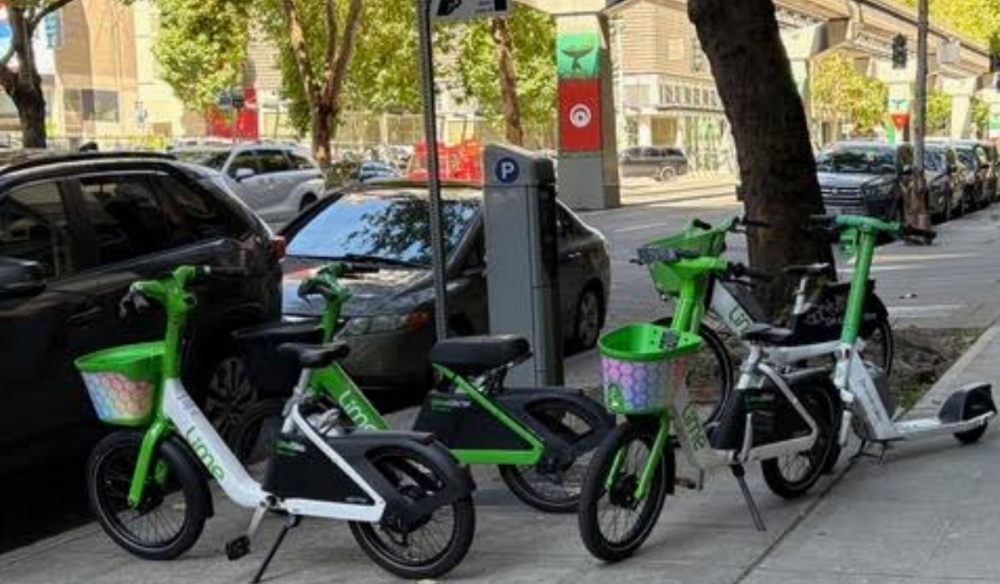

With 14,000 green and white Lime e-scooters and e-bikes parked all over our city’s sidewalks, it is easy to see that Lime loves Seattle. Lime is allowed to plaster the city with more rental scooters per resident than anywhere else they operate. Neutron Holdings, Inc, (trade name: Lime), is raking in the cash. In 2025, according to newly released documents, Lime received $37.4 million in operating revenue from its Seattle rentals; and in 2025 it only paid the Seattle Department of Transportation (SDOT) $1.36 million to conduct its for-profit use of the public sidewalks under its permit from SDOT for its city-wide rental locations and e-scooter and e-bike parking lots.
What’s different in 2026 is that SDOT has now gifted Lime a monopoly on the e-scooter and e-bike sidewalk rental business in Seattle. SDOT spent months in 2025 working to kick Lime’s smaller competitor, Bird, out of Seattle. Has SDOT even been minding the cash register, let alone caring for cluttered sidewalks or hundreds of injured riders from Lime in Seattle? Hard to think so, particularly if one compares how two of the other cities, Milwaukee and Denver, both comparable in size to Seattle, also authorize shared e-scooter and e-bike rental programs with a monopoly vendor.
The fresh news is the actual scale of Lime’s Seattle operating revenues — until a few weeks ago, this has always been Lime’s business confidential data. For years Lime has been a privately-held start-up venture, with Uber as its largest stakeholder. Desperate for cash to meet a mountain of maturing debt, Lime this year began offering shares to the public through an Initial Public Offering (IPO). That IPO required a thick disclosure filing with the U.S. Securities and Exchange Commission (SEC). In its pitch for new public shareholders to invest in its business, Lime singled out Seattle, and only Seattle, as its financial crown jewel, disclosing the confidential Seattle revenue numbers, and fully depending on their eye-popping impact on prospective investors. (Lucky we!)
It’s unlikely that even SDOT had known the scale of the Lime bonanza until two months ago when the $37.4 million number for 2025 appeared in the IPO disclosure filed at the SEC. On the other side of the ledger is the pittance paid to Seattle, confirmed to this reporter by SDOT, $1.36 million of Lime’s annual payment to Seattle for its sidewalk privileges. That’s an amount equal in 2025 to about 3.7% of Lime’s Seattle operating revenue.
The obvious questions are: Why in 2026 has SDOT given the city’s sidewalks over to Lime for a pittance and kicked out the other scooter company, Bird, to give Lime a monopoly? As for two of the (very rare) other cities setting up monopoly scooter vendors, Milwaukee and Denver, these cities made much better financial bargains with their vendors. In Denver’s case, that city recently has thrown out both Lime and Bird, to contract with a fresh vendor, Veo, with a better service package than Lime offers Seattle.
Lime’s success at Seattle’s expense has been a long time coming. With SDOT’s indulgence, Lime has been building its hold on Seattle for years. All this despite no financial transparency and no accountability for the conflict between Lime’s e-scooters’ alarming fatality and injury outcomes and defying SDOT’s supposed Vision Zero pedestrian-safety goals. Nor has the city restricted Lime’s year-after-year default on explicit permit requirements for proper device parking by its riders to protect Seattle’s American Disabilities Act sidewalk-accessibility obligations. Lime e-scooters and e-bikes are everywhere illegally ridden on sidewalks. Lime is allowed to park them on sidewalks, but only properly, instead of thrown all over, as is typical.
There is no question Lime has had a spectacular run in Seattle when it comes to running up its operating revenues, expanding its device count, and seizing market dominance.
SDOT first allowed Lime and two competitors (Bird and one other named Spin) each to launch 2000 e-scooters in Seattle. By 2022. Lime had expanded to 3,700 e-scooters and e-bikes, holding a market share of 32% in SDOT’s rental program. That year, the SEC filing for the IPO also reveals, Lime collected Seattle operating revenue of $9.7 million. By 2025, when Lime’s Seattle operating revenue hit $37.4 million, SDOT allowed Lime a peak of 13,300 for rental e-scooters and e-bikes – growing Lime’s market share to 82%. Now, in 2026, Lime in Seattle daily sets out for rent on the sidewalks 10,723 e-scooters and 3,741 e-bikes, and now enjoys a 100% market share in Seattle, a new monopoly.
In 2026 Lime’s operating revenue from Seattle will certainly top its 2025 high water mark. SDOT orchestrated Lime’s final ascent to monopoly in months of efforts in 2025 to revoke the permit held by its struggling competitor, Bird. Dozens of emails obtained through Public Disclosure Requests trace a tortured SDOT course starting with a permit-revocation notice to Bird in early May, 2025 — based on insurance coverage and documentation shortcomings and citing other program-performance disappointments.
Bird immediately submitted a vigorous appeal. But SDOT was apparently bent on shooing the last Bird e-scooter out of Seattle by September 30. SDOT was duty-bound to give Bird 30 days final notice by September 1. In the very last week of August preceding the September 1 trigger date, SDOT scrambled together a makeshift administrative process to dispose of the appeal that had been sitting unaddressed since May.
Then came a bizarre surprise outcome worthy of a clown-car bureaucracy. The SDOT internal appeal process overturned its own permit revocation issued in May. The insurance issues having gone away. Bird should walk away from the guillotine. But no. In the same message to Bird announcing a reprieve, SDOT declared Bird’s permit to be revoked on September 30 anyway. Staff cited assorted performance issues. Sufficiently tangled and obscured in the late summer scrum, SDOT’s interim director Adiam Emory asked that those performance issues be better fleshed out for her the day before her rushed sign off on the Bird summary execution.
With SDOT staff spending the better part of a year trying to get Bird out of Seattle, the internal SDOT documents show no evidence of an effort to line up another firm to take Bird’s place. SDOT — unlike major city rental e-scooter/e-bike programs almost everywhere else in the United States and abroad — doesn’t offer the public a choice of competitive vendors. Ironically, SDOT itself had sold the program in this way to the City Council in 2020. Instead, SDOT ordained Lime’s new Seattle monopoly.
Another glaring SDOT strategic omission, at least from any documentary evidence, was to not keep then-Mayor Bruce Harrell’s office fully in the loop on the plan to fundamentally restructure Seattle’s micromobility program — right during the run-up to the November, 2025 mayoral election. In mid-September, SDOT belatedly briefed the mayor’s office on the imminent Bird revocation. That briefing did not go well. The sticking point was what the mayor’s staff called the single-permittee outcome. In the aftermath of the briefing, Andrew Myerberg, Mayor Harrell’s chief of staff, emailed SDOT: “Can you tell us what U.S. cities have a scooter/bike share program with only one permittee.” A day later, Meyerberg pleaded, “We very much need to understand the impacts of having a single permittee.”
Without even waiting for an answer, Myerberg suggested SDOT hold off for 90 days its intended September 30 deadline to have Bird gone from Seattle, to which SDOT acquiesced, setting a new deadline of December 30. That ended any possible hot-potato issue arising in the final weeks of the mayoral campaign. Once the election results told of the change of City Hall leadership, nothing more on the Lime monopoly question seems to have had the attention of the lame-duck Harrell staff. Under new Mayor Katie Wilson, SDOT’s ouster of Bird inched forward, confirmed by SDOT to the new mayor’s office in February.
As a result, in March Seattle bid farewell as the last straggling Bird e-scooters disappeared from Seattle sidewalks. SDOT had now settled the Lime monopoly until at least the rest of 2026 and very likely beyond. Even so, that opportunity to have some competition is still available. How did SDOT get back to the Harrell staff question about other single-permittee cities, even if the Harrell lame-duck staff lost interest in the answer? SDOT in a September email to the mayor’s office, claimed awareness of only four U.S. single-permittee micromobility cities: Hartford, CT; Fort Collins, CO; San Jose, CA; and Milwaukee, WI. Hartford and Fort Collins, each with programs well under a thousand scooters and bikes, plainly offered no comparability to a program of Seattle’s scale. San Jose, a city larger than Seattle, in September had just shut down its single-permittee program, commencing a long process to reconsider problems like safety and clutter. A recent program re-boot in San Jose has yielded two permittees, Lime being one, each authorized for 2000 e-scooters.
That leaves Milwaukee. where Lime has about 3,000 e-scooters, and a modest program by Seattle standards. Milwaukee is a city not too much smaller than Seattle, so a look at the Milwaukee/Lime e-scooter operation is by turns sobering and revealing. June 2026, was a very bad e-scooter month in Milwaukee. On June 10th, a 17-year-old high school senior tragically died on the eve of high school graduation, apparently from injuries suffered in her fall from a Lime e-scooter. (In Milwaukee, as in Seattle, Lime’s policy, if not its practice, sets age 18 as the minimum for riding its scooters.)
A week later, on June 17, a Lime e-scooter at full tilt on a Milwaukee sidewalk slammed into a man stepping from a doorway, all captured on a surveillance camera for a subsequent feature on prime-time local TV news programs. The victim ended up in the hospital, with broken ribs, broken bones in his foot and spinal fractures, requiring multiple surgeries. The 20-year-old scooter rider admitted on scene to knowing he was not supposed to be riding on the sidewalk (illegal in Milwaukee, as in Seattle). He has been criminally charged with felony second-degree reckless injury and could face significant jail time if convicted.
These events have triggered heated Milwaukee aldermanic demands for a stern crackdown on a variety of e-scooter abuses. The media coverage has also surfaced a Milwaukee Public Works Department annual report on performance of the Milwaukee e-scooter program for the just ended year 2025, a data-rich accountability document the likes of which SDOT has never provided a counterpart. Milwaukee drives a much harder financial bargain with Lime than does SDOT. The annual permit per device fee in Milwaukee is $200 compared to SDOT’s $150 for stand-up e-scooters and its deep discount rate of only $75 for e-bikes and the Lime seated e-scooters, together now expected to make up half of Lime’s Seattle deployment. Does SDOT have any idea what permit fees the market will actually bear, while it continues in 2026 Lime’s bargain-basement fee levels?
Milwaukee also adds a fee to Lime of 25-cents per ride. If SDOT charged that fee per ride, which it does not, SDOT would have received $2.2 million additional revenue from Lime in 2025. SDOT apparently is leaving millions on the table in potential Lime fees even as Lime holds out Seattle to the investor public as the city demonstrating its best-anywhere operating revenues where it also holds dominant market share.
There is one city for comparison SDOT did report to Mayor Harrell’s staff. That is Denver. Denver was not a single permittee city last September. It had two vendors, Lime and Bird, sharing a market that has rivalled Seattle in micromobility popularity. Seattle and Denver, along with Washington, D.C. and Chicago were the four top ridership cities in the country in 2025, according to an industry survey, with Denver actually handily besting Seattle in e-scooter trips per device per day.
But in Denver there have been 15 fatalities since e-scooters launched in 2018, including eight in 2025. In April 2025, the Denver Department of Public Health and Environment published a report tallying 3,600 e-scooter emergency department visits in Denver in the four years 2021 to 2024.
With issues surrounding the program from every direction, as in Seattle, such as parking clutter and sidewalk riding, adding to the injury epidemic, Denver late in 2025 announced it would not renew either the Lime or Bird five-year contracts. A new vendor, named Veo, making a push into cities all over the country, was selected. Denver therefore embarked on a single-permittee program in 2026 — not, however, with Lime, whose thousands of devices disappeared from Denver two months ago, following a final city council vote.
SDOT might have found Denver an interesting model against which to measure its monopoly arrangement with Lime. There are just 9,000 devices to be managed in Denver, compared to more than 14,000 in Seattle. But there are innovative options introduced in Denver by Veo: two-seater scooters (carrying a friend), for example, and e-cargo bikes for rent (bringing home the groceries). Such innovations are not seen from Lime in Seattle. Denver also has a $248 per device annual permit fee, far higher than SDOT’s rock-bottom permit fees charged Lime. Also, in Denver, a Veo across-the-board resident discount on the per-minute rental charge. Tourists still pay full fare. Good plan.
That brings us back to where we began: Lime showcasing Seattle to its potential investors as its crown jewel market model. Lime did not mention Denver, where its operating permit had just been cancelled. It did not mention its major Australian setback, where Melbourne canceled permits six months prior to expiration citing the familiar litany — rider injuries, reckless behavior, and scooter clutter. Not to mention the industry harbinger, even if not a Lime city, Brussels. That city’s decision a few weeks ago to end e-scooter rentals as of January 1, 2027 citing too many injuries (more than 600 in 2025), too many parking obstructions, and too much reckless riding. Similar to Paris, Madrid, and Prague, no rented e-scooters will be allowed in Brussels.
Whatever Lime’s revenue bonanza in Seattle is, it has never demonstrated what SDOT might hope to show, but never has, that promoting rented e-scooters and e-bikes for a tiny share of Seatle’s daily trips, and short ones at that, and mostly in nice summer weather, actually furthers SDOT’s dream of reducing car dependence in Seattle.
The Lime IPO actually closed with minimal public notice on July 1. Neutron Holdings, Inc., raised $166 million in new capital needed to stave off maturing debt from start-up lenders that might have forced its demise. “Seems like it was an IPO of desperation needed to clean up their balance sheet,” according to one analyst. Another skeptical analyst worries about regulatory risk to Lime’s eventual profitability -– crackdowns and stricter rules.
An example was last week’s legislation proposed in Germany to consumer advocates’ applause — vendor liability to victims hit by e-scooters regardless of identified rider or fault, plus much more restrictive control on sidewalk parking. E-scooters are big in Germany: about 40,000 in Berlin, including Lime and others — although that’s 15% fewer e-scooters per capita than SDOT’s Lime e-scooter flood in Seattle. Germany in 2024 saw 27 e-scooter fatalities, 1,500 people seriously hurt and 11,400 with minor injuries. Justice Minister Stefanie Hubig said, “Anyone who makes money renting out e-scooter must also take responsibility for the damage caused by the vehicles.”
Maybe Lime needs Seattle more than Seattle needs Lime?
It’s worth remembering that SDOT has promised the City Council from e-scooter Day One, that the vendors’ permit fees, not taxpayer’s funds, would pay all the costs that rental e-scooter and e-bikes would impose on our city. Rental scooters and bikes offered by for-profit private companies should not be subsidized by taxpayers any more than we should subsidize Uber or Lyft ride share, similarly seeking profit from privatized use of the public right-of-way. Subsidy must be reserved for public transportation, like our Metro bus system.
Many of the unending e-scooter/e-bike problems in Seattle can be traced back to the simple fact that SDOT gets totally inadequate funding from the permits to support robust permit compliance, oversight, and enforcement. Why, for example, are there far too few parking corrals to manage the Lime devices parking on the sidewalks? Because fee revenues are too skimpy to pay for them. There is no way SDOT on the cheap can properly manage Lime e-scooters and e-bikes on steroids in Seattle.
Discover more from Post Alley
Subscribe to get the latest posts sent to your email.


Good article. Lime is indeed getting a heckuva deal with the City. What would really make sense is if the “$1.36 million of Lime’s annual payment to Seattle” — assuming it goes to the general fund — be redirected to underwrite bicycling-related projects, e.g. bike path maintenance and development. Anyone who rides the area’s growing path network is impacted by Lime’s presence. Cyclists and pedestrians are routinely endangered by careless Lime customers. In the core Seattle waterfront, I bike on Alaskan Way — since it’s less risky than encountering those on Lime bikes and scooters. Our taxes help build out our improving network of paths. Should Lime have a free ride? Do Cascade Bicycle Club or other bike orgs have a stance on this?
Here is an answer I believe from SDOT about where the fee money goes. I found it recently in the minutes of a King County Vision Zero task force meeting: “Revenues from vendor permit fees are about $1.5 million per year which mostly goes to staff time.” Staff time, that is, of SDOT’s shared miromobility bureaucracy, though tiny. So, for example, there is not enough money left over to buy paint for stencils on downtown and Capitol Hill sidewalks. “No riding e-scooters on sidewalks.” How simple would that be?
So did I understand this right the little over a million the city is getting from lime is going to pay city workers? That’s it? So basically a kickback.
Doug, this article doesn’t point out one of SDOT’s biggest indirect subsidies of Lime – the continuing program of building curb ramps under the transportation levy without any consideration that their use primarily benefits and encourages e-scooter riders who illegally use them to maintain their speed on sidewalks and crosswalks, rather than the mobility-limited individuals they were intended for. There appears to be no mitigation by SDOT of this widespread, known and foreseeable (at this point) illegal use, even as SDOT continues to build the ramps. Although I am not an expert in municipal law, I would think that there was potential liability to the city for pedestrians injured by scooters traveling at speed due to the unmitigated construction of these racetracks. Consequently, from a liability and funds-availability perspective, perhaps it would be wise to advocate starting the stenciling (no e-scooter, either sit-down or stand-up) at the curb ramps with funds from the transportation levy.
Awesome idea!
On the bizarre irony of SDOT spending millions on curb ramps to the practical effect of speeding the sidewalk e-scooter riders smoothly from one sidewalk to the next: I’ve long wondered why this point has received so little attention. If you are a Seattle resident or visitor with mobility, vision or hearing disabilities, this is the “Add insult to injury” feature of SDOT’s impact on you from its passion for uncontrolled rental e-scooters and e-bikes. But it’s worse than that. In ADA jargon that bumpy yellow panel on the curb ramp is called a TWS, a Tactile Warning Surface. Think Braille. Its strictly AADA-regulated design and placement is purposed to assist vision-impaired people to know the approach of the intersecting street and the safe location for navigating the six-inch hazard of the standard Seattle vertical curb. However, if you are fortunate enough to be a fully-sighted person crossing any busy intersection in South Lake Union, Downtown or elsewhere, what the yellow panel today warns you is to avoid this precise location for transiting to or from the sidewalk. Step aside, not on the yellow panel. Because the e-scooter riders exercising their sidewalk riding convenience and entitlement are moving faster than you from back or front and aiming right at that yellow panel to ramp on or off the sidewalk. Danger, danger! Probably the likeliest place you as an ordinary pedestrian will be brushed or worse by an e-scooter rider is if you are trying to stride on that yellow panel. Excellent simple mitigation suggestion in the comment. At the top and bottom of each yellow panel, paint this sign: “No e-scooter riding on sidewalk.”
As a starting regulatory attorney decades ago, one of the first things I learned working with you and others was that a key element of regulatory advocacy is convincing regulators that it is in their agency’s or their own personal interest to decide in your client’s favor. I’m just trying to figure out ways to highlight liability risks, perhaps for the City Attorney if not SDOT (which may not care unless any settlements would come out of their budget), and that there are ways of inexpensively mitigating them, especially when the expense can be easily incorporated into the construction budgets. However, from reading your articles and seeing SDOT’s half-hearted attempts to discourage sidewalk scooter riding, I am getting the impression that they may see sidewalk riding as helping to get more riders comfortable with scooters, increasing adoption, which is what they are trying to accomplish.
I live on the Seattle Waterfront where scooter use is at its highest. Even with geo fencing to keep them out of some high pedestrian areas, they still flood most sidewalks. Mandatory helmets? Any helmet you see is on a privately owned scooter. No riders under 18? I routinely see children as young as 10 operating scooters. Like so many other laws designed to insure public safety, there is absolutely no enforcement of laws applying to scooters.
Addendum: Alternately, perhaps any Lime payments could pay for City resources to enforce safety on the paths. King County is making a new, worthwhile effort along those lines by assigning officers on ebikes to police paths, and by adding informational signing about ebike regulations. Maybe enforcement is already taking place, and I’ve just missed it?
Doug,
Can you provide an update on e-scooter and e-bike injuries and deaths? I know a couple years ago you found a dramatic undercount of these accidents in police records with much higher numbers from emergency rooms.
Thanks,
Dick Lilly
A critically important question I am currently trying to work on. The answers are not easy, because SDOT appears to have no mechanism for tracking the injury numbers and the state’s funding of the study on which I previously reported was exhausted in the work through 2024. This leaves the problem shouted in mystery, although SDOT showed the current mayor’s office a “trend” graphic in February, suggesting through 2024 a steady rate of about seven injuries per 100,000 e-scooter rides. Assuming about 9 million rides in 2025, tht wold extrapolate to an expectation of over 600 injuries in 2025, It is going to be very hard to get a better, real, number given the vacuum of data (or interest?) at SDOT.
Great article, Doug, and I look forward to a follow-up that updates the numbers on injuries and fatalities. The stories from Milwaukee and Denver are so heartbreaking. And we have our own recent one, where a teenager used a Glider on a stairway and died. These tragedies are preventable: the lease must be ended.
Regarding the city’s take of the profits, which was so unbelievably small, I think you should add the cost to taxpayers of SDOT’s employees spray painting the scooter corrals both on the sidewalks and streets, then returning to apply the marking material later. These corrals are all over and they required planning trips, spraying trips and marking material trips – isn’t that close to a million dollars right there?
I don’t understand why Lime owes the City more in fees — did I miss that the City collects more from rental cars for the privilege of using our roads? What’s the basis for demanding special payments here?
Lime is PUBLIC TRANSPORTATION that integrates well with our bus and train system, bridging the problem of the last mile to deliver the rider at their destination. Now is one of the best times to be car free in Seattle, thanks to smart phones and the ability to coordinate trips across modes of transportation. Ditching your car can mean savings of $1,000 or more in expensive Seattle, and Lime plays a role in alternate ways to move around the city.
I’ll give you that there is always room for improvement with emerging industries and technologies, but let’s think carefully about how we do this.
$1,000k/mo in savings by skipping car ownership — that’s monthly payment, gas, insurance, parking, taxes, and other incidentals like maintenance or parking/moving violations. It adds up.
Having never driven a car in Seattle since moving here from Olympia in 2007 (no driver’s license, vision disability) I have quite a lot of multi-modal experience in getting around Seattle. Walking, bicycling, buses, light rail, Yellow Cab, Lyft (I try to avoid Uber – too expensive), and riding with my wife when she drives our car. The less one depends on cars, the better. Alternatives to cars – great. But not when they blatantly and illegally terrorize pedestrians on sidewalks, trample the ADA rights of the disabled to enjoy clutter-free sidewalks – and incidentally send hundreds of people annually to the emergency room, or worse, how many even to the hospital operating rooms? If the emergency rooms were filled with scores of people a month injured from riding Metro buses, do you think something would be done? This is a city-sponsored and city-authorized program. It should work, Obeying its own rules. for starters. Is that so complcated?
Just for the record, Washington state charges a substantial rental car tax for rentals shorter than 30 days – currently 11.9% of the rental price.
So, does the RCW authorize cities to levy that tax on dockless e-devices?
Doug, I really appreciate your articles on Seattle’s disgraceful partnership with Lime. The contract with Lime and the almost complete absence of enforcement of its requirements raises questions of a sweetheart deal and friends in high places. And I haven’t seen a single bike/scooter advocacy group call out SDOT, when they should be demanding action for rider and pedestrian safety.
Memories of former SDOT head, Scott Kubly, who used his position to help his old e-bike employer.
Rental cars, rental e-scooters and Amazon trucks do not pay road use fees to use the roads (big topic there, for another day). Rental cars maintain their own lots to rent their cars from. Rental e-scooters and e-bikes use the sidewalks to rent their devices from, and that’s why Lime pays a fee to the city. So does a restaurant with a sidewalk “streeters.”
I disagree that Lime is “public transportation.” I can assure you that data-based examination of Lime’s utility as “last mile/first mile” connectivity to real public transportation (Sound Transit or Metro) is badly needed and will, I believe, turn out to be very low – much lower than rhetorically claimed.
Ahh thanks for clarifying that bit on sidewalk use and fee payment, makes more sense.
We’ll agree to disagree on the “public transportation” function/definition. Airlines, Ubers, taxis and other privately held companies importantly move people around and are regulated for public use. Public transportation comes in many forms, I’d urge you to talk with people from many backgrounds to understand how they get around in Seattle. (My comment on the rise of car-free living seems to have been lost, but it is increasing and every scrap of alternatives that help Seattleites save money by ditching car ownership helps.)
Excellent article that provides many of the details we have been asking for. With the revenue Lime is getting, they should be able to geofence the sidewalks so that scooters and e-bikes cannot operate there. SDOT should be thinking about pedestrian safety but instead is going backwards—away from Vision Zero objectives.
I could be wrong, but geofencing isn’t a solution for sidewalks. If you get off the sidewalk, as you should, you’ll be riding right beside it. The slightest locational error runs a 50% chance of finding you in the fenced zoning and interfering with the operation of the scooter, as if you needed more trouble than you already had riding along the side of Seattle’s premium quality roads.
It’s like the rest of the problems. It’s a shame SDOT doesn’t seem to care, but short of just ending the program – as other cities have done – the deaths, the life changing head injuries, the pedestrian collisions, the obstruction of sidewalks, are bound to continue regardless.
Now the newest scooters have cameras on them and tell people not to ride on the sidewalk. People ignore it. If they have that camera tech to see you’re on the sidewalk, it should go into a no ride mode until you’re visibly in a bike lane or on the road.
People riding the scooters on the sidewalk makes me so angry. Multiple times they’ve almost hit my dog as I’m walking him.
You’ve touched on what Lime and SDOT love to talk about as “sidewalk riding detection technology.” Lime has begun retrofitting some of its e-scooters (jus the stand-up models, not the seated ones, I believe) in Seattle. More slowly than SDOT hoped for since Lime last February alerted SDOT to supply chain issues. Problems are reported from Chicago, where Lime was required by the end of 2025 to implement 100% sidewalk riding detection on all e-scooters; apparently a close eye has to be kept on Lime to keep the technology functioning properly. My view is that prompt attention is required today to whether this technology is actually performing to SDOT’s promise that it will significantly cut down on sidewalk riding. Or not. We need to know that now, not wait for a report maybe by mid 2027.
With Lime making so much money maybe this is a way to close the budget gap: increase the fees for Lime to be in Seattle!
Great article. These bikes and scooters are dangerous and do not belong on the streets or sidewalks. They impede walkers. As someone who, while in a crosswalk, was hit by a lime bike I can testify. Aadditionally, these bike accidents are not registered unless the “victim” goes for emergency or medical treatment. These Limers also ride on sidewalks. Laws need enforcement. I’m all for licensed bicycles which they have in Hawaii. Licenses requires just like a drivers license. Ugh on Limers.
The reckoning is coming. You can hear the not-so-distant rumblings. For example, yesterday, a rocking package worth viewing on Chicago’s e-scooter sidewalk riding crisis and crackdown from the I-Team at Chicago ABC affiliate, ABC 7. All Lime e-scooters in Chicago were equipped with sidewalk riding detection technology last year. As touted by SDOT and Lime finally for this year here. Lime, however, advised SDOT in February of supply chain issues, which SDOT did not advertise, but simply accepted slow and apparently still incomplete technology roll-out. From the Chicago experience, doubtful it would or will make much difference anyway. The sidewalk video in Chicago could have been shot here. Here’s the YouTube link: https://www.youtube.com/watch?v=pFrNoQi3dqo
If there were a way to rigorously exclude motor powered rentals from the sidewalk, we’d run into the next problem: “b-b-but sometimes I have to ride on the sidewalk!”
If you aren’t real lucky with your point A to point B route, there will be some places where it really doesn’t look like the road is suited for anything but cars and trucks. SDOT can look out the window from their offices and see that. So if scooter riding “must” be supported, then arguably don’t they have to be allowed on the sidewalk?
You judge the street or bike lane isn’t to your comfort or taste for getting from Point A to Point B on an e-scooter. And a sign on the sidewalk says (as it should) “No scooter riding on sidewalk,” in view of a law designed veery rationally because of the well-reported dangers of sidewalk riding, to protect your own safety and others. Maybe then an e-scooter isn’t a good choice for you for getting from Point A to Point B. Same logic as if your desired route from Point A to Point B or an e-scooter would take you to ride your e-scooter the wrong way up a one-way street.
I have no doubt that SDOT and the City entirely has conducted the LIME deal in a suboptimal manner. A friend of mine in fact was injured because some idiot left a LIME bike in an obscure spot ….so I’m sympathetic in general to your criticism.
But I don’t understand your numbers
$35 million operating revenue… What does that mean? How much profit? Is that shown in the SEC filings?… looking at the deal from the point of view of a percentage rent in real estate $1.5 million rent on $35 million of gross sales is low (considering there are all kinds of operating cost… Lime doesn’t have any kind of triple net contribution)…
But I’m not quite as shocked as you want us to be in part because I’m not sure I understand the number you are looking for.
How much should the City be paid? On what theory? That “we can get away with it” because the City has a permanent easement over the street right away?
That’s what seems to be missing in your article. What is the deal that you think the City/Lime should have?
I have a few qualms here, but thank you for writing the article nonetheless.
1) I use Lime frequently — having a Lime pass has dramatically changed many trips I take in the city. Just putting that out there that this, for many, served as a stand in for public transportation and in many cases has served me better than the bus.
2) Operating revenue is not profit. I doubt their margins are that strong, even here to be honest, and you don’t seem to mention their margins so I assume they aren’t known. But the payment to Seattle at 3% of revenue does not seem that low to me. But Seattle should get visibility into their margins if they are a sole permittee to ensure both they are getting a fair fee, and to ensure riders aren’t getting taken advantage of.
3) A .25 fee would be a 10% charge on each ride for me with the Lime Pass. Seems a bit much and not really necessary— I think we’ve had enough of the regressive sales taxes, personally!
4) I was also concerned when Bird was kicked out. I think the city needs to push more here.
5) Lime can and should do more for safety, and they’ve made recent moves for riding on sidewalks — though this is sometimes necessary and not always socially bad (when no one is there) — but it remains that Lime is still a better and safer option than driving and if the city removed it I believe it would be much worse off. You don’t call for a Lime ban, but I always worry these articles could get taken as an excuse to limit a very successful and beneficial public good instead of reform.
1) Rental Car companies know who the driver is and verifies they have a license. There is also insurance on the cars.
2) Lime only requires a phone number and payment account. In Seattle, even pets have paypal accounts and their own phone.
3) SDOT only records collisions when they are on a police report. But police will not show up to scooter collisions…just the Medics. Those reports are not reviewed.
4) SDOT has allowed thousands of electric moving vehicles on our sidewalks and has NEVER thought of a Safety Plan. I wonder if they will do the same once they unleash Waymo on us.
5) From the very beginning, Lime boasted of their technology to prevent sidewalk riding. Now, several years after the contracts have been signed, they are talking about putting a handful of those on our streets.
6) My block is redlined on the Lime maps. It is supposedly not possible to ride scooters/bikes or park them on the sidewalk. It’s still a free-for-all.
7) At a presentation a year or so ago, the SDOT employees said “we are paid by Lime.” Not Lime pays the city so the city can pay us. This attitude tells you everything.
8) The local rep for Lime used to be an aid for City Council.
9) Check out the story of Jane Ouartsi. She was hit by a Lime Bike ridden by a 10 year old. She will probably never walk again. She’s still in rehab after multiple fractures. You can see the horrifying video. Lime refuses to pay her.
10) Since there is no way to identify the bike number/rider, the scooters are becoming a favorite getaway device by criminals.
11) Lime gets the revenue and pays a percentage to the city. Lime won’t pay for any harm their vehicles/riders cause. The riders need no insurance. Those harmed by Lime vehicles must pay for everything themselves. What a deal!
12) Those originally negotiating with Lime now work for them.
13) Our roads and highways have been partially paid with gasoline taxes. Lime got us to build the infrastructure without our recovering any money.
We have dangerous vehicles on sidewalks with no way of tracking them down, no one accepting liability, that are easy for people to ride anonymously. And Lime assumes no liability. Who the hell negotiated THAT contract?
Thank you so much for this comprehensive roundup of all the problems and negatives. Quite eye-opening.
https://www.msn.com/en-us/news/other/harborview-seeing-more-and-more-patients-injured-in-e-bike-e-scooter-crashes/ar-AA29SzL0
Hello, I have a documented data set of over 1,000 Find-It, Fix-It tickets with mass repeat offenders- in many instances documented cases of the same user blocking accessibility ramps 20 or 30 times or more. This has been presented to the city micromobility operations manager. There are a group of impacted citizens hoping this causes permit changes, but are ready to press Title II violation litigation if the operating permit isn’t fixed. Please feel free to e-mail me, we are trying to strategize next steps.
Victoria BC has much more control over Lime; their e-devices are parked with more discipline empathy; the corrals are almost like docks. See: https://www.victoria.ca/getting-around/walking-riding-rolling/e-bikes-and-bike-share