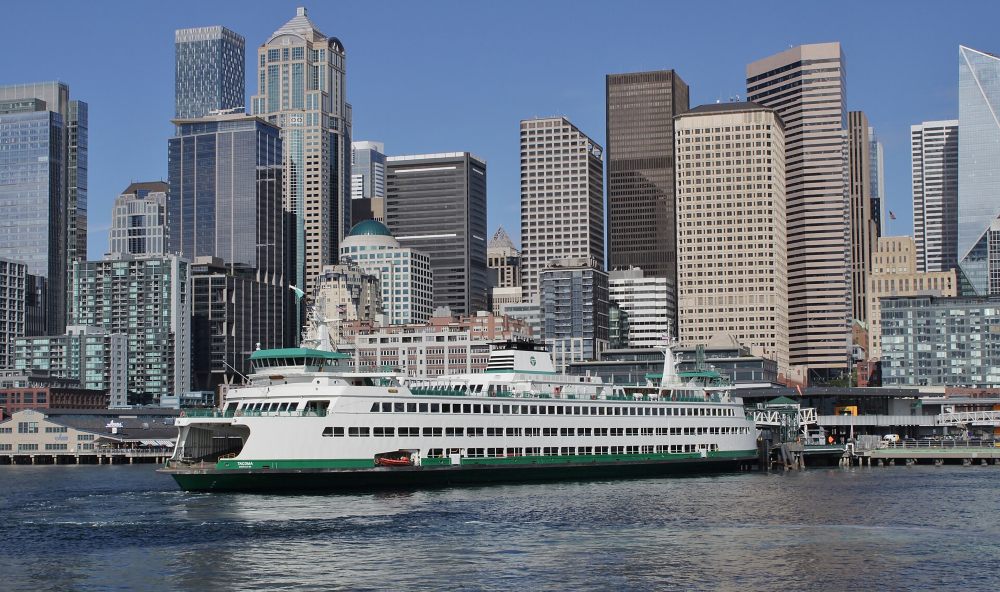

Morale is sinking fast aboard Washington ferries, or so a high-level show of hands shows.
The top brass over at the Marine Engineers Beneficial Association said as much on Thursday from Colman Dock in Seattle. They pinned the problem on burnout, staffing shortages, and a widening wage gap they say is driving experienced engineers out of the system faster than Washington can replace them.
A June 2026 survey of Washington State Ferries engine room workers says it all. More than 60 percent of respondents said they’re angling to retire or leave WSF for another job. More than 55 percent said they were none too happy about the jobs they have now.
It’s not hard to see why. That same survey also found over 42 percent of engineers canned vacations or time off because of staffing shortages and overtime demands. The very same 25 engineers logged between 585 and 1,504 overtime hours in one year flat.
Eric Winge, a representative for MEBA, the union representing engine room crews, those problems will persist unless the state pays up.
“Washington state is spending billions of dollars on new ferries, but if they don’t step up with more competitive pay we won’t have enough licensed crew to operate and repair the new hybrid electric vessels when they come into service,” he said.
The warning comes as ferry riders slog through canceled sailings and service disruptions — two things lawmakers swore to improve, namely by shoring up staff.
The Legislature notably passed House Bill 1264 from House Transportation Committee Chair Jake Fey in 2025 to suss out how Washington ferry pay stacked up against comparable employers around the country.
A survey conducted by consulting firm Segal Group gave the state a glowing review, but union bosses decried errors of omission that inflated Washington’s marine engineer wages. This includes a wage analysis for the assistant engineers who make up much of the ferry fleet and comparisons with smaller ferry operations that don’t employ U.S. Coast Guard-licensed engineering personnel.
Moreover, it failed to make an apples-to-apples comparison with WSF engineers to private-sector maritime employers and big-time East Coast ferry systems operating larger vessels with similar systems, namely New York’s Staten Island system.
Fey shared the union’s chagrin about the survey.
“We passed this legislation to ensure that ferry system employees would be fairly compensated and that WSF would be able to retain current employees and recruit qualified employees,” he said. “That is why it is so disappointing that the current survey does not sufficiently follow the direction in HB 1264.”
Keeping enough humans on payroll to keep the ferries running is going to be another big ask next session as lawmakers rummage under the couch cushions to fill state coffers next year.
A version of this story first appeared on the Washington Observer website.
Subscribe – it’s a must-follow for Washington State politics.
Discover more from Post Alley
Subscribe to get the latest posts sent to your email.


So how much are they paid?
To my recollection, I’ve read that ferry people are extremely well paid.
(The fact that wage scales are not even mentioned in this article is bizarre.)
It’s very easy to find public employee salaries — the highest ranked WSF worker earns $137k/year. Sounds like the biggest issue is burnout and being required to work huge amounts of overtime — between 500 and 1500 hours/year (!!!) You can ask for a pay raise to compensate you because the employer can’t guarantee they’ll hire more staff to get you the help you’ll need.
Thanks!
Yes it’s best to do one’s own research on basic facts to support the arguments made in a Post Alley article. After all, PA is a volunteer organization and authors shouldn’t have to do their own work.
Average pay for Washington State Ferries (WSF) employees varies widely by job class — reported averages range from roughly $36 per hour (about $75k/year) for generic WSF roles up through captain/engineer wages near six figures, and entry or on‑call positions (deckhand, booth operator) commonly report lower hourly rates in the $19–$40 range depending on source and job.
And with 2x overtime, the salary seems OK (except for living in Seattle).
I think the main sticking point is burnout. Working 500-1500 OT hours/year is insane.
Maybe it’s time to build a bridge.