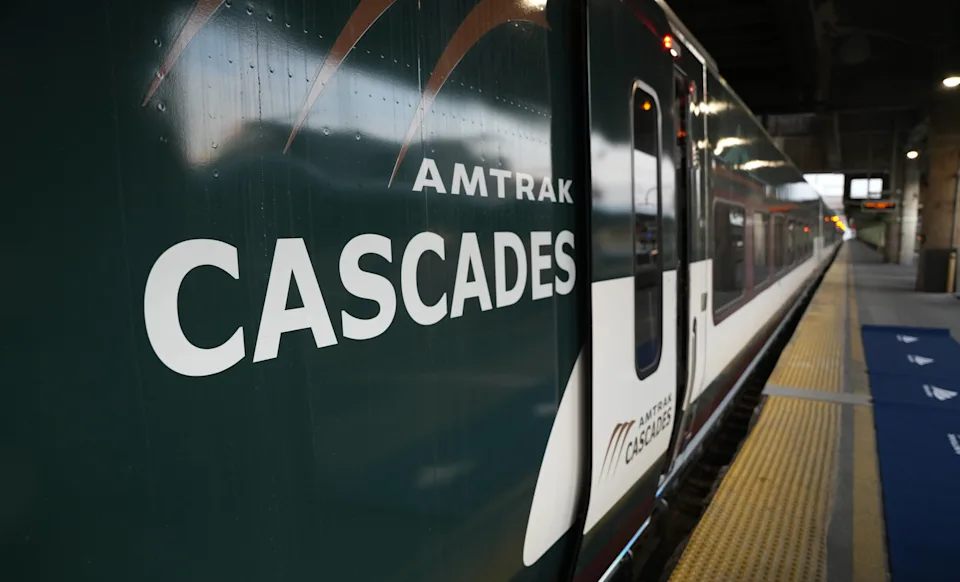

Cross-border personal vehicle traffic between Washington and British Columbia is down significantly since President Donald Trump took office, but train crossings remain steady. Amtrak, which operates its Cascades line between Portland, Oregon. and Vancouver, B.C., is investing in the region but faces a unique set of challenges in its expansion.
Data from the Whatcom Council of Governments shows a 35 percent drop in southbound cross-border traffic among B.C. registered vehicles in 2025 compared to 2024. Whatcom County border towns, which rely heavily on Canadian consumers to stimulate their economy, have said that their businesses and economies are struggling greatly amid increased fear and uncertainty over border crossing practices.
Crossing complexities
Catherine Skrzypinski, a journalism professor at Western Washington University who contributes to Salish Current and other publications, is a frequent rider of the Amtrak Cascades route between Bellingham and Vancouver. She holds a U.S. passport, a Canadian permanent residency card and a Nexus card, which is an easy-access card for frequent crossers of the U.S. Canadian border. Skrzypinski said traveling across the border is still smooth sailing for her.

“There have been instances where I’ve noticed the U.S. border (guards are) more intense with their questions—not toward me, but because you’re in the train you overhear those conversations,” Skrzypinski said. “There was one time when they asked to see phones.”
Amtrak’s 2025 ridership report shows that their service has helped maintain cross-border traffic despite issues with vehicle crossings. Cross-border traffic in 2025 rose slightly in the Cascades region, significantly on the New York-Montreal route and fell sharply on the Buffalo-Toronto route, which featured significant delays, construction and policy changes for both vehicle and train crossings.
Vehicle traffic made up roughly four times the train crossings in both New York and Washington. In the Cascades region, southbound vehicle crossings from B.C. to Washington fell a total of 25 percent.
New trains, old tracks
Washington’s 2026 transportation budget was signed into law by Governor Bob Ferguson on March 31 and is set to focus extensively on highway restoration. Despite a lack of investment in rail infrastructure as many riders and advocates had hoped for, Amtrak said its increased ridership numbers in the Northwest region have given it enough revenue to unveil eight new trains in the region.
“The new trains will revolutionize the Amtrak Cascades experience,” said the Washington State Department of Transportation’s Amtrak Marketing Manager Laura Kingman in a February press release, after the new fleet was unveiled in Washington, D.C. The Cascades region is home to over 11 million people. Current Amtrak trains, which are the only rail connection between all cities in the region, are plagued with a slew of mechanical and operational problems.

“Made in the U.S.A., the new Amtrak Cascades trains are funded as a part of the Federal Infrastructure, Investment and Jobs Act,” said Kingman. “The new trains will arrive over a period of several months, entering into service once they have been thoroughly inspected, tested and approved.”
In mid-May, the first trainset of Amtrak’s new Airo fleet arrived in Seattle for its final stage of testing before it joins the Cascades route. The trains will be passenger-ready by the end of the year.
Amtrak already faces severe delays and only runs two trains in the Cascade corridor per day, one northbound and one southbound. Skrzypinski said that she has been on trains that have sat for over an hour waiting for freight trains to clear the tacks.
“The eight new trains that will go into service in 2026 will be replacing existing older trains, not adding more trips at this time,” wrote WDSOT’s manager for Rail, Freight and Ports Communications, Janet Matkin, in an email. “There will be about 40 percent more seats available on the new trains, so that will increase the number of passengers we are able to serve, but we do not expect there to be any changes in staffing at the Bellingham Station.”
Delays and dangers

Matkin also confirmed that the new Amtrak fleet would not be impacting pricing or altering trip schedules at this time. The preliminary findings report for the WSDOT 2026 State Rail Plan sets a goal of up to 300 percent more passenger trains per day on some routes, including four new trips per day between Seattle and Vancouver, B.C.
“The Amtrak Cascades trains are often cited as the easiest way to cross the border into British Columbia, since the immigration and customs checks are all conducted at Pacific Central Station, once passengers arrive in Vancouver,” said Matkin. “Coming south, trains stop in Blaine for about 10-15 minutes while U.S. border officers board the train to check passengers before they continue on to Bellingham.”
Transit advocates have expressed frustration at the lack of alterations to anything besides the fleet itself, and many have cited significantly longer delays in Blaine than those claimed by Matkin. Skrzypinski said that the time it takes to pass through Blaine depends on how many riders are on the train.
“There was one time I was sitting there for two hours, and they weren’t giving us updates, and this was relatively recently,” Skrzypinski said of a delay in which a freight train took precedence over the Amtrak. “I was literally a mile away from my apartment, I could have rolled off the train and walked home, but I didn’t clear the border.”

In 2017, a deadly Amtrak Cascades derailment exposed that the fleet did not meet Federal Railroad Administration safety standards, and six of the eight trains in the fleet had to be scrapped.
Noah Williams, a transit advocate for the Seattle-based Transit Riders Union, says that to fill the gap, Amtrak pulled trains from Chicago and the East Coast, and that those trains, some of which are still in service today, were mechanically outdated as well.
“Procuring these new trains that are built to modern safety and quality standards, and have things like inbuilt wheelchair lifts that are well tested, will do a lot to bolster the system’s overall reliability and ability to maintain service—provided that they meet the standards that the vendor is advertising, which is always an ‘if,’” said Williams.
A worthwhile investment
Despite the increased commute times, frequent delays and aging trains, train riders still find the investment in traveling by rail to be worth it, both in terms of enjoyment and accessibility. Skrzypinski said that conductors and staff remember frequent riders of certain routes.
“It’s nice to relax and not deal with traffic. You get to know people, people become familiar and they’re all very nice… we’re like-minded people. We don’t want to destroy the environment. We’ve all had that experience of traveling by train in Europe and Asia. We want to do that in North America, but there are a lot of impediments,” she said.
The statements were echoed by Williams and other transit advocates who have traveled to parts of the world with modern rail systems with fast connectivity.
“I would love to see more investment in rail infrastructure. Not just in high-speed rail as permeated by pop culture, but even faster regional rail,” said Williams. “Expanding services to places that don’t have it, or 125 mph regional rail like is common in the Northeast would do so much good, and we know there is so much pent-up demand for it.”
This story first appeared in the Salish Current
Discover more from Post Alley
Subscribe to get the latest posts sent to your email.

