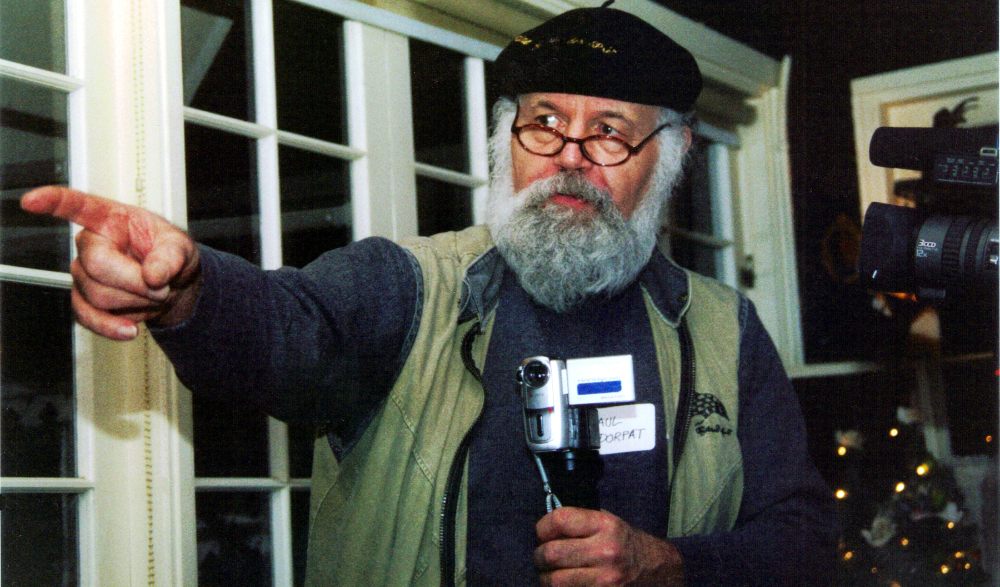

Paul Dorpat was an unforgettable presence and an indefatigable chronicler of the local scene. He died May 27 but his puckish spirit will live on in his many books and in the vast photographic collection (more than 309,000 images) that he donated to the Seattle Public Library.
Some years ago, I was persuaded to write a profile of Dorpat for HistoryLink, the online encyclopedia that he co-founded with his friends Walt Crowley and Marie McCaffrey. To prepare for that profile, I arranged a lunchtime interview with Paul in Wallingford, the neighborhood that he photographed on his daily “Wallingford Walks.”
But if I expected to talk to Paul about his background, I was quickly disabused. Paul arrived armed with two single-spaced printouts. Grouped into categories, there were dozens of projects he wanted to accomplish in his final years. He explained, “One of my older brothers died at 80. That means I have another 10 years.”
It wasn’t going to be easy discussing his past when Paul insisted on talking about the future. Everything was of interest to this great bear of a man with a saint’s grizzled beard and a voyeur’s dark eyes. He would have been a menacing presence were it not for his soothing deep bass voice.
He’d come by that voice honestly. He was the son of a Lutheran minister, the Rev. Theodore Erdman Dorpat and Ida Christiansen Dorpat. Born in Grand Forks, North Dakota, home to staid German and Danish Americans, Paul moved with his family to Spokane where he grew up. As a teen, he seemed determined to follow in his father’s footsteps and enter the ministry. He described his father as “having a great booming voice” and the business skills needed to manage a church. His mother wrote plays presented at the church.
Paul graduated from Spokane’s Lewis & Clark High before moving to Concordia Academy in Portland. Although assured he’d make a good preacher if he’d just apply himself, chance stepped in. After he slipped a spinal disc playing basketball, he spent two months recuperating in bed, giving him time to reassess his future plans. Instead he applied to Whitworth College and secured a scholarship to sing with the choir and the school quartet.
After leaving Whitworth and beginning grad school at Claremont, Paul made the decision to become an artist and move to Seattle to be near a brother, Dr. Ted Dorpat, a forensic psychiatrist.
One of Paul’s first steps was to enroll in a Free University sculpture class taught by Rich Beyer, later famed for many Seattle works including Waiting for the Interurban in Fremont. Paul continued at the Free University as a curriculum coordinator and teaching a series of lectures based on the popular writers like Marshall McLuhan.
The 1960s were a creative — if chaotic — era and the University District, home of the Free University, was ground zero for free spirited activity. Inspired by the example of counter-cultural papers like the Berkley Barb, members of the Free University were thinking of publishing a newspaper of their own.
In Rites of Passage, the late Walt Crowley wrote about discussing the paper with Dorpat and other U District regulars, including writer Tom Robbins, poet and songwriter John Cunnick and Seattle Post Intelligencer cartoonist Ray Collins. The group, fretting about a name, finally decided on The Helix in reference to the Watson-Crick description of DNA.
Dorpat borrowed $200 to rent a storefront where he and his associates began producing a newspaper. The first 1,500 copies (priced at 15 cents) rolled off the press March 23, 1967. Overseen by Dorpat, the paper lasted through war protests, police crackdowns, wire taps and assorted demonstrations, finally closing its doors with the June 11,1970 issue. Helix’s farewell: “It is time. We are tired. Three years is a long time for an experiment to last.”
While publishing the paper, Dorpat took part in related ventures, including production of the Sky River Rock Festival and Lighter Than Air Fair, the Northwest’s own version of Woodstock, in 1968. Dorpat masterminded a work of performance art, the infamous “Piano Drop” that involved dropping a piano from a helicopter to see what noise it would produce. Dorpat later recalled, “We were fortunate it missed the target – a wood pile on Larry Vanover’s Duvall farm — instead landing in the swamp-soft grass and ending as ‘a piano flop.’”
The Sky River festivals and newspaper contributed to Dorpat’s growing reputation for doing big things for hardly any money. He lived off selling copies of Helix while organizing the 10-day long Multi-Arts Festival on the Western Washington College (now University) campus. His pursuit of “a life of freedom and fun” led Dorpat to apply for and succeed at obtaining grants and commissions. He put on benefits for charities at Old Fellows Hall; he painted walls at the Harvard Exit and even opened Acme Industries, a short-lived promotions agency housed on Capitol Hill.
During that time, Dick Moultrie, a college friend, asked Dorpat to research the history of the old Merchants Café in Pioneer Square that Moultrie was working to reopen. Dorpat’s quest sparked his interest in Seattle history and led to publication of a book titled 284 Glimpses into Historic Seattle and its Neighborhoods. It was a paperback pictorial history using photos from his files and what he was able to borrow from other collections. It proved so popular that it went through additional printings racking up sales of more than 40,000 copies. In the aftermath, Seattle Time’s columnist Eric Lacitis suggested to Paul that he might do a feature for the Sunday magazine. Dorpat pitched it to Pacific Northwest editor Kathy Andrisevic who said, “Let’s try it.”
The first combo of photos and text appeared in 1982. In the ensuing 38 years, Dorpat supplied more than 1,800 “Now & Then” columns to the magazine. Meanwhile, he authored a bookshelf full of pictorial historic books. Besides Glimpses, his publications include “464 More Glimpses,” three Seattle Now & Then volumes and Building Washington, written with his wife, history professor Genevieve McCoy. He co-authored Washington Then & Now partnering with photographer and co-journalist Jean Sherrard.
Seattle Chronicle, Dorpat’s video history of Seattle, was released in 1992 and Bumber Chronicles, a video of the Seattle Arts Festival’s first 30 years, in 2020.
That same year, Dorpat stepped away from his weekly Seattle Times column, leaving it to long-time collaborator Jean Sherrard and historian Clay Eals. Although Paul became bedridden, he continued to banter with — and question — frequent visitors. He never lost his skill at interviewing the interviewer. Invited to a 2019 radio show that I helped produce, Paul showed up 10 minutes late but, as always, equipped with questions. As he said, “Without a story, history is a recluse refusing to invite you in.” He will always be remembered as a storyteller and a Seattle legend.
Discover more from Post Alley
Subscribe to get the latest posts sent to your email.

Beautiful remembrances/reflections, Jean. I was privileged to know Paul as I worked with Walt and Marie in the early days of HistoryLink. Wonderful times. Paul leaves a rich legacy.
Thank you for writing this, Jean. As I wrote on my own blog about Paul,
“I had the good fortune to make his acquaintance back when I was the Seattle History Examiner, sitting on the steering committee of the University District Museum Without Walls, and working on the first edition of my book. He encouraged my love of writing about local history, and I will forever be grateful. May his memory be for a blessing.”
Thank you Jean
I carry fond memories of Paul from the heady days of the Helix, the piano drop and Sky River. He was a force of nature.
Paul changed so many people’s lives. His process was thorough and thoughtful but his style was so offhand and casual that no one he ever befriended or helped or advised—and there were so many—felt beholden to him in any way. But of course, we all are.
You’ve captured him perfectly. Thank you.