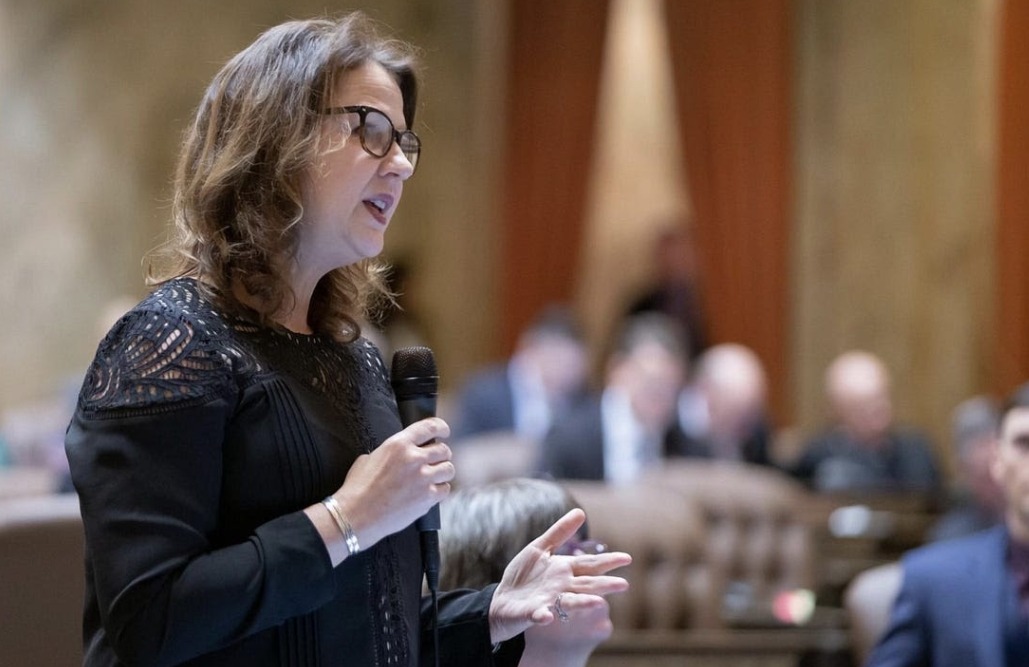

The dwindling caucus of business-friendy Democrats in the state Legislature got some encouraging news Monday with a text from Rep. Amy Walen, D-Kirkland: “Yes, I’m running.”
Walen’s re-election campaign, which surprised her own colleagues and supporters, queues up an intraparty fight in the 48th Legislative District, with Redmond City Council member Jessica Forsythe running to Walen’s left. While the race doesn’t affect Democrats’ ample majority either way, it will be a bellwether signal whether the Legislature’s increasingly leftward tilt is palatable to voters. A key development is how Democrats caught its white whale, aka a progressive income tax, this session and following last session’s record-breaking business tax increases.
Another pillar of that dwindling caucus, Rep. Larry Springer, D-Kirkland, took a break Monday from rototilling his garden to say he hasn’t yet decided if he’ll run for his 12th term. The 79-year-old said he’ll probably announce next week after gauging his level of support for the 45th District. If he decides to run, he too will face opposition from the left. So too will Senate Majority Leader Jamie Pedersen, D-Seattle, cast as a corporatist and incrementalist despite his leadership in catching that income-tax whale.
That moderate caucus is dwindling for a reason. The Trump era has emboldened progressives to pick off or push out more centrist members because, as Springer said, “the further left you are, the better you look” as a foil to President Trump. Democrats’ biggest backers (public sector labor unions) are self-motivated to push candidates left on taxes. To paraphrase former Secretary of State Steve Hobbs, a famous member of the so-called centrist “roadkill caucus” — when you’re in the middle of the road, you get run over. Hobbs himself was removed from the Legislature via an entertaining bit of realpolitik that put him in the statewide office.
Walen got run over in a 2025 Senate race in the 48th against Vandana Slatter despite a wave of business support that swept in $665,000 in donations and another $350,000 in independent spending mostly funded by Big Business’ Jobs PAC, which got big checks that year from Realtors, Microsoft, Marathon Petroleum, dentists, and others. This session, Walen gave us a peek into her caucus’s deliberations on the millionaires’ tax by proposing a Constitutional amendment to modify the income tax, which thoroughly ticked off House leadership. Her amendment went down, and Walen was a “no” on the tax.
Forsythe, who heads the nonprofit Emerge Washington, which trains women and non-binary candidates to run for elected office, said the millionaires’ tax “didn’t seem to be an issue for this district,” which has the second-highest percentage of likely payers among the state’s 39 legislative districts. Intraparty challenges such as this one reflect a feeling that, “we’ve done certain things for a long time and people are looking for sustainable, tangible change,” said Forsythe, who filed her campaign finance paperwork to run last November.
The money race for the bellwether 48th District race will be interesting. The House Democratic caucus generally sits it out until after the primary on intraparty challenges. Forsythe has union connections (her nonprofit is a member of SEIU Local 205), suggesting labor money will flow her way. Walen, who left Olympia in March looking like she’d like to burn the place down, is starting without a big fundraising war chest, with about $50,000 in her surplus campaign account left over from the 2025 race. Forsythe has raised more than $53,000 so far, and said she’s aiming for $150-200,000 overall.
The aforementioned public-sector union money has been known to play aggressively against moderate incumbents. Notably, those players went big against then-Sen. Mark Mullet back in 2020, backing a union nurse who challenged the famously business-friendly Democrat in East King County’s 5th Legislative District. Mullet, who left the Legislature for an ill-fated run for governor and was elected mayor of Issaquah last year, barely squeaked by, thanks to big bucks from the business lobby.
Springer faced a less-showy challenge from the left in 2024. Union organizer Melissa Demyan gave him a scare in the August primary, although he rallied to win in November by more than 13 percentage points after aggressive spending on his behalf, again from the business lobby.
One effect of the diminishing moderate blocs in the Democratic caucuses is that it creates fewer leverage points for the cadre of high-dollar lobbyists who get paid primarily to check the most progressive inclinations of the Legislature.
We’re regular consumers of the disclosure reports required of those lobbyists, which include any wining and dining of lawmakers, and Walen and Springer appear frequently. Should they depart, willingly or otherwise, new dining companions might be hard to come by. (Jonathan Martin also reported this story.)
This story first appeared in the authors’ blog on politics, The Washington Observer.
Discover more from Post Alley
Subscribe to get the latest posts sent to your email.


I think Springer is right, that leftiness plays well as anti-Trumpiness, and at a national level Democrats are likely to field candidates who, overall, are farther left than they should be for the optimum odds of winning the most seats and, importantly, holding them in the next cycle.
These are some screwed up times. That the Ds are going left while the Rs are going right (to take on their own who are more moderate) only makes our body politic more divided.
Amy Walen has voted against progressive taxation time and again, and in the 2026 session, she had the lowest Labor Council rating by far and away in the entire Democratic caucus, trailing even a lone Republican. Even Larry Springer, long viewed with suspicion, voted with working people 100 percent of the time in the recent session, as did Osman Salahuddin, Walen’s seatmate. In addition, Walen got wiped out in her primary bid for the Senate seat. So I have to ask, as I’m sure many others have, why in the world would labor NOT go after Walen in her re-election bid? She’s no “moderate.” She’s an anti-labor conservative in a liberal-trending district, and her voting record makes that clear. We’ll be well rid of her.
My take is that it is more about good candidates than whether one is from the progressive wing or moderate wing of Democratic Party. Factually there are just better candidates coming forward out of the progressive wing of the party. They know how to communicate. They know the issues. They have connections. They can explain why they are running and what vision that they have.
Donations and business support can only take you so far. Every candidate needs to demonstrate their ability to know the issues, understand how to get things done within the legislature to represent their district, and to communicate an appealing vision. You see time and again how Republicans in this state just put forward frankly bad candidates. Same could be said for moderate Democrats.
We need to really ask ourselves what it means to be a progressive. And then look at how certain factions have manipulated progressive guilt to put aside people who are actually Progressive in favor of people who are really just the mirror image of the right wing.
An example was when BLM activists started abusing Bernie Sanders at Westlake. There was an uproar as though Seattle showed itself to be fakes by the fact some people showed displeasure. That it was a limus test and Seattle failed find out quickly submitting to these bullies.
To me the limus test is between people who gullibly think they have to go along with things that are clearly manipulative, abusive and being done in bad faith because it’s done by a group that is labeled marginalized versus people who realize that being a progressive doesn’t mean saying how high when certain demographics say “jump”.
Dwindling caucus of business-friendly Democrats?? How so?
Last session we had HB 2103, “Authorizing certain public entities to contract for the capability of renewable or nonemitting electric generation projects.” This would have set us up for Whoops-style nuclear power contracts where utilities would have been able to buy in and then required to pay up, regardless of whether any power was ever produced. If you’ll recall, last time we did that it caused the biggest bond default in US history to that point, and some rate-payers are still paying for it. This time ’round, nine of the ten sponsors were Democrats: Stearns, Parshley, Zahn, Ryu, Leavitt, Simmons, Reed, Fitzgibbon, Bernbaum. Fortunately, this bill had enough additional flaws that it didn’t make it to the floor.
HB 2634, Concerning the safe management of radioactive waste and cleanup of hazardous substance releases into the environment, was sponsored by Democrats under the leadership of Rep. Pollet, Pollet, Bernbaum, Stearns, Ryu, Parshley, Nance, Leavitt, Goodman, Taylor, Wylie. This would have done the right stuff in dealing with nuclear waste, etc. Despite public pressure, this didn’t make it out of the Environment & Energy committee, led by Democrats Doglio and Hall.
The lead proponent of our supply-side housing policies has now been elected to the state senate, Sen. Jessica Bateman. Check out her Public Disclosure Commission web page. She raised $192,587.57 for her senate race. $72,550.00 of that came from PACS, including real estate interests and charter schools. Another $43,750.00 came from businesses.
You get the idea.
The real problem is that without a functional Republican party, we will never get Democrats to perform like the progressives so many claim to be.