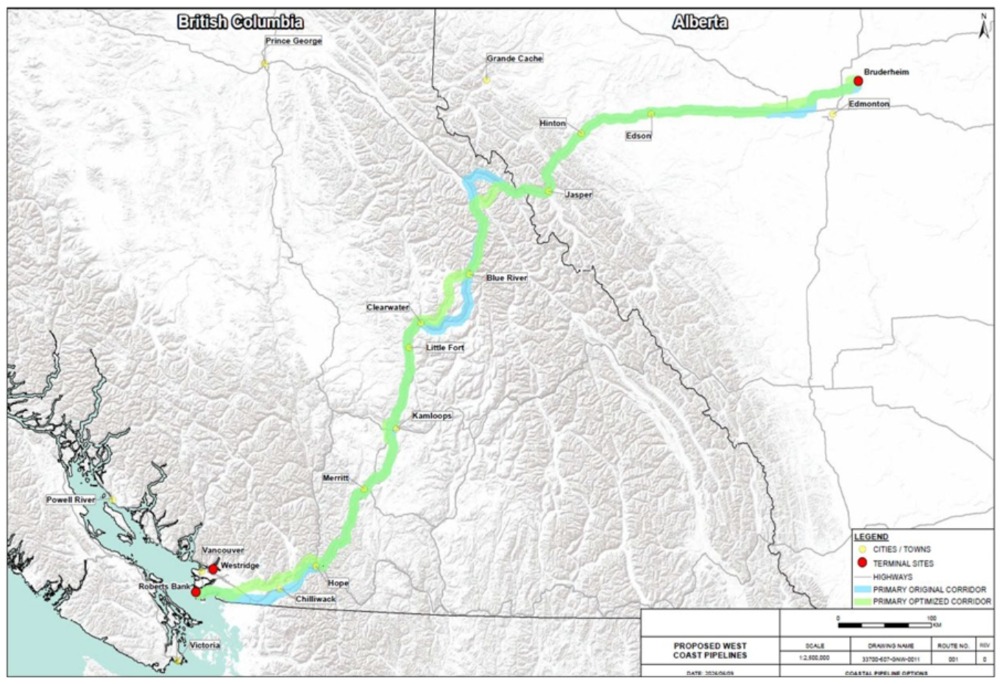

Since Canadian Prime Minister Mark Carney designated the Pacific Link pipeline as a project of national interest on Oct. 1, San Juan Islands spill response and environmental advocate groups have been preparing for what would bring over a million barrels of crude oil through Washington waters daily.
The new designation means that the pipeline is on an accelerated timeline for permitting and development, with construction set to start in September 2027.
“We are disappointed in the decision today by the Government of Canada to list the proposed oil pipeline as a project of national interest,” Washington Gov. Bob Ferguson and Department of Ecology Director Casey Sixkiller wrote in a joint statement on Oct. 2. “The classification puts the project on a fast track, limiting environmental reviews and the ability to provide input.”
According to Brian Kirk of the Department of Ecology’s Spills Program at a recent San Juan County Marine Resource Committee meeting, tankers would go from Roberts Bank in British Columbia, down through the Strait of Georgia, Boundary Pass, Haro Strait and out through the Strait of Juan de Fuca. While these ships are prohibited from calling on ports east of Port Angeles, they will be traveling through Washington waters, so Washington observes the spill risk.
The marine terminal at Roberts Bank in Delta, B.C., can host up to two very large crude tankers, Kirk said, ships up to three football fields long and able to carry 800,000 barrels of liquid cargo. “Oil tankers of that size are unprecedented in these waters,” he said. “They’ve never had tankers that large fall on our shared waters.”

Stakeholders were outspoken about this well before Carney’s decision.
In a June letter to the Secretary to the Cabinet of Canada, Friends of the San Juans marine protection and policy director Lovel Pratt wrote that improving regulatory efficiency must not come at the expense of Canada’s legal obligation to protect species at risk. The proposal would undermine core legal protections under Canada’s Species At Risk Act, weaken science-based decision-making and pose risks to southern resident killer whales, she wrote.
Pratt recommended integrating species act recovery strategies into the early project design and assessing environmental impacts as well as being more collaborative with invested businesses and Indigenous communities.
According to the Oct. 1 announcement, Indigenous communities will be offered a minimum of 10% ownership interest. Canada Energy Regulator, an independent federal agency, will lead the review process which includes “respect for Indigenous rights, environmental protections and local hearing and oversight — with Indigenous Peoples involved from the start.”
The project, the announcement states, will create 140,000 jobs across Canada and generate over $20 billion CAD in GDP per year. Canada Energy Regulator will also host public hearings, though dates for these have not been announced. In a September letter in the Islands’ Sounder, the San Juan County Council recommended placing pressure on U.S. and Canadian industry and governments to mitigate and remediate dangerous heavy crude oil spills.
“Each of these ships has the capacity of up to 92 million gallons of oil,” Ferguson and Sixkiller’s joint statement read. “That’s 260% more oil than the largest tanker currently in these waters, and the capacity of each of those vessels is eight times the volume of oil spilled during the Exxon Valdez spill.”
In one of the largest environmental disasters in U.S. history, the oil tanker Exxon Valdez ran aground in the shallow waters of Prince William Sound, Alaska, in 1989 and spilled 11 million gallons of oil. The oil killed about 250,000 seabirds, 2,800 sea otters, 300 harbor seals, 250 bald eagles, 22 killer whales and billions of salmon and herring eggs. To this day, Kittlitz’s murrelets, marbled murrelets, pigeon guillemots and a pod of killer whales in that area are listed as “not recovering” or “unknown.”
In July, U.S. Rep. Rick Larsen, D-Everett, wrote to the Commandant of the U.S. Coast Guard that the Coast Guard must immediately begin prevention planning through the Canada-United States Joint Marine Pollution Protection Plan. The joint statement said that Washington’s spill resources would be insufficient in the face of this scale expansion.
Representatives from the U.S. Coast Guard did not respond to a request for comment.
Local response
“The way in which boat traffic moves through the islands is it puts very large vessels very close to the islands, obviously,” said Brendan Cowan, Islands’ Oil Spill Association treasurer. “It’s, if not the most, certainly one of the most challenging landscapes for spill response in the country and maybe beyond, just in terms of the tidal conditions, the weather conditions, the short days for long stretches of the year and then the fact that there’s this international border running through everything.”
While the response system between the Islands association and the Western Canada Marine Response Corporation is “robust,” Cowan said the size and volume of vessels is a whole order magnitude greater than what the organizations have looked at so far. According to Islands association Executive Director Elaina Thompson, the organization responds to an average of 15 spills per year, and 80% of these are small, local spills.
“Unless there’s a massive large-scale incident, which that’s always a possibility when you have tankers running around, nothing about my work changes,” she said. The number of large spills has drastically decreased in recent years, Cowan said, crediting prevention work like vessel traffic management and tanker escorts. “But that doesn’t mean one can’t happen, and once one happens, no matter how good all the responses, that spill will be catastrophic.”
Cowan said only focusing on response is a “foolish way to look at spills.”
“The best way to look at spills is how do you keep them from happening in the first place on the prevention side,” he said, “so I think that our ability to influence things at the federal level in Canada is not nothing, but it’s clearly somewhat limited.”
Cowan said he hopes the project comes with significant upgrades to both the prevention and response side in Canada.
Discover more from Post Alley
Subscribe to get the latest posts sent to your email.