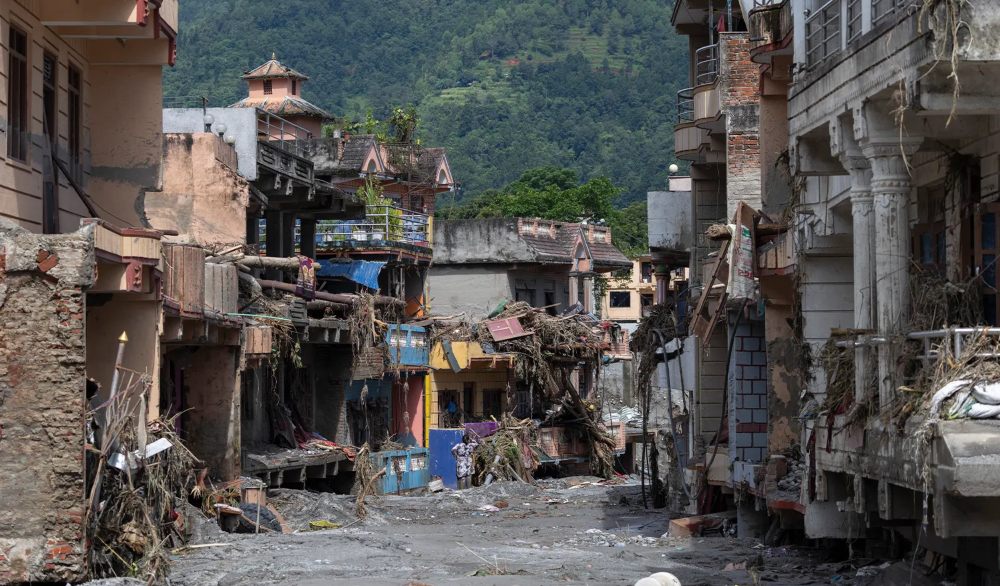

The climate change chickens — vultures more like — are coming home to roost. And it’s terrifying. From the floods in Indiana and Nepal to the super-heated cities and wildfires of Europe to the devastating fires in Spokane, it’s been a hard, hot summer.
Here in the Wallowas, in the far northeastern corner of Oregon, we have been surrounded by wildfires on all sides. For a month we were under a blanket of smoke. And we aren’t, any of us, “out of the woods” just yet with a longer fire season in our warming world.
Now we are busy adapting to a warmer climate. I have mixed feelings about that. While adapting is necessary, I wish we weren’t only applying adaptive band-aids. Some of which, like more air conditioning, will aggravate the basic causes as power use soars.
I’m hearing about other adaptations. Just yesterday I read speculation that football will become a spring sport, to avoid athletes doing pre-season training in the year’s hottest months. My own hunch is that, long term, the traditional “summer vacation” will be a thing of the past, as more people will shift to winter vacations, those who can afford it going south.
But one form of adaptation detailed in the current issue of The New Yorker caught my imagination in a more hopeful way. The article “Taking the Heat” is by Eric Klinenberg. Subtitle is, “As Summers Grow Deadlier, European Cities Are Racing to Re-Invent Themselves.” Klinenberg tells us about “Green Urbanism.”
After reviewing the “extreme heat” days of this summer in Europe, the spike in heat-related deaths and the likelihood of more extreme heat days to come, Klinenberg reports that, “It’s in the cities, where the danger is most urgent, that architects, planners and officials are racing to lower the temperature of the landscape, inventively redesigning it around three ancient forms of cooling: water, soil and shade.”
Back to the basics: water, soil and shade.
From there he takes us to Milan to meet Stefano Boeri, an architect who is known “for designing buildings and occasionally whole metropolitan areas, around trees.” Boeri’s most well-known projects are the residential towers Bosco Verticale. You might call it a vertical forest, nineteen stories high, with apartments nestled among the trees, shrubs, flowering plants and bird life. Photo below is from Wikipedia.

Treehouses for everyone! Well, not so quick. As you might expect, living in Bosca Verticale is an expensive proposition, and so not an answer for everyone or for all cities. But the general idea of relying on ancient elements — water, soil and shade — for cooling has a lot of variations and possibilities with multiple upsides.
Boeri points out that the tree canopy in his hometown of Milan covers only 15% of the city. In other European cities it is more in the range of 20%. For comparison, Seattle’s tree canopy was 28.1% in 2021, slightly down from 28.6% in 2016, with a city goal of reaching 30% by 2037.
“We need more trees to clean the air, but we also need more to cool it,” says Boeri. In most modern cities, “shade is one our most precious resources, and planting trees — lots and lots of trees is the best way to get more of it.”
This is an adaptation I can get behind!
Here in the Wallowas Linda says that our cabin is located in a “tree cave.” There are huge old firs towering above us, but also 20 more trees that we’ve planted in the last ten years. These include maples, aspens, larch/ tamarack, ponderosa pine, spruce, cedar and fir. The result of all the trees is shade and temperatures that are typically 10 to 15 degrees cooler than in the nearby towns of Joseph and Enterprise or the valley in which those communities are located.
Not everyone thinks adding trees is prudent from a fire protection point of view. Some new homes here, built with fire retarding building materials, are surrounded by a 100’ ring of gravel, no grass or trees at all. That’s one strategy for saving your home in the event of fire. We’re pursuing a different option, termed “clean green.” That means planting less flammable tree species as well as keeping the trees trimmed and well-watered, while mowing grassy areas and reducing flammable debris. Beats gravel, in my book, as that becomes another heat sink, warming a home during the night.
What I love about Klinenborg’s report is the idea that some adaptations, using water, soil and shade, are energy efficient while humanizing the scale and feel of the built environment. Cities don’t have to be more and more asphalt, in fact, they can’t be if we are going to survive.
The City of Seattle has a program of providing free trees of selected varieties for residents to plant in parking strips, thus adding to the city’s overall tree canopy. That canopy has been reduced in recent years by the trend toward buildings that cover most/ all of a lot (think four-plexes). This spring I tried to interest residents in our small southwest facing condo building in planting some free city trees in the parking strip in front of our building. Wasn’t a “go” this time around, but often, in my experience, new ideas get a “no” the first time you propose them. I’ll be back.
Given our exposure to full summer sun and that our 2008 building has a lot of glass but not nearly enough windows that open (regrettably a typical style of construction), a bank of trees between us and the summer sun may move, at some point, from being a debatable idea to an urgent necessity, one that would create shade and clean the air from a busy street and nearby train traffic. It’s not risk free. Trees can come down in storms and require maintenance and care. But what people at REI like to say when they sell you a new pack, tent or boots applies as well to a tree, “If you take care of it, it will take care of you.”
Imagine cities that prioritize the tree canopy, along with water, soil and shade, nature’s remedies for extreme heat. Imagine cities that are urban forests with Bosca Verticale type towers and pockets of water and trees. These could be beacons of hope and sanity amid a crisis of climate change.
Discover more from Post Alley
Subscribe to get the latest posts sent to your email.


Thanks, Tony, for pointing out Eric Klinenborg’s article on “Taking the Heat.” It was helpful in understanding what we need to do to design better for increasing hot climate. Let’s hope we’ll take architect Stefano Boeri’s recipe for cooling: water, shade and soil, planting ever more trees. Imagine cities where asphalt is hammered away to plant ever more shady trees!
Seven Decisions You Can Do to Limit Climate Change
Key Point: Stop burning fossil fuels to limit global warming.
Orientation: Simplicity. Electrification. Environmental Justice.
Footnotes: because it is complicated.
1. Opt out of using a gas-burning car.[1]
2. Insulate and seal up your house.[2]
3. Opt out of using an oil or gas furnace.[3]
4. Opt out of using a gas hot water heater.[4]
5. Opt out of using a gas range.[5]
6. Reduce beef consumption and focus on grass-fed beef.[6]
7. Properly recycle your old clothing and plastics.[7]
[1] Friends of ours announced that they were retiring to Mexico. Would we like to buy their 2013 Nissan Leaf? The price was right and we went for it! The car had only 24,000 miles on the battery pack, so we felt that it would last for a long while. Also, the range was 80 miles which suited us for errands and driving around town. But we have held onto our Hybrid for longer driving.
[1] Go for an all-electric vehicle next time you buy. And/or use public transportation, bicycle and walk.
[3]. We wanted to go further. We ripped out a perfectly fine gas furnace so that we stopped burning so much fossil fuel in our own home. In addition, I had seen very hot days in Seattle go from one day a year to one week a year to one month a year! Going to a heat pump would give us air-conditioning as well as heating. From the perspective of the 2021 Heat Dome it has already been worth it. A key fact: Seattle electricity is 97% renewable sourced, mainly hydropower. It is important to know the source of your electricity and fight for power companies to convert to 100% renewables.
[4] Back in 2008 when we moved into our current house, a tankless hot water heater was seen as superior to hot water tanks that constantly heat your water. I hesitate to replace our tankless heater because it works well and allows us to fill our tub in the winter without boiling pots of water to complete the fill. So it will stay for now. A compromise.