
Sabrina Griffith was only two years old when she went missing the first time. She was taken from the front yard but her mother and stepdad—both alcohol and drug addicts—didn’t notice until several hours later. When Sabrina eventually was found in an abandoned, boarded up dog kennel in a field, she was crying, naked, and bleeding. No one took her to the hospital or filed a police report. She was simply brought home. The perpetrator was never caught.
At 10, an older relative started abusing her but her family told her to keep it a secret. At 17, she left her home and fled to “the first person who paid attention to me.” He and two other men held her captive in the bedroom and when she tried to escape, she was beaten. She regained consciousness on train tracks that were still in service. Then she heard police sirens.
“I learned what it means,” Sabrina says. “That you can disappear in plain sight.”
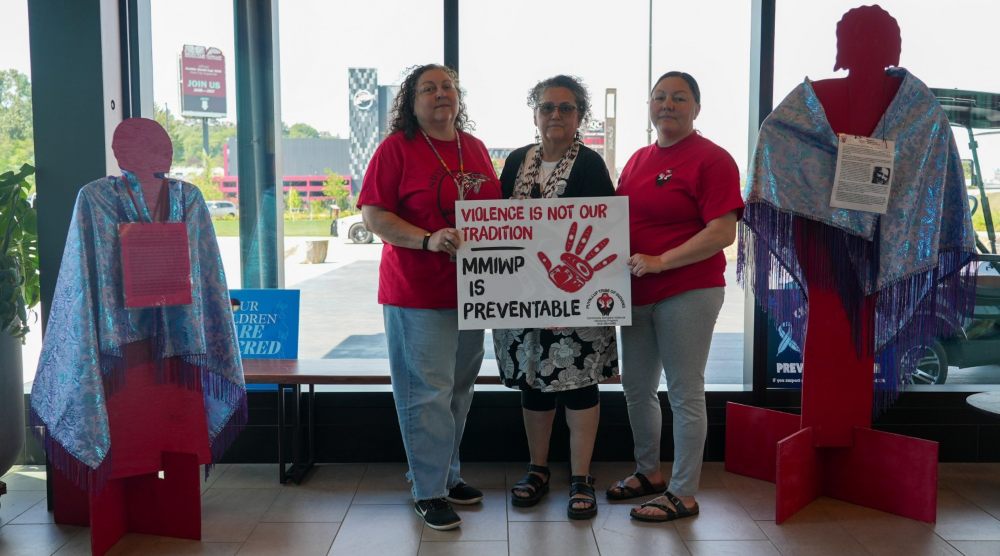
Sabrina, a member of the Confederated Tribes of Siletz, stands on the stage at the 2026 Missing and Murdered People (MMIP) Symposium, held in the towering Legends Casino Hotel in Toppenish on the Yakama reservation. She bravely recounts the horrors of her life for 245 attendees in the red T-shirts that have become a symbol of MMIP and Missing and Murdered Women (MMIW). She does it, she explains, “so other people know they will be safe, seen, and not forgotten. I had no one when I was two years old. Would I have become just another missing or murdered Indigenous child without a name?”
In the U.S., thousands of Indigenous girls and women like Sabrina go missing—and many end up murdered. In 2025, the FBI reported almost 10,000 incidents of American Indian and Alaska Native people going missing. (Incidents don’t equal the number of people who go missing.) More than half of these incidents involved a female and most missing females were under the age of 18. Because of limited data, there is no reliable nationwide count of how many Native girls and women go missing or are murdered each year, reports the National Indigenous Women’s Resource Center.

Even more alarming is that many cases remain unsolved: approximately 4,200, estimates the Bureau of Indian Affairs. According to the Urban Indian Health Institute, Washington state ranks second highest in the nation, after New Mexico—although Indigenous people make up less than 2 percent of the population in the state, they account for 5 percent of unsolved cases. Most of the missing Indigenous women in Washington disappear in King County (mainly in Seattle) and Yakima County, home of the Yakama Nation, one of the largest reservations in the state.
The Yakama Nation is spread out over 1.3 million acres in Southern Washington, hugging the Oregon border and overlooking the Yakima Valley. The vast reservation appears when the arid, golden-brown desert hills drop into green farm fields. In the distance rises snow-covered Mount Adams, called Pahto by the Yakama. The Cultural Center, shaped like a giant winter teepee, welcomes visitors but large parts of the reservation are closed to non-tribal members. It is easy to disappear here, or hide a victim, without anyone noticing.
- On the evening of June 30, 2018, 18-year-old Rosalita ‘Rose’ Longee was asked by her grandmother to leave the house, where Rosalita had been raised, because she was under the influence of drugs. No one ever heard from her again.
- Benita Long (40) suddenly stopped cashing the bank payments she received from the tribe. She was last seen March 26, 2022, outside a motel in Toppenish, close to the Yakama Nation reservation, where her family lives.
- Shari Dee Sampson Elwell’s sexually mutilated body was found December 30, 1992, by hunters in a remote, closed area of the Yakama Nation. The 30-year-old woman had been strangled. Her case remains unsolved.
Indigenous people “have the longest standing record of people missing” in the U.S., says Debra Lekanoff, the only Native American female representative in Washington state and Co-chair of the Washington State MMIWP Task Force. “We are being killed on our own lands. Our blood is running through our own waters.”
Native women have been vanishing and getting murdered since colonization, with Pocahontas—whose real name was Amonute—being one of the first examples. Advocates point out that contrary to the romanticized and sexualized Disney version, she was kidnapped by colonists in the 17th century, taken to England, and married off to a white man.
Settlers and militias used rape to colonize the New World and, in its push to bring tribes under their control, the U.S. government subjugated Indigenous women, who held powerful positions in their communities, and enacted patriarchal laws. “A nation is not conquered until the hearts of its women are on the ground,” an often-quoted Cheyenne proverb goes.
The acts to remove the Indigenous population continued with the forced relocation of tribes to remote areas, Native people being held in mental hospitals, and children being taken away from their parents to be sent to boarding schools, where they endured horrific emotional, sexual, and physical abuse. If they made it home alive, they did so with devastating trauma that was carried into the next generations.
This generational trauma underlies the crisis of Missing and Murdered Indigenous Women. It has led to broken families, addiction, domestic violence, sexual abuse, mental health problems, homelessness, and abject poverty—risk factors that make Indigenous women and girls particularly vulnerable to predators.
More than four out of five American Indian and Alaska Native women have experienced violence in their lifetime, including 56.1% who have experienced sexual violence by an intimate partner, according to a 2016 study by the National Institute of Justice. 97% of the victims of the different types of violence in the study experienced this at the hands of a non-Native perpetrator.
This pervasive violence leads to shockingly high murder rates: in a 2023 survey by the CDC, homicide was the sixth leading cause of death of American Indian and Alaska Native women between 1 and 44 years. On some reservations their murder rate is even 10 times higher than the average U.S. rate, reports the Indian Law Resource Center.
In the past years, the MMIW crisis has escalated even more because it has become entwined with a worldwide epidemic in human and sex trafficking. Already in 2015, the National Congress of American Indians (NCAI) found that 40 percent of female trafficking victims on four surveyed sites in the U.S. and Canada identified as American Indian, Alaska Native or First Nations, although Indigenous people made up approximately 1 percent of the U.S. population. And Washington state is a hotbed for sex and labor trafficking, according to the Attorney General’s office, due to the border with Canada, the port, and vast rural areas.

The MMIW Search and Hope Alliance, a Portland-based volunteer organization that searches for and repatriates missing Indigenous people, has found several dozen in two years, either alive or deceased, founder and director Kimberly Lining says. Of the runaway Indigenous girls that they have come across, thirty percent are about to be trafficked or being trafficked. “They’re all minors.”
While most of the missing girls are found in Seattle and Portland, many originally come from rural reservations, such as in the Dakotas and Montana, where there is a lack of educational opportunities and resources. “What they do have,” Lining says, “is access to the internet.”
Since the lockdowns during the pandemic, recruitment for sex trafficking has largely moved to Facebook and Instagram, and gaming sites, where traffickers target vulnerable girls in highly sophisticated and tech-savvy ways, says former detective Chris Cuestas, who is an expert in street gangs and has consulted families in MMIW cases. “They create algorithms for girls who post photos or mention sex or problems at home, and groom them.”
A large number of victims are in foster care, where Native children are overrepresented due to domestic violence or addiction at home, and don’t have a positive male role model in their lives. “Indigenous girls have a deep need to feel loved and safe,” survivor Sabrina Griffith explains.
Lining cautions that traffickers are “not creepy old men. Mean men don’t attract victims, nice men do.” The traffickers her organization has identified are generally 14 to 30 years old.
The traffickers pick the girls up on the highway. Many reservations are in rural areas close to major highways. The I-5 corridor from Canada to Mexico has become a major trafficking pipeline, as has I-90 through Montana. “And they are never to be heard from again,” Lining says.
The danger comes from both outside and within: family members and intimate partners also traffic Indigenous girls and women. Sometimes, they are literally snatched from parks or parking lots. Lack of public transportation options on reservations are an extra risk factor because it leaves many Native women, who travel for ceremonies and family visits, no choice but to walk, hitchhike, or accept rides from people who might not be reliable.
In fact, the places where they are particularly at risk are the reservations, including tribal casinos, where traffickers also recruit women. One of the main reasons is that the prosecution of crimes on reservations is constrained due to the complexity of federal Indian law. Not all the land on reservations is owned and controlled by the tribes, making for a patchwork of jurisdictions and law enforcement agencies that are in charge. But the biggest problem is a 1978 U.S. Supreme Court ruling that tribal nations could no longer prosecute non-Natives who commit a crime on tribal land.
The result: “Almost lawless communities,” says Cherokee Nation member and attorney Mary Kathryn Nagle, who specializes in restoring tribal sovereignty. “It’s pretty well-known that you can do whatever you want to a tribal woman on tribal land without consequences.”
In 2013, Congress restored the authority of tribal courts to the degree that tribes could prosecute non-Natives for domestic violence, but this authority was only expanded to sexual violence and sex trafficking in 2022—44 years in which perpetrators could commit these crimes with impunity. Even today, tribal courts are bound by sentencing limits of one year, and only three years if they provide additional due process protections, such as law-trained judges and free, appointed, licensed attorneys for impoverished defendants.
Trafficking organizations, which nowadays operate as corporations with multiple divisions, exploit these legal vulnerabilities by increasingly targeting rural reservations, says Cuestas, who has testified to U.S. Congress about the investigative challenges regarding sex trafficking on tribal land. “They move into a region and send scouts to try out different facets, such as sex trafficking and drug dealing. They know that tribal communities don’t have the resources to respond, so these communities have become a viable revenue stream for cartels.”
Cuestas once consulted on a case involving an Oglala Sioux teenage girl who was taken by her mother’s Mexican boyfriend when the mother couldn’t pay off her drug debt to him. The girl was moved to Mexico and was waiting in a Catholic church to be picked up by a sex trafficking cartel when U.S. law enforcement bought her back for $10,000, he says.
Cuestas learned from his sources that Indigenous girls are marketed as “exotic” by traffickers—an eerie flashback to colonial times. “International businessmen fly in for them,” Cuestas says, “so the fees and the potential to make money on them are significantly higher for the organization.”
Escape is usually impossible: victims are sometimes moved to other countries or forcibly branded or tattooed with symbols such as crowns, dollar signs, or barcodes that contain property information. This includes “who owns them, what the asking price is, what their estimated value is,” explains Spokane Tribal member Margo Hill, a professor at Eastern Washington University who is an expert in MMIW and trafficking. “This is horrible stuff!”
Meanwhile, at home in Indigenous communities, the thousands of missing and murdered daughters, mothers, sisters, cousins, nieces, aunts, friends, and grandmothers have deepened the generational trauma and left loved ones yearning for answers and justice. Mildred Quaempts from the Yakama Nation was only a little girl when her mother was found in Toppenish with a broken neck. Quaempts is 73 years old now and has tried her whole life to find out what happened, she says at the MMIP Symposium. “I’ve been praying for healing. Maybe the answer will never come for me.”
Josephine Rattler’s body was left in 2004 at the front door of a hospital in Browning, Montana, where she died, at 27 years old. Rattler was married to an abusive and controlling man from a different tribe who even picked up her paychecks at her work, her sister Idella King says. Rattler had mentioned to her that she wanted her freedom back but King didn’t know how bad the situation was. “We found out later that Josephine had called the police 19 times in the year she died.”
King suspects her sister was planning on leaving the day she died. Her husband claimed later that she was trying to commit suicide and that he had taken her to the hospital, although he hadn’t gone in with her, according to King.
The case was never properly investigated, she claims. “My sister was a firecracker, just beautiful. She loved fiercely. But her life wasn’t valuable enough for an investigation. All the different law enforcement agencies were hands-off.”
Glacier County undersheriff William Gobert says the sheriff doesn’t have criminal jurisdiction in Browning, but the cause of death is “strangulation due to hanging.” However, the manner of death—if this was possibly a homicide—is still pending investigation. “This is basically an open case.” The Blackfeet tribal police tell Post Alley that tribal policy doesn’t allow them to give information to the media and the FBI is not able to comment on investigations outside of the public record.
The crisis of MMIW is a crisis of invisibility. Native women disappear three times: when they go missing, when they aren’t mentioned in the media, and when they aren’t included in the data. Institutionalized racism and victim-blaming play a major role, according to advocates. “But that person was someone’s whole world,” Griffith says.
Most cases of missing and murdered Indigenous women are not covered by the media, which is a stark difference with the overwhelming attention for white women like Gabby Petito and Nancy Guthrie. As opposed to these victims’ families, Indigenous families usually don’t have the financial means to hire a private investigator, a crusading lawyer, or someone else who could be their advocate.
Neither do Indigenous women always show up in the data because of underreporting and misclassification. Until a few years ago, the Cold Case Unit did not check if a victim was Native American, Rep. Lekanoff says. “On all public safety levels—state patrol, sheriff, police—there is a lack of knowledge of MMIW.”
Law enforcement, including tribal police, are stretched thin in spread-out areas. Insufficient public funding is another impediment to solving cases. The remains of Aidan Spear, who disappeared from Tacoma in 2022, were found in January of this year and identified three months later, but that is an exception, says Deputy Carly Cappetto, Public Information Officer of the Pierce County Sheriff. “The process usually takes years and is very expensive. Funding can definitely deter our ability to quickly identify a missing person.”

In their fight for justice, Indigenous women themselves have worked tirelessly for decades to bring attention to the MMIW crisis. They train their own search groups, organize rallies, run marathons, create podcasts, hang red dresses to commemorate their sisters on May 5, National Day of Awareness for MMIW, and write about it, as Coast Salish writer Sasha LaPointe did in her gripping essay collection Thunder Song.
As a teenage runaway, she could easily have gone missing, she says—although she only realized this when a friend pointed it out while she was writing the essay. “She said, ‘you’re one of the lucky ones who came home and found safety’. It shook me to my core.”
For years, LaPointe was in survival mode due to sexual assault and her mother’s struggles with substance abuse. “Native women have a capacity to disappear, not just physically but also into substances or disassociation. Telling and sharing stories and attending rallies for me is active resistance to invisibility.”
The Coast Salish stories and teachings helped her heal. “I had all the wisdom and knowledge to get through it. In that sense, I was very privileged. Hopefully my writing will reach other women to let them know they have a voice, too.”
At the MMIP Symposium in Toppenish, which was organized to bring awareness to Indigenous communities and give them resources such as counseling and digital literacy to combat the risks, Kimberly Lining asked the attendees to also take their responsibility.
“We can only blame so many things until we look at ourselves,” she says. “What have we done to create this problem and what is the solution? We have to be accountable to ourselves and break the cycle.”
Indigenous communities need to form alliances with non-Indigenous parties to stop the crisis and “shed light on the darkness,” Lining emphasizes. “Otherwise, this system that is built on the assumption that we will not survive, they will win and our people will face erasure.”
The Washington State MMIWP Task Force, which was established in 2021, has made headway by forming these alliances. Rep. Lekanoff says the Task Force functions as an example for other states, with a Missing Indigenous Persons Alert (MIPA) and a MMIWP Cold Case Unit in the Attorney General’s office—both the first in the nation—, law enforcement training on MMIW and Indian Law, and a Missing Persons Toolkit specifically for Indigenous families. Of the 152 MIPA’s that were activated between 2022 and 2025, 129 led to the recovery of the missing person.
“We are sending the message that Native women are not invisible,” Lekanoff says. “You can’t murder us and be violent against us and steal our girls and get away with it.”
INITIATIVES

Sex trafficking is a crisis year-round but there is a large increase during major sports events. To combat it during the World Cup 2026, FIFA, the Port of Seattle, law enforcement, and the non-profit organization BEST (Businesses Ending Slavery & Trafficking) launched a coordinated effort. This included free training of staff, especially workers in the transportation and tourism industries, in recognizing and responding to signs of exploitation. The training was focused on businesses near high-traffic event areas, such as the stadium district, the waterfront, and the Fan Zones.

The Port of Seattle and the City of SeaTac were in some ways ahead of the game: the Port launched Port Allies Against Human Trafficking (PAAHT) in 2023 and has since installed signage throughout the airport and its maritime properties, and trained the Port police, employees, and tenants.

The City of SeaTac stepped up patrols on and around gamedays. In the past six months, law enforcement conducted four preemptive sex trafficking operations and made sixteen arrests, SeaTac Police Chief Marcus Williams reports. Two female minors from Portland who were trafficked, were returned to their parents in June. Overall, there was not a notable increase in sex trafficking, possibly because visiting soccer fans didn’t stay in Seattle long before or after the games, according to Williams. “They got in and out.”
Discover more from Post Alley
Subscribe to get the latest posts sent to your email.


Thanks for the well-researched and well-written article. It sheds light on a very dark subject that needs more attention.
An extraordinary account of the serious dangers facing indigenous women. Very well researched and written, giving the public important insights into a system that poses extreme danger to these women and girls. Thanks for posting this important story.
Very well reported and written. An important story.
A detail — in this sentence, “In the distance rises snow-covered Mount Baker, called Pahto by the Yakama.”, I believe you’re referring to Mt. Adams, not Baker.
Excellent article. Traffickers are “not creepy old men. Mean men don’t attract victims, nice men do.” And sadly, sometimes those traffickers are women who cruelly attach themselves to young women as protectors.
as to: “…But the biggest problem is a 1978 U.S. Supreme Court ruling that tribal nations could no longer prosecute non-Natives who commit a crime on tribal land.” I remember this ruling. Is there no way this can be resubmitted before the court?