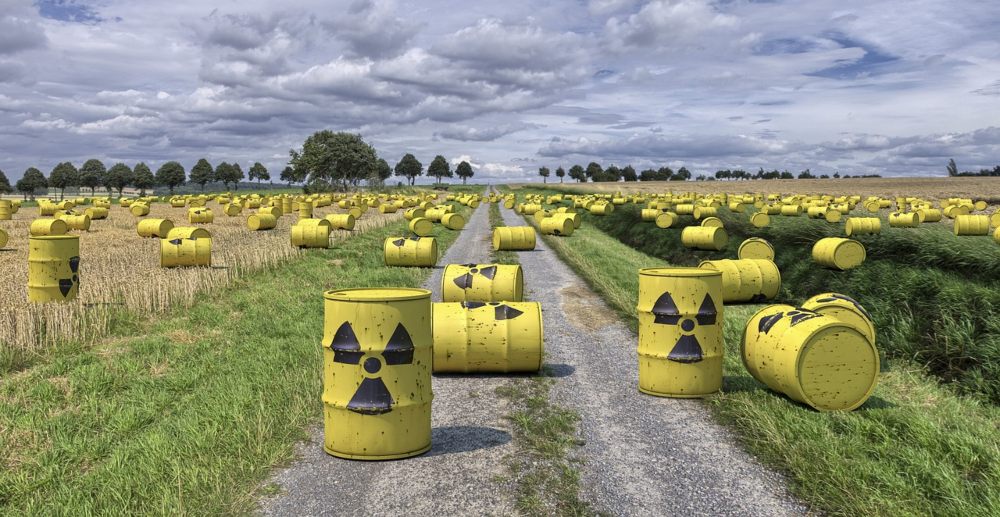

The Energy Department has said it will provide up to $17.5 billion in loans to the builders of new nuclear power plants. Is anyone surprised?
Back in the day, Martin Luther King Jr. had a dream.
So did Richard Nixon. The hero of Watergate dreamed of building 1,000 nuclear power plants across the United States.
The Trump Administration doesn’t seem to have much use for King or his dream. But it has embraced a fantasy much like Nixon’s. Trump envisions a host of new nuclear reactors completed in record time in order to pump out energy for all those big new data centers – which are arguably designed to help the rich grow richer ASAP. The first of the new reactors – which may start generating power next year – went critical at the Idaho National Laboratory on June 4
Trump is not the only one envisioning – yet again – a nuclear future. Last year, Amazon announced a deal with Energy Northwest to build small modular reactors (SMRs) at Hanford to power Amazon’s own data centers and AI.
This is not a one-off: Microsoft has taken a different step toward nuclear. In 2024, it announced it would pay to restart and buy the entire output of Three Mile Island 1, twin to the notorious Three Mile Island plant that started melting down in 1979. No one died, but “Three Mile Island” has been shorthand for the nation’s best-known and most dangerous nuclear accident. (Three-Mile Island made people think about what might have been. Seven years later – now just 40 years ago, the Chernobyl accident made people think about what nuclear actually was. Microsoft will use the power to offset power from other sources, so it can say that – once you do the math – its electricity is generated carbon-free. Or not. With a commitment to pour kilowatts into AI, Microsoft may now be reconsidering its ambitious climate goals
Meanwhile, Microsoft co-founder Bill Gates has invested in a demonstration sodium fast reactor plant in Kemmerer, Wyoming. The reactor, which will use thorium, rather than uranium, as fuel, applies a concept once pushed by the former director of the Oak Ridge National Laboratory, Alvin Weinberg. (Weinberg, who worked on Eugene Wigner’s team that designed the first Hanford reactors, once said that he had started touting nuclear power after reading a mid-century book about the dangers of global warming, and deciding we’d better have an alternative to fossil fuels.)
When Nixon envisioned a nuclear future, nukes seemed to be the next big thing. Even then, the technology wasn’t exactly new. The U.S. launche3d its first nuclear submarine, the Nautilus, in 1954. Power from an experimental reactor – at what is now the Idaho National Laboratory — lit up the town of Arco, Idaho in 1955. Those were the good old days in which some optimists figured nuclear plants would make electricity “too cheap to meter.” (That was also around the time that some people figured Washington state would become a center of nuclear industry. In other places, citizens were scared of the atom; but here, “they’ve all in. People have driven through Hanford and they know it won’t kill them.”)
Utilities were building –or planning to build – dozens of new plants, all larger than any the industry had operated in the past. Some of those plants are still operating. Reactors provide some 18 percent of the nation’s energy.
Complex regulations, a lack of standardization, endless construction delays tanking demand, soaring costs meant the numbers just didn’t add up. The economics didn’t work out.
The Northwest became a poster child for nuclear failure: Pushed by the Bonneville Power Administration – and pulled, perhaps, by their own hubris – a consortium of Northwestern public utilities known as the Washington Public Power Supply System (which was pronounced – prophetically, as “whoops”) bit off a whole lot more than it could chew. The utilities set out to build five big nuclear plants.
After, among other things, endless Keystone Kops construction delays, Wall Street stopped buying their bonds for plants 4 and 5. Plants 3 and 4, backed by BPA ratepayers, were never finished. Only one plant has ever generated power. When the organization threw in the towel on plants 4 and 5, it achieved the rest starred in the nation’s largest municipal bond default. (The late Post Alley contributor Joel Connelly covered the WPPSS debacle extensively for the old Seattle Post-Intelligencer. People who were actually trying to deal with the situation would stand around before meetings and talk about whatever Joel had published that morning.)
WPPSS wasn’t the only organization that had a bad experience with trying to build nuclear plants. More than 100 projects were scrapped.
Public fears and criticisms – there were anti-nuke demonstrations, and anti-nuke state initiatives and laws — didn’t help the economics. Government saying “trust us” didn’t go very far. The old Atomic Energy Commission (AEC) was responsible for promoting, as well as regulating nuclear power – a built-in conflict of interest
In 1974, to resolve the conflict, Congress created a separate agency, the Nuclear Regulatory commission (NRC) to handle regulation alone.
Now, the Trump Administration is making America great again by bringing that old conflict back to life.
Trump held an Oval Office meeting last year to present his vision of new plants built in a hurry. He said a goal was to quadruple nuclear energy production within 25 years. Interior Secretary Doug Burgum said the industry had been choked by over-regulation. Trump announced plans to deal with that. The NRC is supposed to approve permits within 18 months. The Department of Energy has been pruning the regulatory jungle. The Kemmerer plant has received fast-track approval through the NRC. The SMR pilot plants will skip the NRC, seeking approval instead from the DOE.
The results – made public not by the government but by National Public Radio – seem to have done quite a good job. The DOE has allegedly reduced the number of regulatory pages by two-thirds, and lowered the bar for compliance. Workers can be told to work more hours and withstand four times as much exposure to radiation. Radioactive discharges to groundwater should be minimized but they are no longer forbidden. Feel safer? The argument for new small nukes is that they are not only cheaper and quicker to build, but they’re also safer. If they’re safer, why loosen the safety regulations for them?
Before we go all in on this new one, it would be nice if the desirability of building new nukes in a hurry were thoughtfully discussed. Good luck with that. There’s some serous FOMO involved. A wave is starting to sweep the world. We can either surf it or find ourselves underwater.
And yet . . . haste isn’t the best mindset with which to approach say, using a power tool. It hasn’t proven to be a great idea where nuclear plant construction or nuclear waste disposal is concerned, either. That seems to be a key lesson of the WPPSS debacle. And of the fact that Hanford’s radioactive waste, first hastily disposed of during World War Two, may not finally be cleaned up until 2086. If ever.
Last summer, Trump, eager to see those new nuclear plants built quickly, issued an executive order to have three demonstration plants up and running by this coming Fourth of July. To keep things on a fast track, the administration has decided to clear-cut the forest of regulations that have delayed nuclear plant construction for decades. The administration didn’t announce this. It was done in private. NPR broke the story in January.
The changes strip out hundreds of pages of regulations, change the groundwater contamination standard from “must” to consideration should be given, and lower the barriers to irradiating workers. “The new orders strip out some guiding principles of nuclear safety, notably a concept known as ‘As Low As Reasonably Achievable’ (ALARA),” NPR explained, “which requires nuclear reactor operators to keep levels of radiation exposure below the legal limit whenever they can.
Removing the standard means that new reactors could be constructed with less concrete shielding, and workers could work longer shifts, potentially receiving higher doses of radiation, according to Tison Campbell, a partner at K&L Gates who previously worked as a lawyer at the Nuclear Regulatory Commission.”
“I don’t think cutting corners when you’re talking about nuclear safety is a good idea,” Edwin Lyman, Nuclear Power Safety Director at the Union of Concerned Scientists, has – reasonably – said.
Less attention to safety will only make some people more uncomfortable with the administration’s reported interest in letting new private nuke-builders use weapons-grade plutonium for fuel.
And there’s no guarantee that the administration’s haste will pay off: “Despite billions in global investment, SMRs have stayed ‘five to ten years away’ for over a decade—with zero U.S. projects ever breaking ground,” Geekwire reported last year, after Amazon announced its deal with Energy Northwest. “Some U.S. efforts have been canceled for financial reasons; Others remain stuck in prelicensing or depend on international progress to reassure hesitant investors. [Advanced reactor] projects in Canada and China are further along, but none are operational.” Here, Energy Northwest, which will partner with Amazon at Hanford, used to called – used to be – WPPSS.
What could possibly go wrong?
Discover more from Post Alley
Subscribe to get the latest posts sent to your email.