
An elegy is a lamentation over the dead and passing. In A Hillbilly Elegy, J. D. Vance regretted the passing of the Scots-Irish Breathitt County Kentucky hillbillies from his early life and his transition into the elite coteries of Yale Law School where he met his wife and scaled up a social arc that eventually led to becoming Vice President of the United States.
My own elegy is for the passing of the dairy, grain, and row crop farming communities of the Salish Sea basin. I wrote Vine Maple Farm: A Whatcom County Idyl, a book about farmers working together; a place and time where money seldom changed hands, where helping friends and neighbors in need was both a duty and a pleasure.
Two data points are hardly adequate to characterize an entire country the size of the United States, but I’ll make a stab at it here by holding up my elegy to the low-land farmers of the Salish Sea basin to compare with Vance’s elegy to the inhabitants of the hills of Kentucky.
Vance’s family left the hills of Kentucky and moved to Middleton, Ohio before Vance was born. Coal mining was declining and industrial jobs were on the rise in Ohio, which influenced their move. Three generations before me, my Dutch and German family were pushed by European politics and theology to move from the shores of the North and Baltic seas and settle in the rainy low lands of the Pacific Northwest, where they formed a culture of immigrants with deep roots in the European Protestant Reformation.
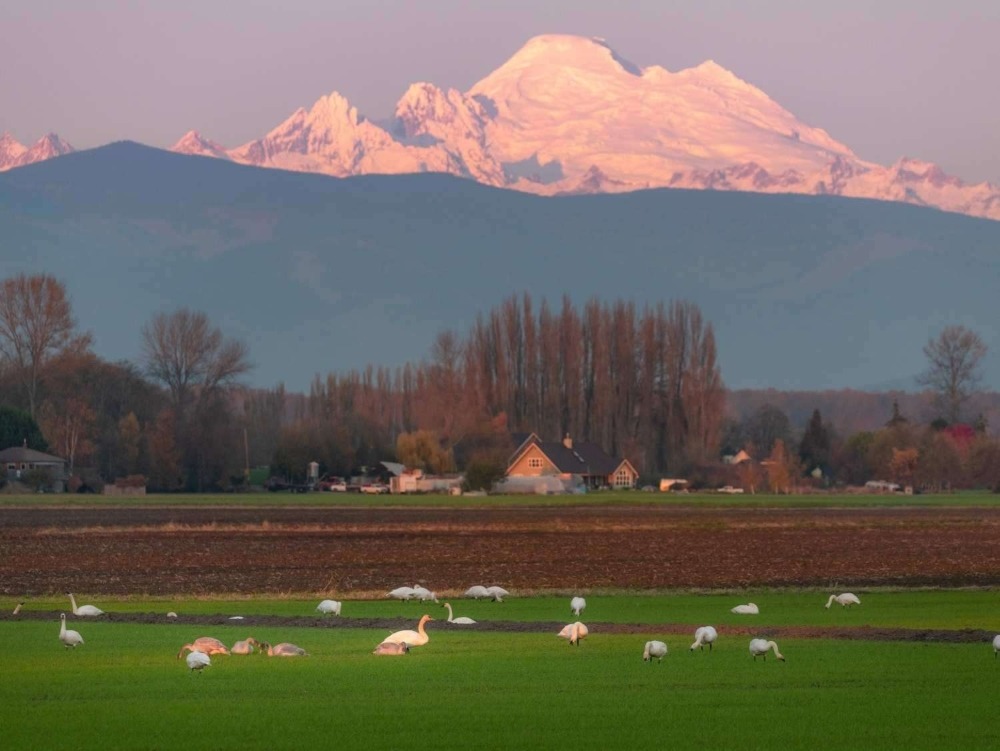
I grew up among farms spread out over river basins in the shadows of glaciated volcanoes and massifs of the North Cascades from the eastern horizon. The hills of Kentucky are nothing like the Cascades, the sources of the rivers that built the fertile soil of the Pacific Northwest. In our backyard today, ten miles inland from the Salish Sea and about a hundred feet above sea-level, the first low hill is Sumas Mountain, a few miles away and about 3500 feet elevation. Double the height of the highest point in Breathitt County. I don’t know what Breathitt County hillbillies would think of snow and glacier covered Mount Baker that looms at nearly eleven thousand feet over Sumas Mountain.
Of course, hilly Kentucky versus mountainous Pacific Northwest with its broad river basins is not the issue. I’m certain Vance would agree that hillbilly is based on an attitude not a geographical feature.
My immigrant great-grandparents chose to settle in a region of staggering wealth. Anthropologists say that the Salish Indian culture of our region, with its fertile sea, rich soil and abundant wildlife, was one of the wealthiest cultures to exist on this planet, a culture where no one, except the enslaved, had to work harder than they felt like and no one ever went hungry. The farmers I wrote about in Vine Maple Farm worked hard, but they were also inheritors of that wealth.
Ferndale, the town nearest the acreage my grandparents homesteaded, and where I still live, was a rural agricultural center until two oil refineries and an aluminum smelter moved in and offered industrial jobs. A grain elevator and the smoke stack from a cream condensing plant are still the town’s tallest structures and monuments to its farming history. However, the economy of the town soon came to be dominated by heavy industry, not agriculture.
Vance’s home town, Middleton, is larger and wealthier than Ferndale, but the small cities have similarities. Kentucky hillbillies moved to Middleton for jobs in the steel mill when coal mining declined in Kentucky. When I entered elementary school in Ferndale School District, many in my first grade class were from a refinery town, Olean, in western New York state. Their parents had come to Ferndale to operate a newly built oil refinery.
Like the cutbacks at Middleton’s steel mill, Ferndale’s aluminum smelter closed a few years ago. The plant was located near Ferndale for abundant and cheap electrical power for electrolytic smelting and a Salish Sea deep water dock for unloading Australian bauxite ore. However, over time, the cost of shipping bauxite to Ferndale and electricity both increased. The plant contracted and finally closed.
When the Middleton steel mill declined as the steel industry shrank under forces far outside the rust belt, Middleton suffered. Businesses like grocery, furniture, and hardware stores that provided services for the steel workers also suffered.
Due to remote external forces they could not begin to control, both Middleton and Ferndale lost jobs that had brought prosperity for a generation.
Here is where Vance’s Middleton and my Ferndale begin to diverge.
According to Vance, his Middleton neighbors lost the will to work, to show up every day at a boring job to support their families. Vance describes their demoralization and despair turning into desire for a strongman protector.
The idyllic farming community of my youth is gone. Among my neighbors, many work at jobs that are less than their dreams and the idyllic communities of sixty years ago have disappeared, the aluminum smelter is gone, but the county has diversified, and my neighbors still work to enjoy life with their families and friends.
Perhaps this is a consequence of the inherent wealth of our region. Drive the country roads and every few hundred yards, see a farmstand with fresh eggs, vegetables, local honey, and flowers sold on the honor system. With eggs and winter crops, these stands are open nearly year round. Almost anyone can afford to hike, snowshoe, and cross country ski in the mountains. The Forest Service offers free firewood cutting permits, if a neighbor doesn’t invite you to harvest their windfall. There are clams to be dug and crabs to catch in the saltchuck (saltwater), and fish to catch in rivers, lakes and streams, all resulting from our regional wealth. Some are demoralized and despairing, but not over jobs or lifestyles.
The United States are polarized. I see a great divide between the Kentucky hills, Middleton, Ohio, and the river basins of the Pacific Northwest, but is that divide the source of our new-found polarization?
Or are we polarized because advances in communications, like the Internet, now show our differences more clearly?
Discover more from Post Alley
Subscribe to get the latest posts sent to your email.


Marv, thank you for your article A Tale of Two Elegies. it brought back memories of the country-town experience and the contrasts between the rugged west of Spokane and the urban Midwest of Columbus, Ohio.
when I was 16, the year before my senior year in high school, my father was transferred from the Spokane Valley to Columbus, Ohio. It was exciting, sad, a cultural dislocation, but very interesting.
Central Valley, WA was farmers, Kaiser Aluminum engineers, teachers, laborers, and in the summer migrant workers who helped harvest strawberries. The high school was all kinds. and all mixed more or less peaceably. Lots of folks skied, or went hiking, or to the lake to swim and water ski. We could walk home from school thru the mud or snow singing sometimes.
Columbus, Ohio was completely …other. Ohio State University meant almost everyone went to college. many got perfect sat scores. there were lots of jokes about The Big Farm, as some referred to o.s.u.
I am grateful for the experience but always have felt in some undefined way that I can’t quite explain, closer to folks in Opportunity, the Spokane valley. IT seems a great pity that there’s no intensive way for people to come to feeling compassion for folks that aren’t like us.
sorry to ramble on.
Thank you again.
The comparison between Ferndale and Middletown is thought-provoking. It shows how two communities facing similar economic disruption can end up with very different stories of adaptation, identity and resilience.