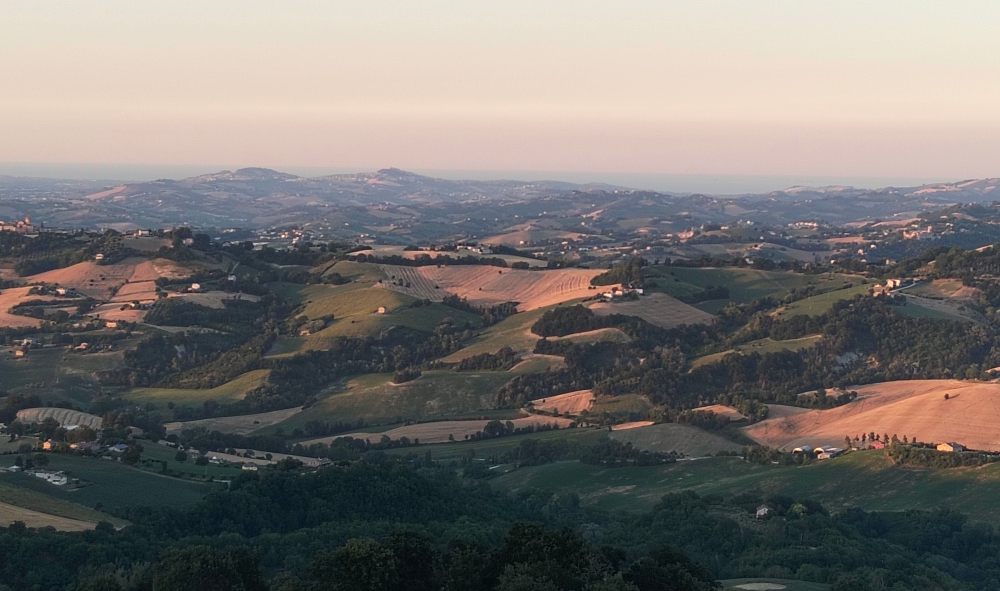

Visitors to the village we have lived in for the last ten years will see a town that appears, at first glance, to have pretty much stayed the same since it was built over 1100 years ago during the “High” Middle Ages. Ancient masonry buildings with terracotta roofs flank narrow, winding cobblestone lanes. A tight cluster of similar structures are perched on the top of a small mountain. A high, thick wall provides a fortified belt around it. Santa Vittoria is one of the more than 200 hilltop towns that dot the region of Marche, most of which have never made it into a travel guide.
However, looking a bit deeper and longer, one can detect a community in decline. Many of the houses are empty, due to the deaths of their aged occupants or because they are owned by multiple heirs who can’t agree on what to do with them. On our street, half the houses are unoccupied or occupied only sporadically during vacations or festivals. Some extended families fill a dwelling when they come to visit Nonna, who will host bounteous and boisterous meals around a long table.
Two earthquakes in 2016 damaged a dozen buildings in the town, with a few totally collapsing with their unreinforced masonry walls. In the aftermath, some people relocated to coastal towns less prone to seismic events. Many prospective buyers of vacant homes were understandably scared off.

In some places throughout Italy, shoddy building renovation and deferred public sector maintenance followed in the decades after WWII and left physically weakened communities. By the early 2000’s, many local roads were falling apart, with ruts and potholes and entirely missing sections of pavement. Inadequate drainage systems allowed rainstorms to spill torrents of mud from hillsides over the roads and onto farmlands. Rivers overflowed seasonally. Decrepitude often overpowered the romantic image of the small Italian town.
Then in 2020, the covid-19 pandemic hit, further diminishing the vitality of these communities. Over the last decade, Italy’s population has declined by almost a million, in part due to deaths, in part due to lower birthrates, and in part because of younger people moving to other countries in the EU with healthier job markets. Only immigration has kept the population from plummeting even more.
A number of small towns have attempted to attract new residents using financial incentives such as the famous “One Euro Houses” — an inducement that has had mixed results given that a new owner must spends many tens of thousands bringing back these buildings to livable conditions. And within a limited timeframe.
The federal government has been offering foreign pensioners a flat 7% income tax rate if they settle in a southern region or one of the designated small towns in central Italy. Curiously, this tax incentive has attracted fewer than a thousand newcomers since it was enacted in 2019. Perhaps for good reason. It will take many more than a few retirees to bring back goods and services to many of these towns.
Immigration laws, which set annual quotas, give preferential treatment to a number of countries in Africa and Asia, in part to assure farmers, construction companies, and hotels that they would have an ample and lower-paid labor pool during prime seasons. Only recently have new visas — the Investor Visa and the Digital Nomad Visa — been added to attract private investment and new, more youthful and educated workers.
So far this has all sounded quite depressing, I am sure. And in sharp contrast to the countless articles in magazines about the many gorgeous and glorious places to live in Italy. However, as some aspects have indeed declined, there are significant improvements in other quarters.
In 2021, in the waning months of its control by center-left parties, the Italian government in adopted the National Recovery and Resilience Plan, which called for a whole host of policies, programs, and projects aimed at revitalizing the economy and specifically reviving small, struggling towns. The current government, led by center-right parties, has enthusiastically embraced the plan. The plan unlocked a series of grants from the EU, totaling over 240 billion euros – considerably more than the amount from the Mashall Plan funds following WWII when inflated to today’s value. Money makes a huge difference.
The thrust of the plan is centered around major public investments in roadways, utilities, energy conservation and solar collection, new schools, hospitals, and civic buildings, restoring historic structures, and replacing outdated administrative technology with state-of-the-art tech, among other actions.

In our little town, with its 1100 residents, we have seen the results and they are breathtaking. Local children attend a new primary school. The main road into the town center has a new, broad promenade lined with trees, benches and lighting. All the old streetlights in town have been replaced with energy efficient LEDS, cleverly fitted into their traditional, ornate “glass lamp” fixtures. Overtaxed storm drainage systems in the rolling landscape surrounding the town have been replaced with modern structures and systems. As have bridges, which were crumbling. The ancient fortress wall enclosing the town has been reinforced with high strength steel “tiebacks” buried deeply in the sloping terrain.
Public spaces have been upgraded. Roads outside the town – paved with asphalt – have been replaced with new smooth pavement, lighting, and fog lines while streets in town that had been patched with asphalt have been returned to their original cobblestones. Houses and buildings that had been damaged by the earthquakes are now being renovated. This little village has had five cranes hovering above its meandering streets and four-story structures for several years.
The local population continues to support a multitude of family-owned businesses providing goods and services, medical and dental care, and fine dining. Bar Centrale, with its espresso drinks, pastries, seasonal gelato, and an assorted array of alcoholic beverages flourishes as the center of local gossip and impassioned “discussions.”
As I noted in a previous article, a coterie of smart, aggressive women has infused a new sense of entrepreneurial energy. I am delighted that my wife is a part of the wave of new and renewed enterprises with her artisanal skin care studio.
The town is preparing itself for a new future, while being careful to maintain its heritage and its traditions. Strategic public investments and irrepressible moxie have been combined to revive this ancient town.
Discover more from Post Alley
Subscribe to get the latest posts sent to your email.