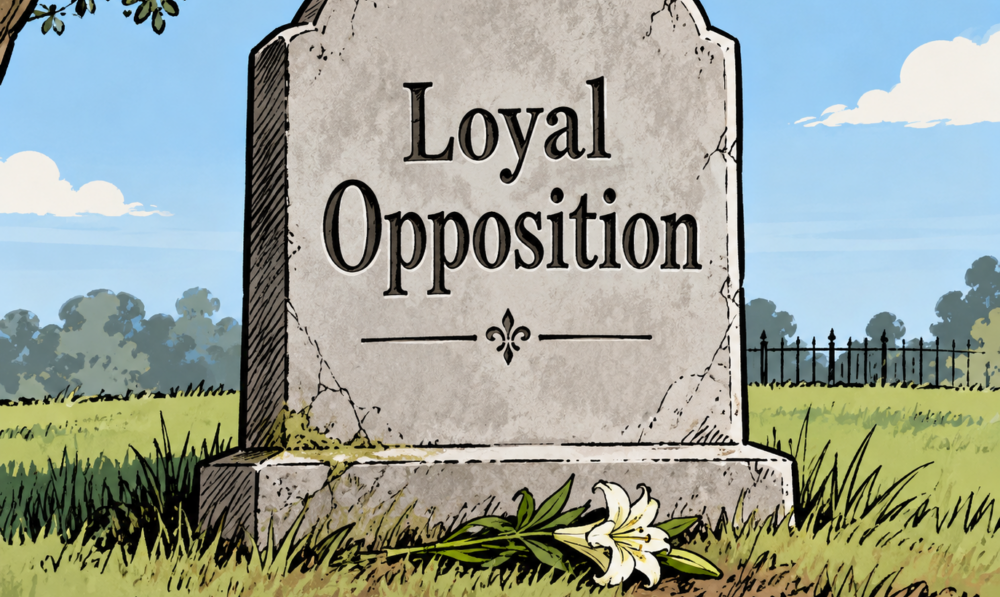

Trump admitted last year that he “hates” his opponents. You may have missed the speech, but you haven’t missed the hatred. It spills over every container. He sticks his adversaries in the eye, calling them “the enemy within” and so on—vermin, traitors, scum. He unleashes “his” DOJ against them.
I taught civics to high school sophomores at the beginning of my teaching career, and it gave me an abiding appreciation for the foundation of political knowledge that is laid in the formative years. My favorite curriculum topic was loyal opposition.
Alongside this concept in American government are checks and balances, limited government, the rule of law, and civil rights. The five ideas are related, each is complex, and demonstrating their relationship is the deeper objective of the course. Good news: the course is required for graduation from high school in our state.
My students were sophomores, 15 years old and unsettled in that liminal zone called adolescence. Like any teens, they were “under construction” morally, emotionally, cognitively, and busy navigating the murky currents of loyalty, dissent, and individuality.
What a rich time to contemplate loyal opposition. You’re 15 and you want to be liked, not shunned. Once accepted, you’re tempted to follow the crowd. You’re likely to confuse loyalty with obedience, inclusion with groupthink, going along to get along. You’re working on trust and hungry for reassurance. You’re becoming your own person, gaining some autonomy from parents and family but perhaps over-bonding to peers.
The “opposition” half of loyal opposition was easiest for my sophomores to grasp. Teens are familiar with the idea already, of course, not so much from instruction as from experience. They’ve had opponents in games, races and other contests all their lives. However, transferring that everyday understanding from playtime to the political realm is a bit tricky. Government and politics (“GoPo my students called it) is a different playing field, but still it has opponents (contenders, adversaries, rivals).
Crucially in both realms, games and politics, your opponents are not enemies. Quite the opposite, they are essential. Winning against opponents is the goal. Without opponents there’s no contest.
Candidates, elected officials, and parties may be disloyal to one another’s positions and policies, they can protest the government and organize against its policies, but they are loyal to the constitutional framework—the playing field—that gives all opponents legitimacy as players.
The concept developed in England a couple hundred years before the American Revolution, so the founders of the U.S. had it in mind when they formed our system. James Madison in particular understood this was how you keep a democracy afloat in a diverse society, against all the odds. The formula is open contestation among competing interests on a rule- based playing field. Opponents are loyal to the ground rules even when they can’t stand one another. Everything depends on everyone’s fidelity to this one thing.
The “loyal” part of loyal opposition in the political realm can be hard for adolescents to grasp. Like opposition, they know loyalty experientially. They’re in the thick of it but in a family-and-friends context, not politics. Personal loyalties are at the churning heart of their psychosocial world as they make a community life that extends beyond family and kin. They value faithful friends—the warm security of it. And they recoil at duplicity—being “two faced.”
They grasp the wickedness of betrayal and wonder if it justifies revenge. They are captivated by stories of treachery, whether traitors in history or unfaithful friends in literature. Benedict Arnold, Judas, and Brutus are not just notorious examples but fascinating, too. And Hitler rose to power on a betrayal narrative (Trump too, in a way). The Godfather and Sopranos make juicy case studies. And personally, Winston’s betrayal of his secret lover Julia in Orwell’s 1984 still gives me the shivers.
Teens will testify to the conflict between loyalty to friends and loyalty to principles—personal loyalty and principled loyalty. The question looms: Can one be a faithful friend and maintain the independence needed to weigh the friend’s actions on the scales of right and wrong?
Here’s where judgment and bravery enter hand-in-hand, for loyalty in both the personal and the political realms includes dissent. Here is the difference between the upstander and the bystander, virtue and cowardice.
Fifteen-year-olds have a lot to say about this. They try out the concept loyal opposition by applying it to their family and friends, and then to ball games and the political system. They aren’t certain of the latter because that system is for them a distant abstraction which, at this stage, they can barely detect. But as they live and read and learn some history, they gain additional on-the-ground examples of the concept. Gradually, their understanding ripens.
Has your understanding ripened? One’s grasp of loyal opposition is a telltale for one’s grasp of constitutional democracy—the cluster of principles and actions at the heart of our modus vivendi. It’s another convention mocked by Trump and his collaborators. Maybe they never understood the idea. Maybe they learned it but dismissed it as irrelevant to their project.
Politicians worthy of the nation’s creed should practice the concept in speech and conduct or face condemnation as turncoats. We can be grateful that there are plenty of loyal opponents in our Washington state elections, and we can thank our civics teachers who forge ahead.
Discover more from Post Alley
Subscribe to get the latest posts sent to your email.