
Editors’ note: This is Part II of a two-part report. You can see Part I here.
There will always be need for services to catch the already-fallen — people who have fully crashed into drug-scarred, traumatizing street life, and whose receptiveness to repair is unknown.
Beyond that there needs to be better diversion: recognizing sooner who is at risk and creating pathways to living well enough for people who aren’t useful enough to the modern economy to be fully self-funding.
There are some models for this, since we have a lot of citizens who don’t pay their own way already. We call them “students,” soldiers,” “seniors,” and even “prisoners.” Consider how the current offerings to seniors are framed: offers include Independent Living, Assisted Living, Memory Care, Skilled Nursing Facilities, and Hospice Care. It’s not cheap, but these are layers of simplification and support to accommodate people whose age keeps them from living like hard-charging mid-lifers.
Independent Living provides you with an apartment much like your previous home, with a kitchen, bedroom, and living room, only smaller and in an organized community. You don’t need to use your kitchen much if you don’t want to—just sign up for a meal plan. Take advantage of the cultural offerings of the community—get on the private bus to museums, concerts, and so forth. Read in the community library. Stroll the community grounds. Converse with your fellow independent livers.
For people who can’t keep up with the rigors of Independent Living, there’s Assisted Living, where you live in a smaller suite without a full kitchen. All meals are provided, along with check-ins as necessary by nurses, help managing medications, and help getting around as needed.
Memory Care, with its Orwellian name, is for people with sufficient dementia to need full care, including restrictions on leaving. Skilled Nursing Facilities provide extended residential care for people who are not physically independent, but don’t need the kind of acute care that hospitals provide and are typically not demented. Hospice Care, of course, eases the experience of living as it becomes the experience of dying.
At the other end of the age spectrum, consider students who attend boarding schools or colleges: they live in dormitories, eat in dining halls, attend classes, follow some (or many) rules, and spend most of their time on campuses. Likewise, young armed service members live in barracks or on ships, eat in mess halls, attend training, follow many rules, and spend most of their time on bases or aboard ships.
Prisons may seem like a strange inclusion here, but nearly two million Americans live in them, albeit involuntarily. Prisons serve to incarcerate people convicted of crimes, but in many cities local jails are also de facto housing solutions for people who would otherwise be sleeping on the street. Some people almost ask to be arrested, and others get taken into custody for being incapacitated and therefore a danger to themselves or others.
Jails will never be a solution to homelessness for most people on the street, though they may be for some who are in fact criminal and dangerous. It would be wrong to start looking for ways to jail people just to get them off the street, but it’s also wrong to pretend that jails aren’t serving as shelters today for some people who would otherwise be living on the street and should be sheltered elsewhere.
One contributor to both the size of our prison population and the size of our homeless population has been the great reduction in the number of patients housed in mental hospitals. That population peaked in 1955 at 560,000 people. A combination of forces led to the reduction of this population by over 90 percent in the decades since, even as our national population doubled.
Some psychiatric asylums were exposed as horrific environments, others were so expensive that states were eager to escape the cost of maintaining them, and the emergence of effective antipsychotic drugs held out the promise of treatment outside the confines of an institution.
There was widespread hope, starting in the Kennedy administration, that a network of community-based care facilities would arise to care for the deinstitutionalized patients. This hope went unfulfilled. Instead, we now have a prison system where nearly half of all inmates have histories of mental illness, a proportion similar to that found among the unsheltered homeless.
Fortunately, there are better models of housing and care for systematically disadvantaged people than prisons and mental hospitals. They borrow some concepts from the institutions serving seniors, students, and service members. Here are three examples.
Plymouth Housing
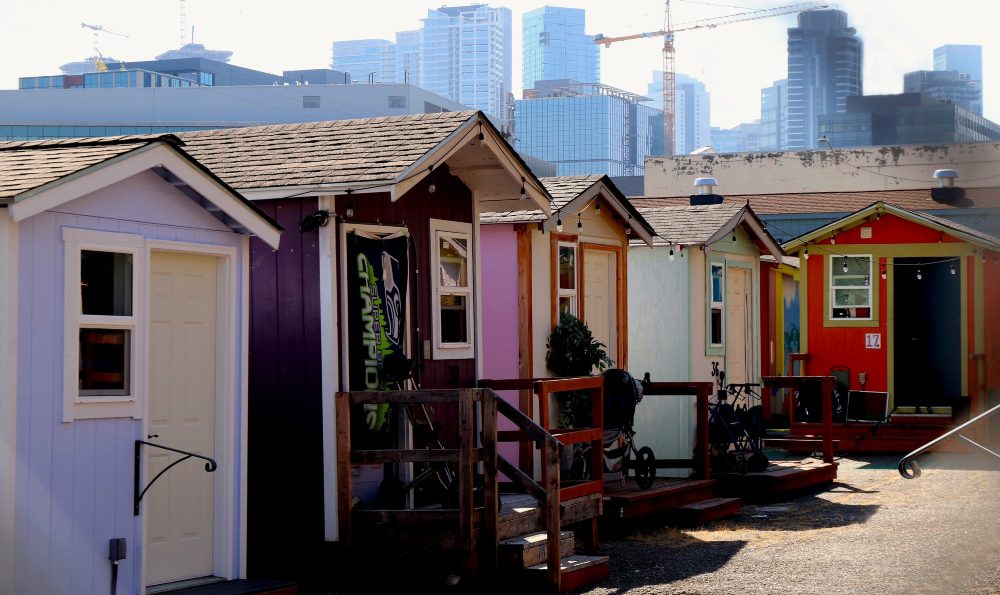
Plymouth Housing is directly focused on creating housing for homeless people and doing so in a way that matches them with other services they may need. It was founded in the early 1980s by Reverend David Colwell and his congregation at Plymouth Congregational Church in Seattle as an independent non-profit.
Today it provides 1400 units of owned housing and supports another 1000 households through rent subsidies. Crucially, it seeks to provide stable housing for people with no time limit: for some, it’s their permanent home. Based on what they’ve learned in the past nearly 50 years, the list of services Plymouth Housing offers is long. Notice the breadth of services required to actually solve the problem:
- On-site nursing and medical care
- Behavioral health treatment
- Substance use treatment
- Hospice care
- Veterans counseling
- Family reunification
- Money management programs
- Community meals, activities and outings
This kind of wraparound housing is far more than some currently-unhoused people need, but would be necessary for many who now live on the streets. Plymouth Housing’s budget this year is $78 Million. Some 98 percent goes to operating current services, with just 2 percent available to grow the number of available units. Because services are so expensive to provide, growth is slow: 1400 residents after 50 years is an admirable achievement, but our city and county have nearly 12,000 unsheltered homeless. Scaling up Plymouth Housing ten-fold would far outrun the capacities of its donor base and its grant-raising abilities.
Homeboy Industries
Homeboy Industries in East Los Angeles helps gang members escape gang life. Although it does not provide housing directly, it serves a distressed, disadvantaged constituency. About 10,000 gang members a year walk in the door, and about 500 per year enter an 18-month intensive re-entry program. Homeboy Industries runs a bakery, a café, a silk-screening and embroidery business, a gift shop and eight other social enterprises run by former gang members, who also run nearly the entire operation.
It is the life’s work of Father Gregory Boyle and has a lot to teach about how to comprehensively change the trajectory of damaged lives. It addresses the whole spectrum of issues that young people trapped in gangs present.
It provides meaningful work, community, responsibility, abundant counseling and therapy, help finding safe housing and, by far the most popular service, tattoo removal, at a rate of about 11,000 annual removal sessions.
To do all this, Homeboy raises and spends a little over $50 million a year. As with Plymouth Housing, note the extraordinary breadth of services and programs which are needed:
- Anger Management
- Batterer’s Intervention
- Case Management
- Domestic Violence Support
- Educational Services
- Homeboy Art Academy
- Homeboy Youth Reentry Center
- Legal Assistance
- Mental Health Services
- Parenting Classes
- Solar Panel Training
- Substance Abuse Support
- Tattoo Removal
- Workforce Development
Hogeweyk® Dementia Village
There’s a third, very different example. It’s not trying to elevate people out of bad lives into good ones as full members of our modern economy. Instead, it makes their permanently-limited lives joyfully livable.
The Hogeweyk® Dementia Village in Weesp, Holland is a village-in-miniature that offers a simplified version of village life for people with severe dementia: they can walk to shops, pubs, and so forth, socialize as members of a community, and are cared for by a staff in the background. It houses 150-190 people but in a very deinstitutionalized way, and with a staff-to-resident ratio greater than 1:1.
It’s not cheap, but it is a much-studied model for how to care for people who will simply never be independent again. Unfortunately this is going to be true for some number of people currently living on the street.
These three are examples of holistic solutions, one for people who might be able to survive in the modern world on their own if given a pathway (Homeboy), one for people who probably will never be able to thrive without help (Hogeweyk), and one for people somewhere in between (Plymouth).
One thing they have in common is the breadth of services required to actually succeed. Developing a broader suite of such solutions and scaling them offers the promise of actually solving the problem of a permanent underclass rendered “unfit” by a dynamic and demanding economy.
None of these three or others like them are necessarily a good solution for local jurisdictions to embrace at scale: cities that provide better support for homeless people attract more homeless people.
It’s also true that businesses which might be called upon to support such solutions would rather not pay for anything they don’t have to and are often willing to move to avoid taxes. Such solutions probably need to be substantially funded at the national level, to avoid creating both of these problems for local jurisdictions.
Solving the problem potentially has a big upside, both economic and social, for businesses and residents, which at least partially offsets the costs of scaled-up solutions of the kinds discussed above. There’s the issue that the direct beneficiaries are not the payees, but we have many such situations under the broad umbrella of our liberal democracy and regulated market economy. It would significantly benefit residents of Seattle and King County to have the problem of homeless people on the street significantly mitigated.
What would this cost? Using Plymouth Housing as an approximate example, it spends about $300,000 per new unit built, and about $14,000/year per resident. Scaling that up to the whole country just for discussion purposes, 750,000 homeless people times $300,000 per unit comes out to $225 Billion dollars in construction costs.
Then, 750,000 homeless people times $14,000/year in subsidies comes out to $10.5 Billion/year in operating costs. If the total number of people experiencing homelessness over the course of a year is in fact more than double the point-in-time snapshot count, these numbers are probably low.
Double 750,000 is 1.5 million people either homeless or nearly so, or about half of one percent of the US population. These guesstimated costs are bigger than what is being spent to not solve homelessness today, but not that large when considered against the scale of total federal expenditures in the US, where our annual 2026 federal budget is $7.4 trillion. The $225 billion is 3 percent of that, and $10.5 Billion is between a tenth and two-tenths of one percent of that. It’s also possible that this program would reduce costs in some much larger federal programs such as Medicare and Veteran’s services.
Adding substantial new social safety net commitments to the federal portfolio is never easy in the United States. Currently Social Security is facing a financial cliff in the relatively near future, our healthcare system is expensive and not universal, and battles to improve it have raged for decades, with more decades of raging probably still ahead of us.
Childcare is another hot button, as is our rate of incarceration. The blue wave of Democrats taking office are brimming with enthusiasm for tackling problems, but the US and many state and local jurisdictions are struggling with budget deficits, and voters want stuff to cost less, and are hence mostly unlikely to support new taxes.
Trust in the government to get stuff done efficiently and well remains low. For all these reasons, I would be astonished if the notion of a national safety net for the most-disadvantaged half-percent of the population was a quick or easy sell, but the problem will not go away, and until it is solved, we will be using jails, streets, parks, emergency rooms, tents on parking strips and the like as a ramshackle response.
Bottom line, we’re flailing at the homelessness problem and spending enormous sums already because we treat it as temporary or hope that a relatively simple solution—just build enough housing, for example—can fix it.
In fact, having a painful share of our fellow citizens unable to do well enough financially in our complex, dynamic economy to afford to remain housed is an unavoidable consequence of the very things that also make many lives better and many people richer.
There will always be a share of population that has simply failed to be self-sufficient in the modern world and will need permanent support. There is also a share of the homeless population that can be helped back to independence, and this phenomenon will not go away either.
There are great benefits to everyone in truly solving the permanent homeless problem, and the cost to do so, when set against the benefits, would be a bargain.
Discover more from Post Alley
Subscribe to get the latest posts sent to your email.