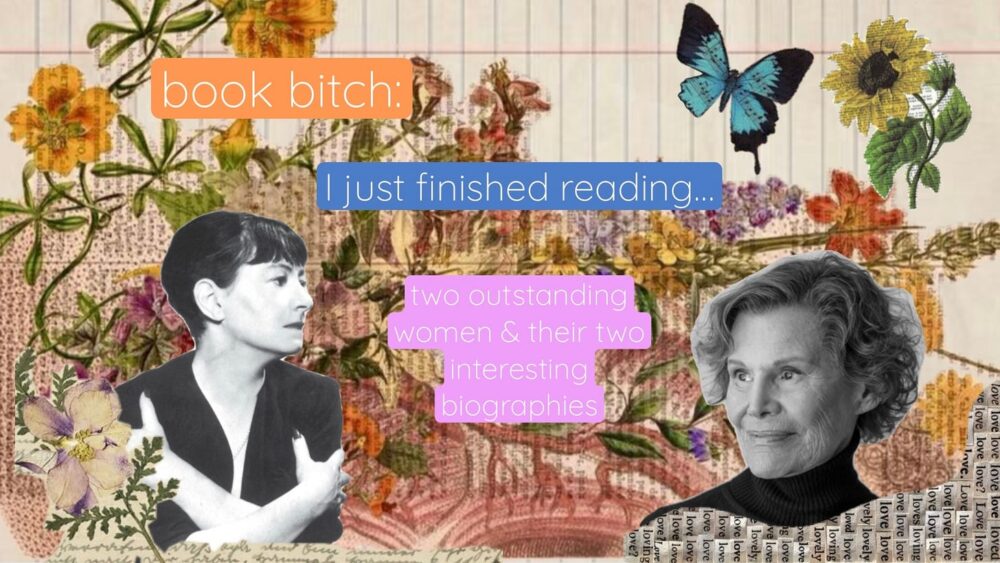

This piece ran in Rose McAleese’s Substack, where she writes as Book Bitch
I typically like to read 2-3 books at a time: one nonfiction, one fiction, and one freebie. The freebie can be another fiction or nonfiction book, but it’s usually a book of short stories: a graphic novel, a collection of essays, or a YA book.
It’s mostly because I have ADHD, but it’s also because it keeps my brain stimulated, so if I find myself bored or not getting into the story fully, I can dip my toe into another story to freshen me up. But enough of the silly logistics; let’s get to the fun bitching,
Purely by accident, I read two biographies back to back: July Blume: A Life by Mark Oppenheimer, and Dorothy Parker in Hollywood by Gail Crowther.
To be the subject of a biography must be so weird. But to be the one who writes it must be crazier. No shame to biographers, but I wonder if some of them find the job a bit invasive. I also wonder where morals lie and where it hinges on their beliefs. I get that the job is to report a story, but there has to be something that feels off-limits.
And does it help if you like the person you’re writing about? Better to go in blind? Learn as you go or have some ounce of understanding of your subject before you dive in? Shit, I didn’t give biographers much thought until writing this piece, but now my mind is dizzy with so many questions.

I read “Judy Blume: A Life” first. I love Judy Blume. She is one of the few authors I can say has carried me through being a kid, to a teen, to a grown-ass adult. Her books have always made me giggle with glee, helped me feel less awkward about my period and body, and taught me things about myself I didn’t know I needed to learn in the first place. She’s a gifted woman, a prized human, and a timeless writer.
Her biography… well, I guess I answered my own thesis about reading about your heroes. Which is, don’t.
I haven’t read any of Mark Oppenheimer’s other work, but he comes off as the type of writer who wishes he could have covered Watergate or been boots on the ground in Vietnam. He carries his pen like he’s shooting from the hip and speeds past the parts of Blume’s life that might be deemed “too girly.” He barrels through them like a stuffy nerd who’s been shoved into the girls’ locker room.
None of that is to say he can’t write, because the man can. But I found it both fascinating and perplexing why he chose Judy Blume as a subject. Did he have sisters? A mom who told him, “Hey, you know what you should do?” Was this just a cash grab? No shame, but curious, inquisitive minds are eagerly awaiting answers.
He did spend a lot of time being hyper-fixated on overanalyzing the men that were in and out of Blume’s life, which might be a great hook and subject for a whole other biography. Just not this one because this is supposedly her “life.”
I skimmed a lot of the book and wanted to give up a few times because I didn’t like this shade of Judy Blume. Which got me thinking how wild it is as fans that we project our perspectives on our heroes or people we admire, but we could be perfectly wrong. Reading the biography didn’t make me like Judy Blume any less; it just made me reflect on how we place people on pedestals.
No matter how much FOREVER… or BLUBBER changed my tiny life, at the end of the day, Judy is still just a woman. A very thoughtful, insightful woman, but just a human who loves a good story.
My first introduction to Dorothy Parker happened the way it did for most hot-blooded American millennial girls like me: Angelina Jolie reciting Dorothy Parker’s poem “Résumé” in the iconic 1999 film “Girl, Interrupted.”

However, I had been involved with Parker’s work long before that. I just wasn’t aware I was reciting her brilliance. My mother has always been one of her biggest fans, so she had me and my sister quoting Parker’s greatest hits (like “What fresh hell is this?!” or “Excuse my dust.”) years before I saw “Girl, Interrupted.” But it was that little quick poem, that tiny teasing of wordplay, that got me hook, line, and sinker into becoming a full-blown Dorothy Parker Stan. The woman made jokes about death? Was she both dark and hilarious? Witty and overflowing with self-loathing?! I mean, come on, that’s my kind of gal.
Of course, I started with that classic “Enough Rope,” her collection of poems. Shortly after, I consumed more and more. I was drunk off her dry, witty, and punchy commentary. I’m always deeply inspired by her work and always left in awe of her magic trick of turning a phrase perfectly.
In “Dorothy Parker in Hollywood”, the author focuses mainly on Parker’s time in Hollywood, a place she absolutely loved to hate. Which hey! After 13 years of living in this city, I get it. But I love Los Angeles far more than Mrs. Parker did. Parker loathed it but couldn’t get herself to admit it, so her stubbornness is both admirable and a tad bit jarring.
Which leads me to how this book made me a little uncomfortable at times about my love of Parker. It, too, like Blume’s bio, made me wonder about my idol, and question if I would want to have a fictional dinner table and invite her. Parker was a fun time, but mostly because she had fun with the drink. And sometimes, the drink won, unfortunately. Turning her into a cruel and judgy person.
Now, don’t get me wrong, I love a good shit-talking from time to time. My favorite quote is the immortal icon Dolly Parton (long live the queen!) in the film Steel Magnolias when she says, “Well, if you have nothing nice to say, come sit by me.” This has been attributed to a bunch of other people, including Parker, but whoever said it, I still love it.
However, reading the book, I got a sense Parker might have Icarus-ed herself because Crowther did not hold back on the countless times she might have teased or joked a little too close to the sun. However, unlike Oppenheimer, Crowther comes off as more of a fan. She is very protective of Dorothy and adds very thoughtful commentary about why she thought Parker was the way she was.
Which I really enjoyed. I can hear the bad in someone and still choose to see the good. It happens all the time!
What I loved most about this biography was how deeply political Dorothy Parker was and how she never thought politics and human rights were a laughing matter. I knew she was a socialite for social change, but reading the chapters about her time covering the war in Spain (with fellow writer and beloved drinking buddy, Ernest Hemingway) was very moving. It reminded me that comedians aren’t just there for a laugh; we also tend to be very sensitive and soulful people. We know both masks of comedy and drama. It’s why we have chosen to try to laugh through life, since it already has so much drama.
When I finished the book, I was sad. I think Crowther did an excellent job of telling a full story, although I had some issues with the structure. What made me the saddest was how worried I became for Parker. I want to hug her, maybe slap her a bit, but also kindly shake her out of those deep, dark holes of depression I myself know all too well.
I felt a resounding kinship with her after reading this book.

With both books, really. But alas, for two different reasons.
I will forever adore these two massive trailblazing pioneers of the literary world. I just might use a tad bit more caution when it comes to reading another book about any of my heroes. I mean shit, next time, maybe I should take the Lin-Manuel Miranda approach and just find a book about a random person I know very little about and then build my entire opinion (or musical) solely off of that.
I mean, as I think about it, “Blume & Parker: The Musical” does have a sorta nice ring to it.
But for now, I’m going to exit stage left and, as always, end this chapter with love.
Sincerely,
the book bitch
Discover more from Post Alley
Subscribe to get the latest posts sent to your email.

